

By Andrés Zambrano Díaz
September 27, 2026
In the landscape of contemporary Latin American literature, few works have managed to pierce the collective consciousness with the surgical precision—and visceral horror—of Tender Is the Flesh (Cadáver exquisito). Authored by the Argentine writer Agustina Bazterrica, the novel presents a chillingly plausible dystopia: a world where a mysterious virus has rendered animal meat toxic to humans, prompting society to legalize, industrialize, and consume human flesh. Since its publication in 2017 and its subsequent victory in the prestigious Clarín Novel Prize, the book has transcended its genre, becoming a global phenomenon translated into over thirty languages and a staple in academic curricula across Latin America, including Colombia.
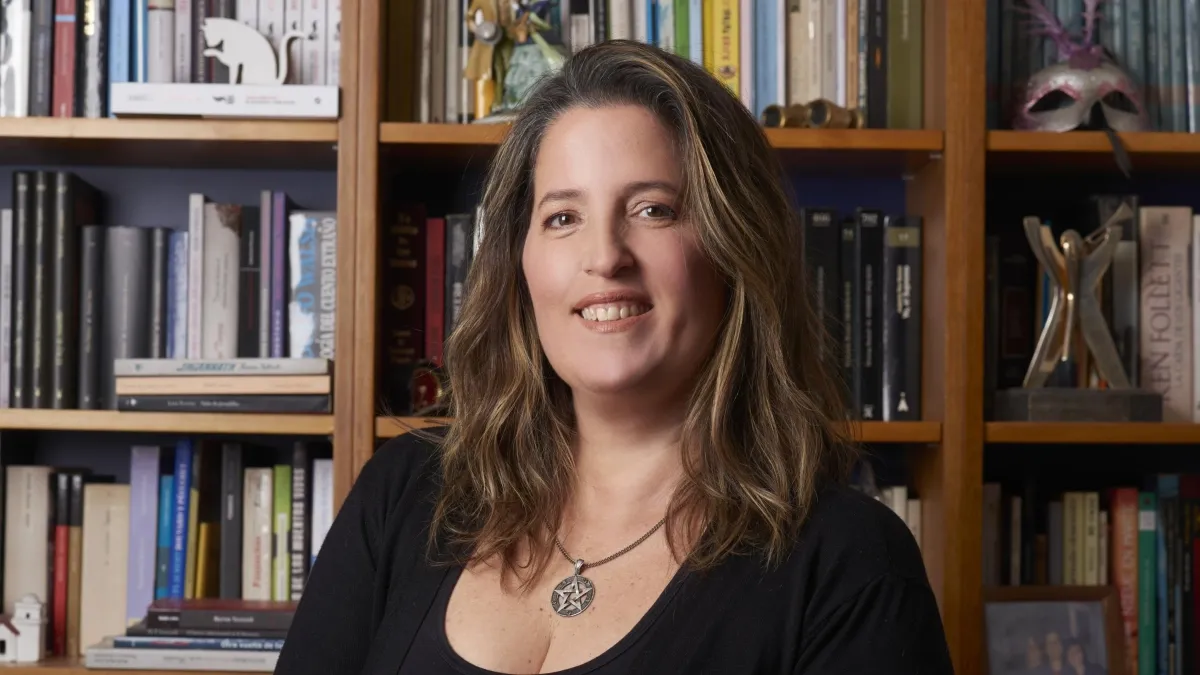
As Bazterrica prepares for her upcoming visit to Colombia on October 20, the literary world reflects on a work that refuses to offer comfort, choosing instead to hold a mirror to the inherent brutality of modern consumption.
The Genesis of a Modern Nightmare
To understand the mechanics of Tender Is the Flesh, one must look at the personal journey of its creator. Bazterrica’s path to this dark narrative was paved by her own decade-long experience as a vegetarian, a choice she maintained from 2014 to 2024.

"I was a vegetarian for ten years," Bazterrica explains. "It is a topic that usually triggers strong reactions—either aggressive or mocking—never indifference. In Argentina, where meat is practically a religion, stepping outside that norm made me de-naturalize the act of eating. What was once a ‘steak’ became, for me, a piece of an animal. That shift in perspective led to the central question: If we have legitimized the consumption of cows, pigs, and chickens, what is the barrier preventing the legitimization of human flesh?"
Her hiatus from vegetarianism was dictated by health necessity during perimenopause, a transition that caused severe iron deficiency and fainting spells. Despite the change in her diet, the philosophical impact of those ten years remains the bedrock of her work. She insists that the novel is not merely "speculative fiction" but a reflection of the reality we live in—a world driven by systemic exploitation and the normalization of violence.

A Six-Month Descent into Darkness
The writing of Tender Is the Flesh was not a hasty endeavor. Before penning a single word, Bazterrica immersed herself in a rigorous six-month research phase. She analyzed the inner workings of industrial slaughterhouses and explored the historical and anthropological facets of cannibalism.
"I read extensively on the subject," she notes, citing the doctoral thesis Pensar caníbal (Thinking Cannibal) by Colombian scholar Adolfo Chaparro Amaya as a foundational influence. Her goal was not to rely on cheap shocks, but to build a narrative so grounded in logic that its absurdity becomes terrifyingly believable.

This dedication to "economy of resources" defines the book’s style. Bazterrica masterfully utilizes silence, leaving the reader to fill in the blanks. By choosing never to name the protagonist, Marcos, she creates an emotional distance that forces the reader to project themselves into his hollow, morally compromised existence. The abandoned zoo and the sterile descriptions of the "processing plants" are crafted with the precision of a short story writer—every sentence serves a function, every chapter ends with a lingering, unsettling cadence.
Genre-Defying Literature: Beyond the Dystopian Label
Critics and readers have struggled to classify Tender Is the Flesh. Is it horror? Dystopian fiction? Eco-feminism? Social commentary? For Bazterrica, these labels are secondary.

"Depending on the country, they categorize it differently," she observes. "In Argentina, it’s labeled as a dystopia. Elsewhere, it’s horror, or even eco-feminism. I never write with a genre in mind; I write to tell a story. It is dark, violent, and certainly not a romance. If I had to choose, I would place it within the ‘literature of the unusual,’ where multiple genres coexist simultaneously."
The author also pushes back against the label of "pessimism." Despite the horrific premise of her novel, she remains fundamentally optimistic about human nature. "I don’t believe in the inherent evil of humanity. My next novel, coming out next year, is even more luminous than my previous work, Las indignas. I choose to believe in human beings until the very last second. While we live in a world that rewards extractive, violent, and predatory mentalities—especially through social media algorithms that profit from rage—there are countless people doing positive, altruistic work every single day."

The Logic of the Unthinkable
A common point of contention is whether the novel is "realistic." Bazterrica challenges the assumption that cannibalism is a relic of the past or a purely fictional construct.
"When I was in Italy this year, a journalist asked me about the difference between my book and ‘realistic’ novels, assuming mine was purely fantastical," she recounts. "But what is realism? Tender Is the Flesh could happen. It is highly improbable, but not impossible. Cannibalism is a social taboo, but it is a dormant condition that most societies repress. If we look at the history of human groups or the way social media can manipulate entire populations into believing anything, we realize that the mechanisms for such a collapse are already present."
She remains steadfast in her artistic process, refusing to cater to the comfort of the reader. "I don’t think about the reader when I write. When I was writing this book, I didn’t have a publisher; I didn’t know it would win a prize or be translated into thirty languages. The only ‘reader’ I consider is a very demanding, almost unbearable voice in my own head—a voice that asks if the story works, if the characters are believable, and if the plot holds up under scrutiny."
Literary Influences and the Legacy of Violence
The shadow of Tender Is the Flesh inevitably draws comparisons to other works of dark fiction and survival narratives. Bazterrica acknowledges these influences, citing the "founding father" of Argentine literature, Esteban Echeverría, and his visceral, bloody short story El matadero (The Slaughterhouse).

"The influence of my favorite author, Juan José Saer, is also present, particularly in his novel El entenado, which deals with cannibalism in a much more poetic, abstract way," she says. She also highlights the work of Brazilian author Ana Paula Maia, specifically De ganados y de hombres, where the surreal image of cattle committing suicide resonates with the themes of industrial slaughter.
These influences culminate in a narrative that is as much about the mechanics of power as it is about the consumption of flesh. While the novel contains moments of extreme, consent-driven sexual violence, these are not gratuitous. They are, in the author’s eyes, a direct extension of a world that has already accepted the ultimate violation: the commodification of life.

Implications for the Future
As the literary world continues to debate the merits and warnings of Bazterrica’s work, the author remains focused on the human element. The success of Tender Is the Flesh serves as a stark reminder that literature’s role is not always to provide an escape, but to confront the uncomfortable truths we prefer to leave in the shadows of the slaughterhouse.
For Colombian readers, the upcoming visit of Agustina Bazterrica on October 20 provides a rare opportunity to engage with a voice that has successfully navigated the thin line between social critique and nightmarish prophecy. In a time of global volatility, her work stands as a testament to the power of the written word to provoke, to disturb, and ultimately, to demand that we examine the cost of our appetites.