
By Diana Vanessa Arévalo Correa
Redacción Últimas Notícias
Enriched and Translated for Global Audiences
Main Facts
More than 500,000 students across Colombia who sat for the Saber 11 Calendario A examinations on July 26, 2026, can now breathe a sigh of relief and access their individual score reports. The Colombian Institute for the Evaluation of Education (ICFES), adhering strictly to its official academic calendar, published the much-anticipated scores, marking a critical milestone for high school seniors and prospective higher education candidates nationwide.
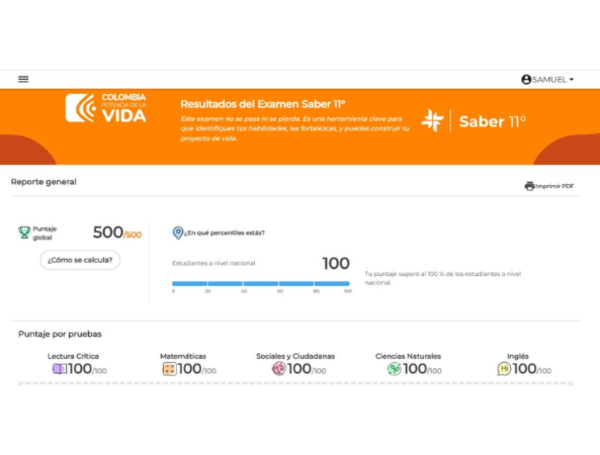
The release grants students immediate access to their global results, alongside granular performance metrics across five core areas: Critical Reading, Mathematics, Social and Civic Studies, Natural Sciences, and English.
In addition to traditional numerical scores, the digital performance reports incorporate essential comparative benchmarks, including national percentiles and qualitative performance levels. These tools are designed to provide universities, parents, and the students themselves with a holistic view of academic readiness, setting the stage for nationwide college admissions processes, scholarship applications, and career path planning.

Chronology of the 2026 Evaluation Cycle
The journey toward the publication of the 2026 Saber 11 results has been characterized by careful planning, punctuated by external challenges that tested the resilience of Colombia’s national educational infrastructure.
- July 26, 2026: Over half a million students nationwide participate in the Saber 11 Calendario A tests, deploying to designated testing centers across urban and rural municipalities.
- August 2026: The academic calendar experiences unexpected disruptions following a major regional seismic event (a 7.4 magnitude earthquake in Colombia). This emergency forced the ICFES to strategically reschedule other national evaluations, such as the Saber Pro and TyT exams, prompting heightened public monitoring of institutional timelines. Despite logistical hurdles, the ICFES confirmed that the Saber 11 evaluation processing remained on track.
- September 25, 2026: True to its official roadmap, the ICFES officially opens its digital platforms at 1:52 p.m., enabling the massive cohort of examinees to access their score sheets, download PDF reports, and verify their standing.
How to Access and Interpret Your ICFES Saber 11 Results
Navigating the official portal requires specific steps. Students must access the designated ICFES results platform using their standard credentials.
Step-by-Step Retrieval Guide
- Visit the Portal: Navigate to the official ICFES results distribution website.
- Provide Identification: Enter the requested personal data, which includes:
- Type of identity document (TI, CC, Foreign ID, etc.)
- Identity document number
- Date of birth
- Unique registration number (SNP)
- Download the Report: Once authenticated, the system presents the full profile, allowing users to view and download the official report in PDF format for institutional submissions.
What to Do If You Forgot Your Registration Number (SNP)
For students who cannot locate their unique registration number, the ICFES has established a dedicated retrieval system. By visiting the official SNP recovery link (https://resultados.icfes.edu.co/...), applicants can input their document type, document number, and birth date to instantly retrieve historical and current registration codes associated with tests taken under their name.
Supporting Data: Understanding the Scoring Architecture
The ICFES report is far more than a single arbitrary number; it relies on a sophisticated psychometric scaling model implemented uniformly across the country.
The Scoring Scale
- Individual Tests: Each of the five main areas is graded on a continuous scale ranging from 0 to 100 points.
- Global Score: The comprehensive performance metric is expressed on a scale from 0 to 500 points.
Weighting Formulas
Not all sections contribute equally to the final global score. To reflect institutional priorities in foundational competencies:
- High-Weight Sections (Triple Value): Critical Reading, Mathematics, Social and Civic Studies, and Natural Sciences each count three times in the final calculation. Their combined performance heavily dictates the final global score.
- Standard-Weight Sections (Single Value): English counts only once toward the final total. While vital for bilingualism metrics and professional profiles, its mathematical pull on the raw global score is comparatively lower.
Percentiles and Levels of Competency
- The Percentile: This metric contextualizes an individual score against the entire national cohort. For instance, achieving a percentile of 70 means the student scored higher than approximately 70% of all examinees who took the test during this cycle.
- Performance Levels (1 to 4): For Critical Reading, Mathematics, Social and Civic Studies, and Natural Sciences, students are categorized into four distinct qualitative tiers. Level 1 indicates foundational mastery, while Level 4 signifies advanced critical thinking and complex problem-solving capabilities.
- International Frameworks for English: Rather than numerical tiers, English proficiency is mapped directly to the Common European Framework of Reference for Languages (CEFR), utilizing bands A1, A2, B1, and B2 to define linguistic competency.
Official Responses and Institutional Perspectives
The Ministry of Education emphasized that the continuous refinement of the ICFES evaluation system—stable since structural updates in 2021—provides transparent diagnostics for the country’s educational ecosystem.

Authorities reiterated that these evaluations are not merely punitive or sorting mechanisms, but diagnostic assets. Educational institutions utilize aggregated Saber 11 data to re-engineer curricula, address learning gaps exacerbated by post-pandemic shifts, and evaluate instructional efficacy.
Furthermore, local secretariats of education, such as those in Bogotá and other major metropolitan areas, leverage these datasets to compare administrative models—including public, private, and concession-run schools—to replicate successful educational strategies nationwide.

Implications for Students and the Future of Higher Education
The release of the 2026 Saber 11 results triggers the most intensive period of the academic year for Colombian youth.
- University Admissions: Public universities (such as the National University of Colombia, University of Antioquia, and District University) and top-tier private institutions heavily rely on these scores for direct admissions or as prerequisites for institutional entrance examinations.
- Scholarship Eligibility: National programs, such as those administered through MinCiencias and regional scholarship funds, use Saber 11 percentiles as filtering criteria to award financial backing to high-performing low-income students.
- Career Guidance: The detailed breakdown of strengths and weaknesses across the five disciplines allows students to identify vocational inclinations. A high score in Mathematics and Natural Sciences may guide a student toward engineering or medicine, whereas excellence in Critical Reading and Social Sciences frequently correlates with success in law, journalism, or the humanities.
As thousands of students download their PDFs and map out their next academic steps, the educational community remains focused on utilizing these metrics to elevate instructional standards across all regions of Colombia.