BOGOTÁ, COLOMBIA — In what is being hailed as a transformative moment for the nation’s economic landscape, the Colombian government has successfully concluded Milagro Week, a high-stakes international investment initiative that shattered initial expectations. Vice President José Manuel Restrepo officially presented the comprehensive balance of the event, announcing a staggering $43.205 billion in secured investment commitments.
The capital influx spans 11 diverse economic sectors and reaches 24 of Colombia’s departments, decentralizing growth and bringing economic development to historically underserved regions. Furthermore, the massive pipeline of projects is projected to generate more than 55,000 formal jobs nationwide, providing a robust boost to employment, technological advancement, and social equity.
The sheer scale of the achievement far surpassed the government’s conservative estimates. Initially targeting around $20 billion during roadshows in financial hubs like New York, the administration doubled its projection, signaling immense global confidence in Colombia’s economic stability, legal framework, and long-term potential.
1. Main Facts and Executive Summary
The success of Milagro Week lies not just in the colossal headline figure of $43.2 billion, but in the broad diversification of the portfolio. The investments are not concentrated solely in traditional extractive industries or major metropolitan centers; instead, they represent a balanced mix of infrastructure, green energy, financial inclusion, technology, retail, health, agriculture, and environmental conservation.
Key highlights of the Milagro Week balance include:
- Total Capital Commitment: US $43.205 billion.
- Geographic Reach: 24 Colombian departments, emphasizing territorial inclusion.
- Sectoral Diversity: 11 distinct pillars of the economy, ranging from heavy infrastructure to biotech and fintech.
- Job Creation: Over 55,000 new direct and indirect jobs projected.
- Social & Environmental Impact: Initiatives dedicated to replacing illicit crops, funding sustainable agriculture, protecting natural reserves, and combating predatory informal lending ("gota a gota").
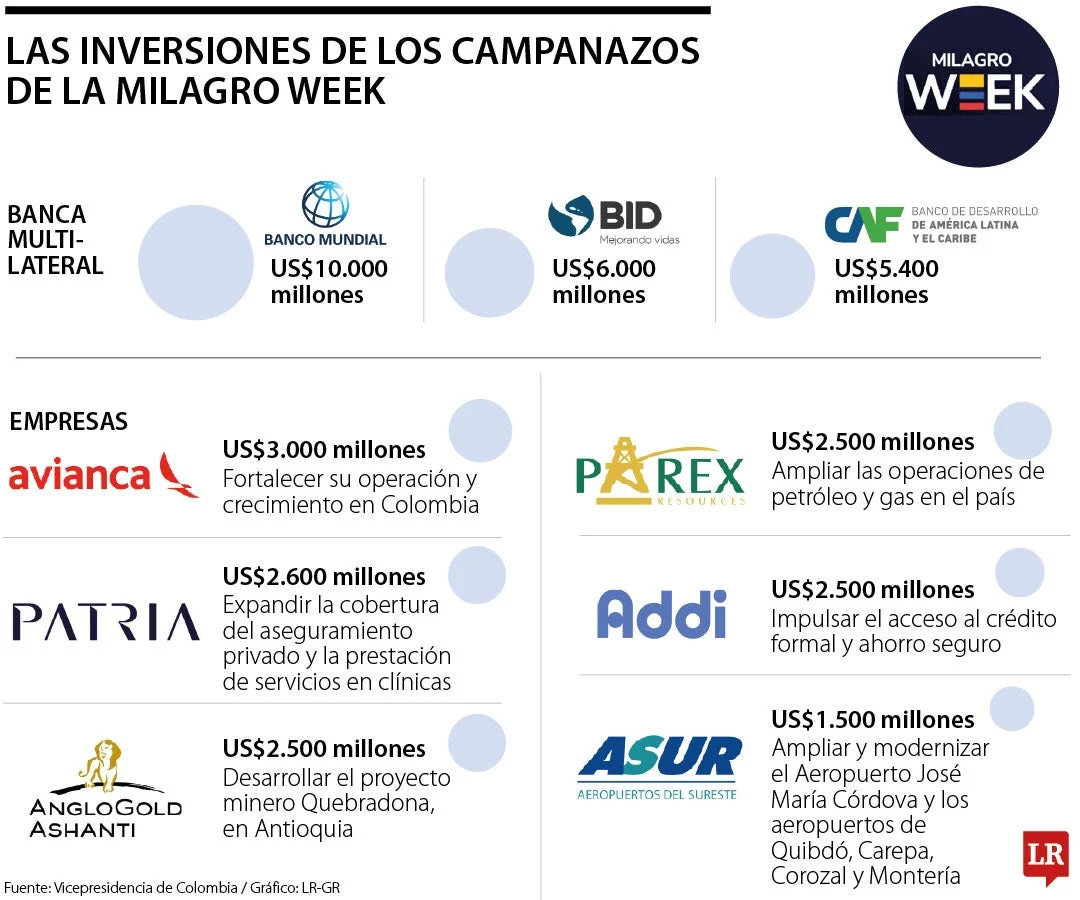
Vice President Restrepo emphasized that these figures reflect the private sector’s belief in the country’s trajectory. Crucially, these amounts represent private sector commitments alone and do not include additional parallel resources pledged by multilateral banking institutions to support private initiatives.
2. Chronology of the Initiative: From New York Roadshows to National Impact
The pathway to securing $43.2 billion was meticulously planned and executed through a series of strategic diplomatic and economic missions, culminating in the intensive engagements of Milagro Week.
Phase One: International Prospecting and Roadshows
Months prior to the final announcements, the Colombian economic team—led by Vice President Restrepo and key trade delegations—traveled to global financial capitals, most notably New York. During these initial meetings, the administration pitched Colombia’s value proposition to international institutional investors, private equity funds, and multinational corporations. The initial target discussed in foreign markets was a modest, yet ambitious, $20 billion.
Phase Two: The Consolidation of Commitments
As word spread and negotiations matured, global corporations and domestic market leaders began scaling up their capital expenditure (CAPEX) plans. Companies that had initially considered standard operational expansions dramatically increased their budgets to align with Colombia’s newly prioritized strategic sectors, such as energy transition, critical minerals, and digital infrastructure.
Phase Three: The Official Balance and Territorial Rollout
During the official closing of Milagro Week, Vice President Restrepo detailed how the promises made in international boardrooms translate into on-the-ground reality across 24 departments. Rather than remaining centralized in Bogotá or Medellín, the capital is earmarked for projects stretching from the Caribbean coast of La Guajira to the Orinoquía plains, the jungles of the Catatumbo, and the mining corridors of Antioquia and Caldas.
3. Supporting Data: Breakdown of Major Investments
The $43.2 billion portfolio is composed of strategic investments led by heavyweights across multiple industries. Below is the detailed breakdown of the capital commitments announced during the initiative:
Infrastructure and Transport
- Transferport: Committed US $3.450 billion earmarked for railway development, prominently featuring the financial closure of the vital La Dorada–Chiriguaná railway corridor. This project is set to radically lower freight logistics costs across the country.
- Grupo Aeroportuario del Sureste (Asur): Pledged up to US $1.500 billion to modernize and expand major aviation hubs, including the José María Córdova International Airport in Rionegro (serving Medellín), alongside regional terminals in Quibdó, Carepa, Corozal, and Montería.
Aviation and Tourism Connectivity
- Avianca: Announced a US $3.000 billion investment plan to solidify and expand its operational footprint in Colombia. The strategy explicitly includes the incorporation of 61 new aircraft between 2027 and 2029, enhancing national and international connectivity.
Energy, Mining, and Natural Resources
- AngloGold Ashanti: Committed US $2.500 billion toward the development of Quebradona, its major copper project located in Jericó, Antioquia. The execution of this capital is contingent upon securing the final environmental permits.
- Parex Resources: Confirmed a US $2.500 billion investment over the next four years to expand its oil and gas exploration and production operations.
- Greenwood Energy: Pledged US $1.100 billion to spearhead large-scale wind energy generation projects in the wind-rich department of La Guajira, advancing Colombia’s green transition.
- Mineros: Announced US $600 million dedicated to responsible, sustainable mining practices within the national territory.
- Collective Mining (Canada): Committed US $100 million through 2027 to advance exploration and secure environmental licensing for its mineral project in Caldas.
- Rio Tinto: Pledged US $100 million focusing on critical and strategic mineral exploration, adhering to strict environmental standards.
Financial Inclusion and Technology
- Addi: Revealed an US $2.000 billion investment aimed at driving digital financial inclusion for underserved populations across Colombia.
- Grupo Plata: Massively scaled up its three-year investment plan from $60 million to US $400 million (with $340 million newly announced in New York). The funds target expanded formal credit access for Micro, Small, and Medium Enterprises (MSMEs).
- Delphi Capital: Committed US $550 million focused on the burgeoning technological sector.
Urban Renewal, Real Estate, and Retail
- Patria Investments: Committed US $1.800 million for urban renewal projects to stimulate the construction sector. Additionally, the firm pledged an extra US $500 million to expand private health insurance coverage and clinical service infrastructure.
- Grupo Éxito: Announced US $1.000 million in investments to bolster its retail, industrial, and food supply chain operations.
Agriculture, Social Substitution, and Health
- Oleoflores: Pledged US $200 million for an ambitious agricultural initiative focused on substituting illicit coca crops with oil palm production in the conflict-ridden Catatumbo region.
- PlasmaPharm: Committed US $200 million to advance biotechnology and healthcare services.
- Campo Capital & Climate Asset Management: Unveiled a joint US $50 million investment to develop an agroforestry cashew project in La Primavera, Vichada.
- Rainforest Trust & Bezos Earth Fund: Committed US $15 million dedicated entirely to backing the creation, expansion, and protection of natural conservation areas.
4. Official Responses and Leadership Insights
During his keynote address, Vice President José Manuel Restrepo highlighted the profound paradigm shift represented by these numbers. He emphasized that the administration’s proactive outreach has fundamentally changed how global capital views Colombia.
"When we were coming to New York, I said we were going to achieve announcements and commitments for around $20,000 million. Having $43,200 million is deeply significant. It is a titanic effort by numerous people who worked toward this single purpose," stated Restrepo.
The Vice President drew special attention to the territorial diversification of the capital. Rather than clustering in the traditional economic triangle of Bogotá, Medellín, and Cali, investments are reaching departments historically affected by neglect, violence, and informality.
Furthermore, Restrepo underscored the strategic importance of targeting critical minerals and hydrocarbons in departments like Arauca, Casanare, Santander, and Putumayo. "This is a clear demonstration of how we are reaching territories that have historically been abandoned," he noted, tying economic development directly to national pacification and regional equity.
5. Broader Implications for the Colombian Economy
The multi-billion-dollar influx from Milagro Week is expected to ripple across multiple dimensions of Colombian society, laying the groundwork for long-term structural transformation.
Eradicating Predatory Informality ("Gota a Gota")
A cornerstone of the financial sector investments—led by firms like Addi and Grupo Plata—is the direct assault on predatory informal lending, locally known as gota a gota or paga diario. By injecting billions of dollars into formal micro-credit mechanisms, the initiative provides small business owners and informal vendors with legitimate, regulated financial tools. This transition not only protects vulnerable citizens from loan-shark violence but actively drives the formalization of thousands of micro-businesses.
Catalyzing the Green Transition and Fifth Industrial Revolution
The inclusion of massive green energy projects—such as Greenwood Energy’s wind farms in La Guajira—demonstrates Colombia’s commitment to decarbonization. Simultaneously, investments in biotechnology, health tech (PlasmaPharm), and digital infrastructure (Delphi Capital) position Colombia to capture the dividends of the Fourth and Fifth Industrial Revolutions.
Peacebuilding Through Sustainable Agriculture
In regions like Catatumbo and the Orinoquía, capital is being deployed as an instrument of peace. Oleoflores’ $200 million substitution project replaces illegal coca cultivation with sustainable oil palm farming, while forestry and cashew initiatives in Vichada offer legitimate, profitable legal alternatives for rural workers. These projects prove that economic development and peacebuilding can operate hand-in-hand.
Unprecedented Multilateral Confidence
In a closing remark of profound significance, Vice President Restrepo highlighted that three distinct multilateral banking institutions participated directly in backing these private sector initiatives. This unprecedented alignment of multilateral entities signaling faith in Colombia’s private sector underscores a rare global consensus: Colombia possesses the institutional maturity, ecological wealth, and human capital necessary to absorb and multiply massive international investments sustainably.
As these projects transition from pledges to execution between 2027 and the coming decade, Colombia stands on the cusp of an economic renaissance defined by decentralization, formalization, ecological stewardship, and inclusive prosperity.