By Economic Desk
Published: November 202X
Main Facts
The Colombian economy continues to navigate a complex macroeconomic landscape as consumer prices register steady upward pressure. According to the latest official figures released by the National Administrative Department of Statistics (DANE), the Consumer Price Index (CPI) for the month of October stood at a monthly variation of 0.20%.
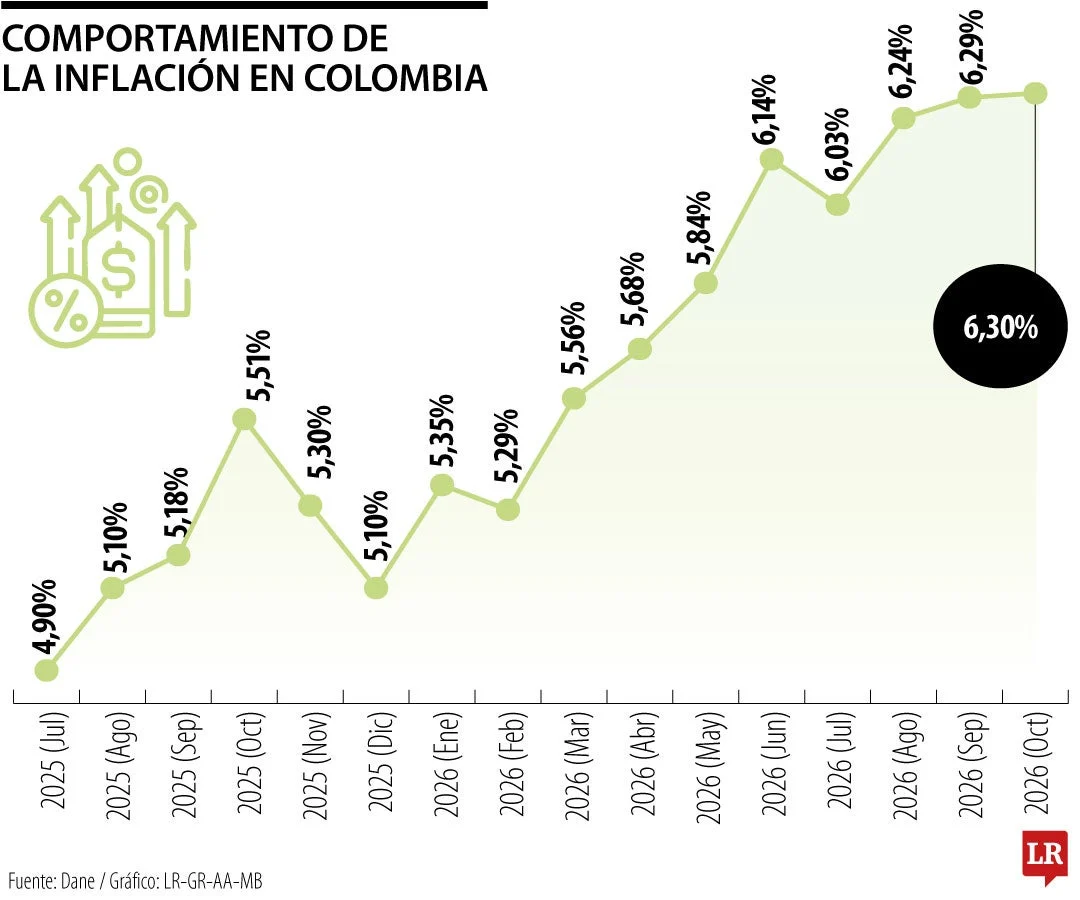
While a monthly tick of 0.20% might appear modest at first glance, the broader trailing indicators underscore persistent structural pressures on the cost of living. The year-to-date (year-corrido) inflation rate—measuring price accumulation from January through October—reached 5.94%. More critically, the annualized inflation rate, which captures the cumulative price changes over the preceding twelve months, climbed to 6.30%.
This latest print places the national cost-of-living trajectory slightly below the consensus expectations held by the country’s financial markets, yet it remains stubbornly above the long-term target range established by the Central Bank (Banco de la República). The primary drivers behind this annualized 6.30% figure were specific sectors whose price variations significantly outpaced the national average. Leading the charge on the upward trend were hotels and restaurants, closely followed by the education, health, and food sectors.
Conversely, the data revealed pockets of relative price stability or softer demand-driven increases in divisions such as apparel, footwear, information and communication, and recreation. The disparity between the surging cost of services and the more subdued performance of goods highlights a bifurcated consumer market, where experiences, hospitality, and foundational services continue to absorb cost pressures faster than manufactured goods.
Chronology
To fully understand how October’s inflation figure materialized, it is essential to trace the economic timeline that led to this point throughout the year, as well as the sequence of events surrounding the data release itself.
The Road to October: A Year in Review
- First Quarter: The year began with persistent inflationary inertia carried over from the previous period. Although initial monthly prints suggested a gradual cooling of the economy, indexations embedded in basic services, educational institutions, and minimum wage adjustments kept annual inflation uncomfortably high, hovering well above the 5% threshold.
- Second Quarter: Mid-year figures saw mixed signals. While agricultural supply chains stabilized—providing temporary relief to the volatile food and non-alcoholic beverages division—service sectors began to demand higher premiums. Tourism, hospitality, and regulated public utilities exerted continuous upward pressure on the monthly indices.
- Third Quarter: As the third quarter drew to a close in September, analysts began noting a subtle re-acceleration in consumer prices. Energy prices, driven by climatic anomalies associated with weather patterns and rising international inputs, began to filter down to urban centers.
- Early October: Leading up to the DANE publication, financial institutions intensified their forecasting models. The prevailing sentiment across Wall Street and local brokerage houses was that inflation would tick upward due to rising fuel costs, currency fluctuations, and resilient domestic demand.
- October DANE Release Date: DANE officially published the October CPI metrics. The headline annual figure of 6.30% surprised several analysts who had penciled in a slightly hotter print closer to 6.38%, prompting an immediate reassessment of monetary policy trajectories.
Supporting Data
A granular examination of the DANE report reveals a stark division between sectors experiencing aggressive price inflation and those exhibiting moderation. The internal composition of the CPI basket provides critical insight into where household budgets are being stretched the thinnest.
Sectors Leading the Annual Inflation Surge (Above National Average)
- Restaurants and Hotels (9.39%): Leading all major divisions, this category posted the highest annual variation. Driven by robust domestic tourism, rising input costs for the hospitality industry, and elevated labor and operational expenses, dining out and overnight accommodations have become significantly more expensive over the past twelve months.
- Education (7.44%): Education secured the second-highest annual increase. Driven by structural adjustments in tuition fees, auxiliary learning materials, and institutional overhead, families faced considerable financial strain at the start of academic cycles that persisted into the broader annual index.
- Health (7.37%): The health sector recorded the third-highest variation. Escalating costs for pharmaceutical products, specialized medical consultations, and private healthcare services continue to push health expenditures upward, affecting vulnerable populations and insured households alike.
- Food and Non-Alcoholic Beverages (7.31%): Traditionally one of the most volatile components of the CPI basket, food prices maintained a strong upward trajectory. Although down from the historic peaks seen in previous years, a 7.31% annual increase ensures that grocery shopping remains a primary pain point for lower- and middle-income households.
Sectors with Moderate or Minimal Variations
On the opposite end of the spectrum, several divisions registered price increments well below the national average, acting as a natural brake on a much steeper headline inflation rate:
- Apparel and Footwear (3.14%): Recording the lowest annual variation, the clothing and footwear sector reflected softer retail demand and competitive discounting strategies implemented by commercial merchants to clear inventories.
- Information and Communication (4.47%): Driven by intense competition within the telecommunications sector, internet, telephony, and digital services remained relatively stable.
- Recreation and Culture (4.52%): While hospitality surged, general recreational goods and cultural events saw more contained price adjustments.
- Transport (5.19%): Despite pressures from fuel prices and logistical challenges, the transport division grew at a moderate pace compared to services and food.
- Miscellaneous Goods and Services (5.37%): Personal care items and related services rounded out the lower end of the spectrum.
Market Expectations vs. Reality: The Citi Survey
Prior to the official DANE release, the financial sector held a remarkably unified—though slightly overestimated—consensus regarding October’s inflation outcome. According to the latest Citi Survey of Economic Expectations, the consensus average pointed to an annual inflation print of 6.38%.
A breakdown of the 21 financial entities consulted by Citi highlights the divergence and convergence of institutional forecasting:
- The Optimist Outlier: Asobancaria stood virtually alone in predicting a deceleration of the headline figure down to 6.25%.
- The Moderate Consensus: Institutions such as Skandia and Positiva accurately anticipated a print of 6.30%. Meanwhile, Itaú (6.33%), ANIF (6.34%), and Corficolombiana (6.35%) hovered closely around the actual realized figure.
- The Overestimating Majority: The vast majority of surveyed institutions anticipated a sharper acceleration. Entities such as Bancolombia, Banco de Bogotá, and Acciones y Valores pointed to 6.36%; Banco de Occidente and Citi projected 6.37%; and Alianza and Colfondos anticipated 6.38% and 6.39%, respectively.
- The Highest Projections: The upper bound of expectations was anchored by institutions forecasting prints between 6.40% and 6.41%, including Moody’s Analytics, Visión Davivienda, Banco Santander, BBVA, and BTG Pactual.
The fact that the actual print of 6.30% came in below almost all institutional forecasts indicates that price moderation in certain goods categories was stronger than anticipated, offsetting the persistent stickiness found in services.
Official Responses
The release of the October inflation metrics triggered immediate reactions from government officials, central bankers, and independent economic observers.
DANE’s Analytical Perspective
During the presentation of the report, DANE emphasized that while the monthly variation of 0.20% reflects a stable short-term environment, structural rigidities remain firmly entrenched in non-tradable sectors. Representatives noted that services—specifically those related to tourism, dining, and professional fees—are behaving much differently than manufactured goods, showing a slower speed of reversion to pre-pandemic normalization trends.
Reactions from the Financial Sector and Analysts
Economists from leading commercial banks and research houses wasted no time dissecting the policy implications of the data.
- "The October print coming in at 6.30%, below the market consensus of 6.38%, is a welcome relief, but it does not give the central bank a green light for aggressive monetary easing," noted a senior chief economist at a major local brokerage. "Services inflation remains uncomfortably sticky, and the Board of Directors will likely proceed with caution."
- Representatives from independent think-tanks pointed out that while the year-to-date figure of 5.94% demonstrates progress over the double-digit inflation rates experienced in prior years, the journey toward the target range of 2% to 4% will be protracted and bumpy.
Implications
The publication of an annualized inflation rate of 6.30% for October carries profound implications for monetary policy, consumer purchasing power, business planning, and the broader financial markets.
1. Monetary Policy and Interest Rates
The primary implication of sticky inflation above 6% is its direct bearing on the Banco de la República’s board meetings. The central bank has been engaged in a delicate balancing act: lowering benchmark interest rates to stimulate a sluggish real economy while remaining vigilant against inflationary persistence.
Because October’s inflation print missed the market’s upward bias by hovering at 6.30%, proponents of a gradual rate-cutting cycle will find supporting evidence that price pressures are not spiraling out of control. However, because the reading remains nearly double the upper limit of the central bank’s target ceiling (3%), any expectations of a sudden, aggressive reduction in the benchmark interest rate are likely to be tempered. The board is expected to maintain a cautious, data-dependent approach, favoring measured rate cuts over rapid monetary loosening.
2. Impact on Households and Purchasing Power
For everyday citizens, an annual inflation rate of 6.30% means that the cost of living continues to outpace nominal wage gains for many working-class families. While basic food inflation has cooled relative to its historical spikes, a 7.31% annual increase in food and non-alcoholic beverages—combined with a 9.39% surge in restaurants and hotels—means that discretionary spending power is severely constrained. Households are forced to allocate a larger share of their disposable income to essentials, dampening retail sales and consumer confidence.
3. Business Strategy and Corporate Planning
For enterprises operating in Colombia, the DANE report underscores the necessity of agile pricing and cost-management strategies. Companies in the service sector—particularly those tied to education, health, and hospitality—retain pricing power due to robust demand, allowing them to pass rising labor and operational costs on to the consumer. Conversely, firms in the apparel, retail, and manufacturing sectors face compressed margins as they must absorb costs to remain competitive against softer consumer demand. Furthermore, corporate treasury departments must factor higher-for-longer interest rates into their capital expenditure and debt-servicing projections.
4. Outlook for the Remainder of the Year
As the economy enters the final stretch of the year, macroeconomic attention shifts toward the upcoming holiday season—a period traditionally characterized by high commercial activity, increased travel, and seasonal price adjustments in hospitality and retail. Whether October’s softer-than-expected print represents the beginning of a sustained downward trend or merely a temporary pause in a stubborn inflationary plateau will depend heavily on exchange rate stability, fuel price policies, and consumer behavior during the year-end festivities.