BOGOTÁ — In a high-stakes debate over the future of the digital economy, the Colombian Association of Cryptoassets and Blockchain (Asoblockchain) has formally petitioned the National Congress to overhaul a controversial provision within the government’s newly introduced Financing Bill (Project Law 477 of 2026). At the heart of the dispute is Article 17 of the legislative package—pushed under the administration of President Abelardo De La Espriella—which proposes a 5% levy on the voluntary declaration of previously unreported cryptocurrencies and digital assets.
According to industry leaders, imposing an upfront tax on the mere declaration of omitted assets will backfire, driving billions of dollars further into the shadows and undermining state efforts to broaden the tax base. Asoblockchain is instead pushing for a 0% tariff on the normalization process itself, arguing that while holders of digital assets should not be excused from paying taxes on future capital gains, penalizing them just for bringing their wealth into the formal financial ecosystem creates an insurmountable barrier to compliance.
1. Main Facts: The Battle Over Article 17 and the 5% Levy
The controversy centers on how the government plans to handle undeclared wealth residing in the digital sphere. Under the current text of Article 17 of Project Law 477 of 2026, taxpayers holding hidden cryptoassets are invited to "normalize" their holdings by paying a one-time penalty or tax rate of 5% calculated on the total gross value of the assets.
Asoblockchain argues that this mechanism is fundamentally flawed for several reasons:
- Taxation of Principal vs. Gains: The 5% charge is levied against the total asset value, rather than actual realized profits. In a volatile market, a taxpayer could be forced to liquidate significant holdings just to pay a tax on a temporary price spike.
- The Volatility Trap: Cryptocurrencies are notoriously volatile. If a taxpayer normalizes an asset during a market peak, they pay an exorbitant fiat-denominated tax. If the market subsequently crashes, the tax paid could represent a disproportionate percentage of the asset’s actual remaining worth.
- Immediate Economic Deterrence: For everyday investors, the math is prohibitive. Normalizing 50 million Colombian pesos (COP) in digital assets would require an immediate out-of-pocket cash disbursement of COP $2.5 million. For holdings of COP $100 million, the penalty rises to COP $5 million. For many retail investors and small-scale entrepreneurs, finding this amount of fiat liquidity outside of their crypto holdings is difficult, if not impossible.
Instead of a punitive entry fee, Asoblockchain has proposed setting the normalization rate at 0%. The logic is straightforward: by removing the penalty for coming forward, the state encourages widespread registration, bringing billions of hidden pesos into the visibility of the National Directorate of Taxes and Customs (DIAN). Once these assets are registered and mapped to their owners, the government secures long-term compliance, capturing future capital gains taxes, income taxes, and transaction-related levies.
2. Chronology of the Legislative Push and Crypto Expansion
To understand the friction between Asoblockchain and the De La Espriella administration, it is necessary to examine the rapid evolution of Colombia’s digital asset landscape and the timeline of regulatory developments leading up to the 2026 Financing Bill.
2021 – 2024: The Wild West Era
For years, Colombia’s crypto market operated in a legal vacuum. While financial authorities issued periodic warnings about the risks of cryptocurrencies, no comprehensive regulatory framework existed. Despite this, adoption soared among citizens seeking protection against inflation and devaluation of the peso, as well as a fast rail for cross-border remittances.
Mid-2024 – 2025: Regulatory Proposals and Institutional Awakening
As transactional volumes climbed, commercial banks and financial regulators attempted sandbox initiatives (such as the Superintendencia Financiera’s crypto-pilot programs). However, these efforts stalled due to anti-money laundering (AML) concerns and a lack of clear legislative mandates. Underground P2P markets and offshore exchanges dominated the space, keeping the vast majority of local crypto capital untaxed and unmonitored.
July 2025 – June 2026: The Surge Recorded by Chainalysis
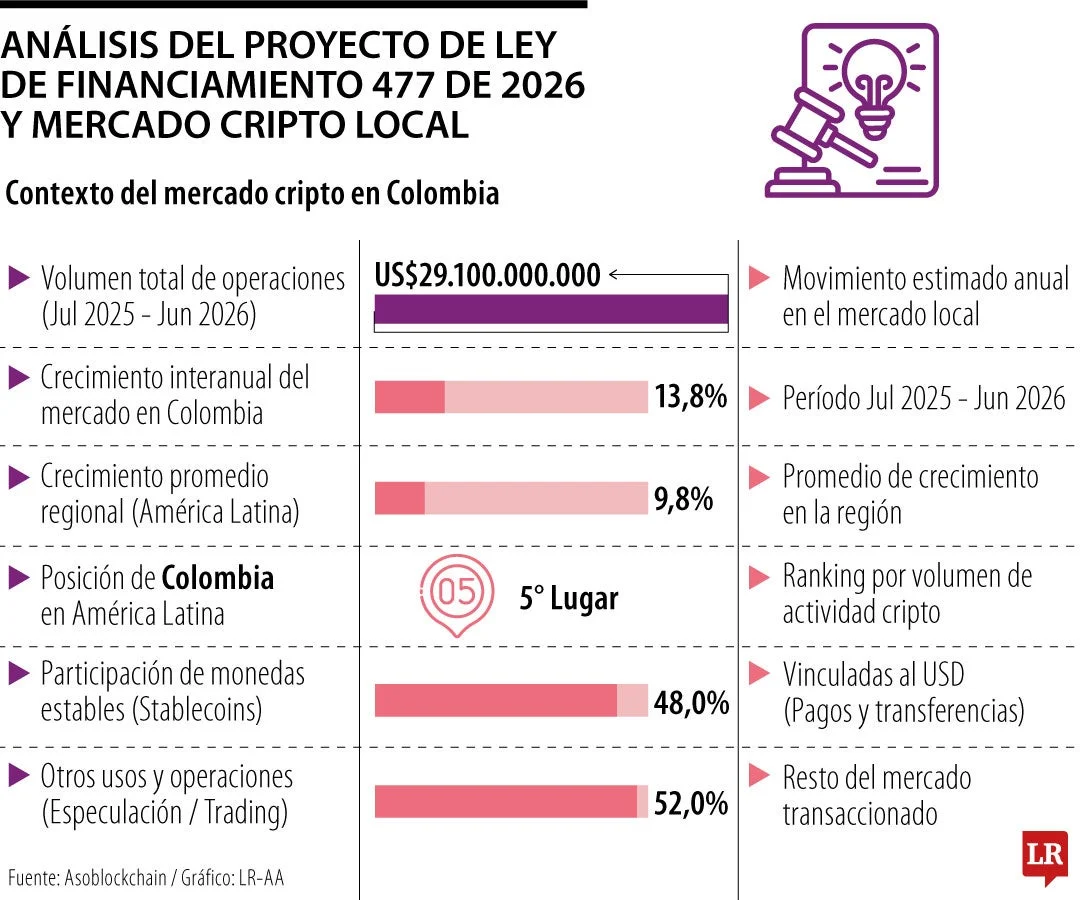
Data compiled by blockchain analytics firm Chainalysis revealed a massive boom in the country. Between July 2025 and June 2026, Colombia processed a staggering US$29.1 billion in cryptoassets. This performance propelled the nation to the position of the fifth-largest crypto market in Latin America, registering an impressive annual growth rate of 13.8%.
Late 2026: Introduction of Project Law 477
Seeking new revenue streams and economic formalization, the administration of President Abelardo De La Espriella introduced the Financing Bill (Proyecto de Ley 477 de 2026). While the bill recognized the economic gravity of the sector by attempting to tax and account for digital assets, its architects included Article 17, triggering an immediate and organized pushback from the blockchain sector.
3. Supporting Data: Colombia’s Weight in the Latin American Crypto Economy
The urgency of Asoblockchain’s demands is underpinned by hard data regarding how Colombians actually use digital assets. Far from being restricted to speculative meme-coin trading by tech-savvy elites, cryptocurrencies have woven themselves into the fabric of everyday commerce, remittances, and corporate treasury management.
The Rise of Stablecoins
According to Asoblockchain’s internal analysis of the market, 48% of all local crypto operations correspond to stablecoins—digital tokens pegged one-to-one to fiat currencies like the U.S. dollar (such as USDT and USDC).
- Utility Over Speculation: Unlike volatile tokens like Bitcoin or Ethereum, stablecoins are primarily utilized for business-to-business (B2B) cross-border payments, international trade settlements, and immigrant remittances. They offer protection against the devaluation of the Colombian peso without requiring traditional correspondent banking networks, which are often slow and expensive.
- Economic Integration: Because nearly half of the market consists of transactional currency substitutes, treating all digital assets as purely speculative wealth stores is a regulatory error. Imposing a blanket 5% normalization tax penalizes operational capital used by small businesses to pay international suppliers just as severely as speculative portfolios.
Macroeconomic Scale
With nearly US$30 billion flowing through Colombian crypto channels in a 12-month window, the government’s desire to capture tax revenue is understandable. However, industry analysts point out that trying to tax a moving train with heavy-handed mechanisms will simply cause the train to derail. If asset holders feel threatened by the 5% declaration levy, they will continue to rely on decentralized exchanges (DEXs), peer-to-peer cash transactions, and foreign-custodied wallets that are functionally invisible to domestic authorities.
4. Official Responses and Industry Stakeholder Perspectives
The debate has drawn sharp contrasts between the fiscal ambitions of the executive branch and the operational realities faced by market participants.
Asoblockchain’s Stance: Cooperation, Not Penalization
Camilo Suárez, president of Asoblockchain, has been vocal in defending the industry’s perspective across national media and legislative forums. Suárez has repeatedly clarified that the guild is not asking for special tax holidays or legal impunity for illicit funds.
"We are not asking for privileges; we are asking for clear, rational conditions to operate and protect the privacy and security of digital wallets," Suárez stated during a press briefing in Bogotá.
Suárez acknowledged that the government made tentative positive steps in the draft bill regarding the methodology for calculating asset costs and accounting for price variations. However, he stressed that these tweaks are insufficient as long as the state demands upfront tribute without establishing a robust, comprehensive regulatory framework for the entire ecosystem.
Specifically, Asoblockchain is demanding legal clarity for:
- Exchanges: Domestic and international cryptocurrency trading platforms operating within national jurisdiction.
- Custodians: Institutional and retail digital wallet providers responsible for safeguarding private keys.
- Tokenization Firms: Companies using blockchain technology to fractionalize and trade real-world assets (RWAs) like real estate, commodities, and corporate debt.
Government and Congressional Silence to Date
As the debate intensifies, economic committees in Congress are weighing the fiscal projections of the Ministry of Finance against the warnings issued by fintech leaders. While the administration argues that the 5% normalization fee will provide an immediate cash injection into the national treasury, fiscal experts aligned with the industry argue that the projected revenue is illusory because compliance rates will plummet.
5. Implications: What Happens If Article 17 Survives?
The final wording of Article 17 will set a critical precedent for how Latin American nations balance state fiscal needs with the growth of decentralized technologies. The potential outcomes of this legislative battle carry significant economic consequences for Colombia.
Scenario A: The 5% Tax Remains Intact
If Congress passes the Financing Bill with Article 17 unchanged, several negative market reactions are anticipated:
- Capital Flight and Deepening Informality: Wealthy holders and active traders will accelerate the movement of funds into offshore decentralized protocols, hardware wallets, and privacy coins. Rather than stepping into the light, capital will retreat further into the shadows.
- Stifled Innovation: FinTech startups and blockchain developers may choose to incorporate in friendlier jurisdictions (such as El Salvador, Brazil, or offshore hubs), depriving Colombia of tech-sector investment, high-paying jobs, and digital infrastructure growth.
- Low Collection Yields: DIAN may find that actual tax collection from the normalization window falls drastically short of projections, as the economic barrier to entry proves too high for the average crypto holder.
Scenario B: Congress Adopts the 0% Normalization Proposal
Should lawmakers heed Asoblockchain’s advice and drop the tariff to 0% for asset registration:
- Massive Database Expansion: DIAN will gain unprecedented visibility into billions of dollars in previously hidden private wealth, creating a comprehensive map of domestic crypto ownership.
- Sustainable Long-Term Taxation: Once normalized at zero cost, these assets can be seamlessly integrated into the annual income tax cycle. Every time a user converts crypto to fiat, trades tokens, or realizes capital gains, the state collects its fair share through normal, predictable taxation channels.
- Positioning Colombia as a Regional Tech Hub: By demonstrating regulatory maturity and a willingness to collaborate with emerging industries, Colombia could cement its status as a top-tier financial technology leader in Latin America, attracting foreign direct investment (FDI) and institutional venture capital.
Conclusion
As Project Law 477 of 2026 winds its way through congressional debates, the spotlight remains firmly on Article 17. The choices made by Colombian lawmakers in the coming weeks will determine whether the nation successfully harnesses the economic potential of the blockchain revolution or inadvertently strangles one of its most dynamic and rapidly expanding digital markets. Asoblockchain continues to urge open dialogue, emphasizing that a cooperative approach to taxation and regulation will yield far greater rewards for the national economy than punitive fiscal measures.