Date: Monday, September 28, 2026
Author: Global News Desk
1. Main Facts
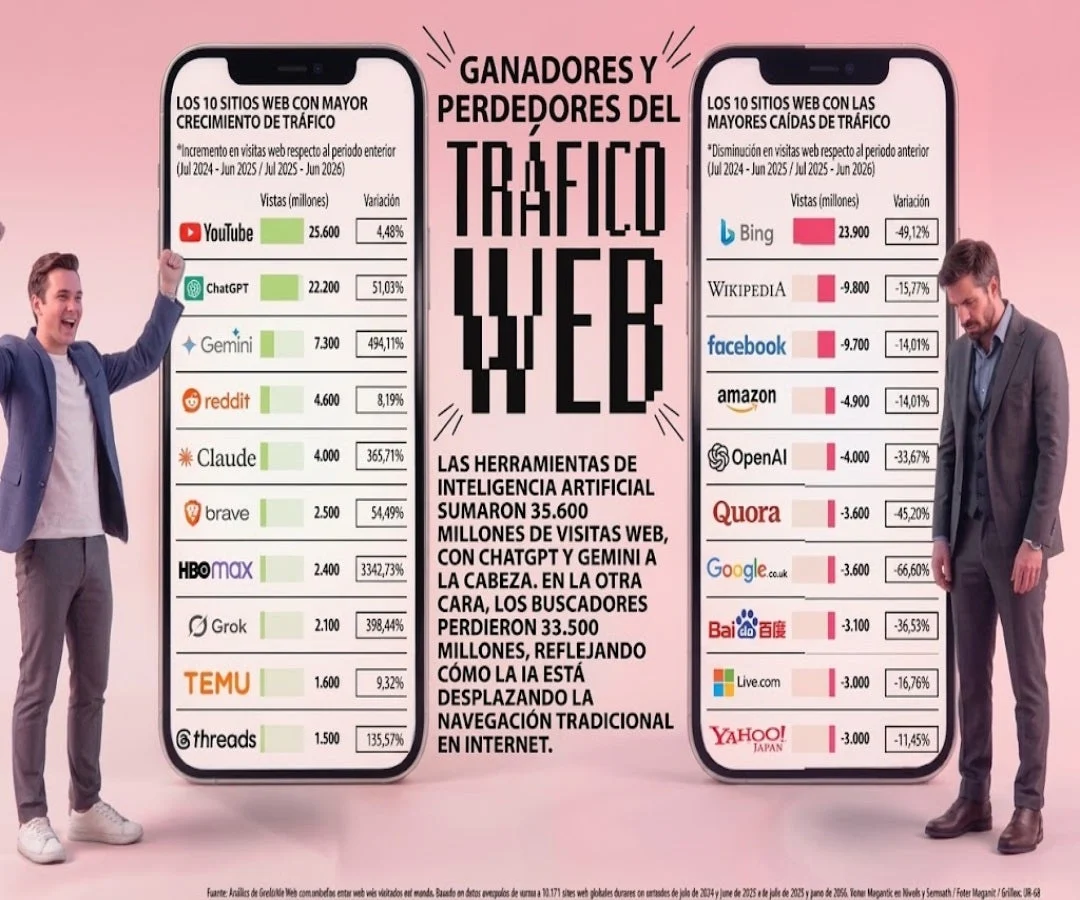
The global digital ecosystem is undergoing a seismic, structural transformation that is redefining how humanity interacts with information, technology, and institutions. According to comprehensive web analytics data released in late September 2026, artificial intelligence tools have officially crossed a historic threshold, capturing a staggering 35.6 billion web visits. This monumental surge is spearheaded by market titans ChatGPT and Google Gemini, which continue to absorb user attention at an unprecedented velocity.
However, this explosive growth comes at a direct and measurable cost to legacy systems. Traditional web search engines experienced a reciprocal downturn, hemorrhaging 33.5 billion visits over the corresponding period. Industry analysts note that this inverse correlation is the clearest empirical proof to date that generative AI is aggressively displacing traditional keyword-based web navigation, shifting the paradigm from searching for links to directly consuming synthesized answers.
This technological pivot coincides with major developments across diverse sectors worldwide:
- The Future of European Football: UEFA has officially announced the host stadiums for the 2028 and 2029 UEFA Champions League finals, selecting the iconic Allianz Arena in Munich and the newly modernized Camp Nou in Barcelona.
- Ethical Warnings from the Holy See: During an official visit to France, Pope Leo XIV issued a stark, philosophical caution regarding the unchecked acceleration of artificial intelligence, warning of a potential "paradise of machines" that could marginalize human agency.
- Athletic Uncertainty: World tennis number one Jannik Sinner faces mounting concerns regarding a persistent knee injury that continues to sideline him from premier global tournaments.
- Macroeconomic Pressures: Economies worldwide continue to grapple with resource scarcity, strict regulatory frameworks regarding firearms, infrastructure modernization challenges—such as the leadership trials at energy giant Ecopetrol—and the economic toll of climate phenomena like El Niño.
2. Chronology of Events
To understand the convergence of these monumental global shifts, it is essential to trace the timeline of events leading up to this point in late 2026:
- Early 2024 – 2025 (The Generative AI Boom): Generative AI tools transition from novelty chat interfaces to deeply integrated operational systems. Browsers begin embedding conversational search features natively, slowly conditioning users to bypass traditional search engine results pages (SERPs).
- Mid-2025 (The Tipping Point in Web Traffic): Analytics firms begin tracking a steady month-over-month decline in organic referral traffic to media outlets, blogs, and traditional web directories, while direct traffic to AI platforms skyrockets.
- August 2026 (The US Open Absence): Italian tennis star Jannik Sinner officially withdraws from the US Open due to a lingering, complex knee injury. Initial optimistic recovery timelines are announced, aiming for a swift return during the Asian swing of the tennis calendar.
- September 15–20, 2026 (Papal Apostolic Journey to France): Pope Leo XIV undertakes a high-profile tour of France, engaging with academic leaders, technologists, and theologians to discuss the ethical boundaries of autonomous systems.
- September 24, 2026 (UEFA Executive Committee Decision): European football’s governing body officially votes on and ratifies the venues for the 2028 and 2029 Champions League finals, prioritizing state-of-the-art facilities with massive global commercial appeal.
- September 28, 2026 (The Traffic Milestone): New digital metrics reveal the historic crossover: AI tools hit 35.6 billion visits while search engines drop by 33.5 billion visits, cementing the new digital reality. Concurrently, ongoing concerns over Sinner’s fitness and global resource management dominate international headlines.
3. Supporting Data and Metrics
The quantitative reality of the 2026 digital landscape paints a vivid picture of disruption. The web analytics metrics published this week offer critical insights into the scale of change:
- 35.6 Billion Visits: The combined traffic accrued by leading generative AI models (ChatGPT, Gemini, and specialized enterprise LLMs). This represents a year-over-year growth rate exceeding 140%, driven by workplace integration, academic research, and casual day-to-day inquiries.
- 33.5 Billion Visits Lost: The measurable contraction observed across legacy search engine ecosystems. Content creators, news publishers, and e-commerce sites report a sharp decline in referral traffic as users increasingly rely on AI-generated summaries rather than clicking through to external domains.
- 70,000+ Spectators: The seating capacity of the Allianz Arena in Munich, Germany, which is set to host the 2028 Champions League final. The stadium is famously home to elite international talent, including Colombian winger Luis Díaz (born 1997), who continues to be a central figure in European club football.
- The Cost of Climate Disruptions: Economists are currently quantifying the staggering hourly cost of energy rationing and resource management driven by the cyclical pressures of the El Niño phenomenon, placing immense strain on emerging markets and national energy grids alike.
4. Official Responses and Institutional Reactions
Major global institutions have been forced to respond rapidly to these overlapping technological, athletic, and ethical crises.
The Vatican’s Moral Imperative
During his address in France, Pope Leo XIV (born 1955) did not reject technological progress outright, but he issued a profound moral caution. Addressing the philosophical implications of runaway automation, the pontiff warned humanity against building a "paradise of machines."
"We must ensure that the tools of our own creation do not become the masters of our destiny," the Pope stated, urging international governing bodies to establish strict ethical guardrails to preserve human dignity, labor, and spiritual autonomy in an increasingly algorithmic world.
UEFA’s Infrastructure Strategy
UEFA’s confirmation of the 2028 and 2029 Champions League venues reflects a calculated effort to blend historical prestige with modern infrastructural excellence. By selecting Munich’s Allianz Arena—known for its architectural brilliance and passionate fan culture, where stars like Luis Díaz perform at the highest level—and Barcelona’s newly renovated Camp Nou, UEFA is signaling confidence in Europe’s premier sports venues to deliver unmatched fan experiences and broadcast revenues.
The Sports Medical Board’s Stance on Sinner
The medical team surrounding world number one tennis player Jannik Sinner (born 2001) has faced intense scrutiny from sports media and fans alike. Following his absence from the US Open, contradictory reports regarding his readiness for the Asian ATP tournaments have exposed the high-pressure environment of modern professional sports, where the timeline of biological healing often clashes with the commercial imperatives of the global tennis calendar.
5. Implications for the Future
The convergence of these events on September 28, 2026, signals a profound turning point across multiple domains of modern civilization.
The Death of the Traditional Web?
The migration of 35.6 billion visits to AI platforms at the expense of search engines raises existential questions for the digital economy. If users no longer visit websites to find information, the foundational ad-revenue business model that has funded the open internet for three decades is fundamentally broken. Publishers, content creators, and regulatory bodies must urgently navigate this transition, confronting issues of intellectual property, fair compensation, and the democratization of information.
Geopolitical and Economic Pressures
Beyond the digital realm, nations continue to grapple with tangible physical realities. The challenges facing leadership at state-owned enterprises like Ecopetrol highlight the delicate balancing act required of emerging economies: transitioning to sustainable energy models while managing the immediate financial drain of climate-induced resource rationing. Coupled with evolving legislative debates over public safety, gun control laws, and strategic tourism planning for the upcoming year, societies are being forced to adapt to unprecedented complexity on all fronts.
As we look toward 2027 and beyond, the overarching message of this era is clear: adaptation is no longer optional. Whether navigating an algorithmic internet, recovering from physical injury on the world tennis stage, or heeding the ethical warnings of spiritual leaders regarding the rise of artificial intelligence, humanity stands at the threshold of a completely redefined future.