BOGOTÁ – In a move that signals a significant shift in the nation’s cultural and developmental trajectory, President-elect Abelardo De La Espriella has officially announced the appointment of Paola Holguín as the incoming Minister of Culture. The announcement, made via the President-elect’s official social media channels, marks one of the most anticipated cabinet reveals of the transition period, positioning a veteran political figure at the helm of a ministry historically characterized by high turnover and administrative volatility.
Holguín, a seasoned social communicator and political strategist with a deep-rooted focus on economic development through cultural heritage, inherits a portfolio that has struggled for stability over the last two decades. As the nation prepares for a change in leadership, the appointment of Holguín is being framed not merely as a political placement, but as a strategic move to transform the "Orange Economy" into a robust engine of national pride and international diplomacy.
Main Facts: A Strategic Appointment for a Critical Portfolio
The appointment of Paola Holguín comes at a time when the Ministry of Culture is seeking a clear identity. President-elect De La Espriella’s choice reflects a desire to bridge the gap between traditional cultural preservation and modern economic viability. Holguín is not a stranger to the intersection of policy and heritage; she is a social communicator with a Master’s degree in Political Studies, specializing in Economics and Development.
In his announcement, De La Espriella emphasized that culture should no longer be viewed as a secondary or "ornamental" sector of the government. "Culture is the memory of a people, the expression of its identity, and one of Colombia’s greatest strengths before the world," the President-elect stated. He further outlined a mandate for Holguín that includes supporting creators regardless of political affiliation, strengthening public engagement with the arts, and dignifying the professional lives of artists.
Holguín’s track record provides a blueprint for her expected performance. She is widely recognized as the author of the "Ley del Carriel," a legislative achievement that designated the iconic Antioquian leather bag as a National Cultural Heritage. Beyond symbolism, her work in the municipality of Jericó—specifically the expansion of the Maja Museum of Anthropology and the establishment of a Center for Arts and Crafts in partnership with the Government of Taiwan—demonstrates a pragmatic approach to cultural management.
Chronology: The "Revolving Door" of the Ministry of Culture
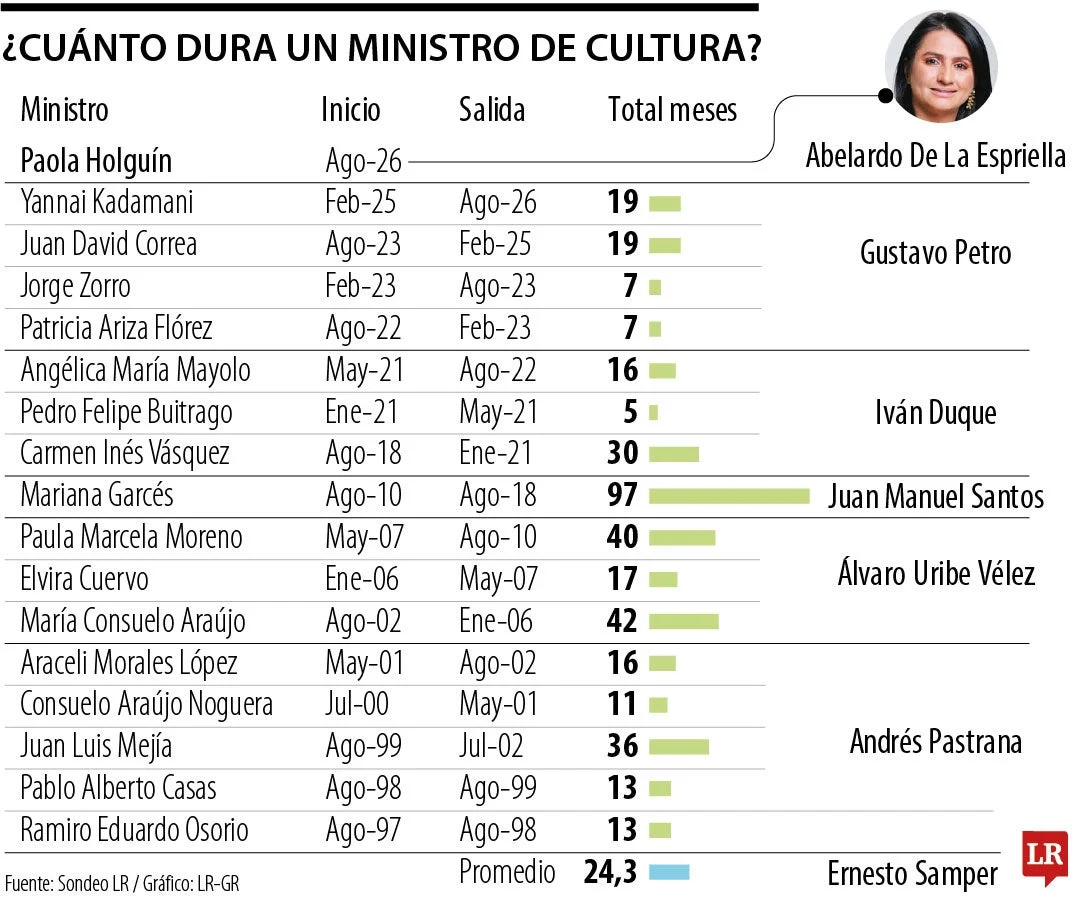
To understand the weight of Holguín’s new role, one must look at the historical instability of the Ministry of Culture. Since the year 2000, the ministry has seen 14 different leaders, creating a "revolving door" effect that has often hindered long-term policy implementation.
The data reveals a stark reality: the average tenure for a Minister of Culture in Colombia is approximately 25 months. This lack of continuity has often left cultural projects in limbo and created a disconnect between the central government and the regional artistic communities.
The Contrast of Tenures (2000–2026)
- The Stability of the Santos Era: The longest-serving minister in the history of the portfolio was Mariana Garcés. She led the sector for a full eight years (2010–2018) throughout both terms of President Juan Manuel Santos. Her tenure is often cited as a "Golden Age" of administrative stability, allowing for the development of long-term cinema laws and library networks.
- The Uribe Administration: María Consuelo Araújo served as a significant figure during the first term of Álvaro Uribe Vélez, holding the post from August 2022 to January 2006. Her term focused heavily on cultural tourism and the "Plan Nacional de Lectura."
- The Petro Administration Volatility: The outgoing administration of Gustavo Petro saw four different ministers in a single four-year term, contributing to the downward trend in average tenure.
- Patricia Ariza Flórez: A renowned theater director who served from August 2022 to February 2023. Her exit was marked by ideological friction regarding the role of "popular cultures."
- Juan David Correa: Served from August 2023 to February 2025, focusing on the editorial sector and the 100th anniversary of La Vorágine.
- Yannai Kadamani: Appointed in February 2025 to close out the Petro term, focusing on community-based cultural initiatives.
Holguín now enters this timeline with the challenge of breaking the cycle of short-termism that has plagued the ministry for the last six years.
Supporting Data: The Economic Reality of Colombian Artists
The appointment of Holguín is underpinned by a pressing need to address the precarious economic state of the country’s creative class. According to recent labor statistics in the cultural sector, a significant percentage of Colombian artists work in the informal economy, lacking access to stable pensions or healthcare.
President-elect De La Espriella addressed this directly, promising that under his government, "artists will never again have to live solely for the love of art." This rhetoric suggests a shift toward a more market-oriented cultural policy, where the state acts as a facilitator for talent to reach international stages.
Holguín’s expertise in Economics and Development is expected to be the catalyst for this change. During her time in the Senate and her work in Antioquia, she championed the idea that cultural crafts—such as the construction of guitars in the Taiwan-backed center in Jericó—are not just hobbies but viable industries. By scaling these models to a national level, the administration aims to increase the cultural sector’s contribution to the national GDP, which has historically hovered around 3%.
Official Responses: Vision and Mandate
The reaction to Holguín’s appointment has been swift across the political and cultural spectrum. Supporters point to her legislative discipline and her ability to secure international cooperation (as seen with the Taiwan partnership) as evidence that she can bring much-needed "gerencia" (management) to the ministry.
In his official statement on X (formerly Twitter), De La Espriella laid out a four-pillar mandate for Holguín:
- Political Neutrality: Supporting creators without "political distinctions," a subtle critique of previous administrations that were accused of favoring specific ideological movements.
- Audience Formation: Strengthening the "formation of publics" to ensure that cultural productions have a domestic market.
- Dignity of Labor: Formalizing the work of artists to ensure they have a living wage.
- National Pride: Using culture as a "motor of development" and a source of international prestige.
Holguín, in a brief initial response, stated that her goal is to "territorialize" cultural policy. This means moving beyond the Bogotá-centric focus of the ministry and empowering local artisans, musicians, and historians in the departments—much like she did with the Carriel in Antioquia.
Implications: What This Means for the Future of Colombia
The appointment of Paola Holguín carries several profound implications for the next four years of Colombian governance.
1. The Professionalization of the "Orange Economy"
While the previous "Orange Economy" concept was often criticized for being too corporate, the De La Espriella-Holguín approach appears to be focusing on "Cultural Industrialization." By emphasizing "Arts and Crafts" (Artes y Oficios), the administration is signaling a return to vocational training. The goal is to turn traditional knowledge into exportable goods and services.
2. Cultural Diplomacy and International Soft Power
With Holguín’s background in international management, Colombia is likely to see an increase in "Cultural Diplomacy." The mention of taking Colombian talent to the "most important stages in the world" suggests a push for more international tours, exhibitions, and biennials, funded through public-private partnerships. This could position Colombia as a primary cultural hub in Latin America, competing with Mexico and Argentina for creative dominance.
3. Stability vs. Political Pressure
The biggest question remains whether Holguín can survive the "25-month curse." The Ministry of Culture is often the first to be sacrificed during cabinet reshuffles to satisfy coalition demands. However, Holguín’s high political standing within De La Espriella’s circle suggests she may have the political capital to stay the course, potentially rivaling Mariana Garcés’ record for longevity.
4. A Shift in Narrative
The transition from the Petro administration to the De La Espriella administration represents a pivot from "Culture as Social Activism" to "Culture as National Identity and Economic Asset." Holguín’s focus on heritage (the Carriel, the Maja Museum) suggests a more traditionalist but economically aggressive approach to national branding.
Conclusion
Paola Holguín’s transition from a legislator and political scholar to the Minister of Culture is a defining moment for the incoming De La Espriella government. She inherits a ministry that is as fragile as it is vital. If she succeeds in her mission to dignify the work of artists and stabilize the ministry’s leadership, she could fundamentally alter the way Colombia perceives its own identity.
As the new administration takes flight, the eyes of the artistic community—from the guitar makers of Jericó to the filmmakers of Bogotá—will be on Holguín. The promise of an "artist-friendly State" is a bold one; the coming months will determine if that promise can be translated from a social media post into a sustainable reality for the millions of Colombians who make their living through the power of creativity.