
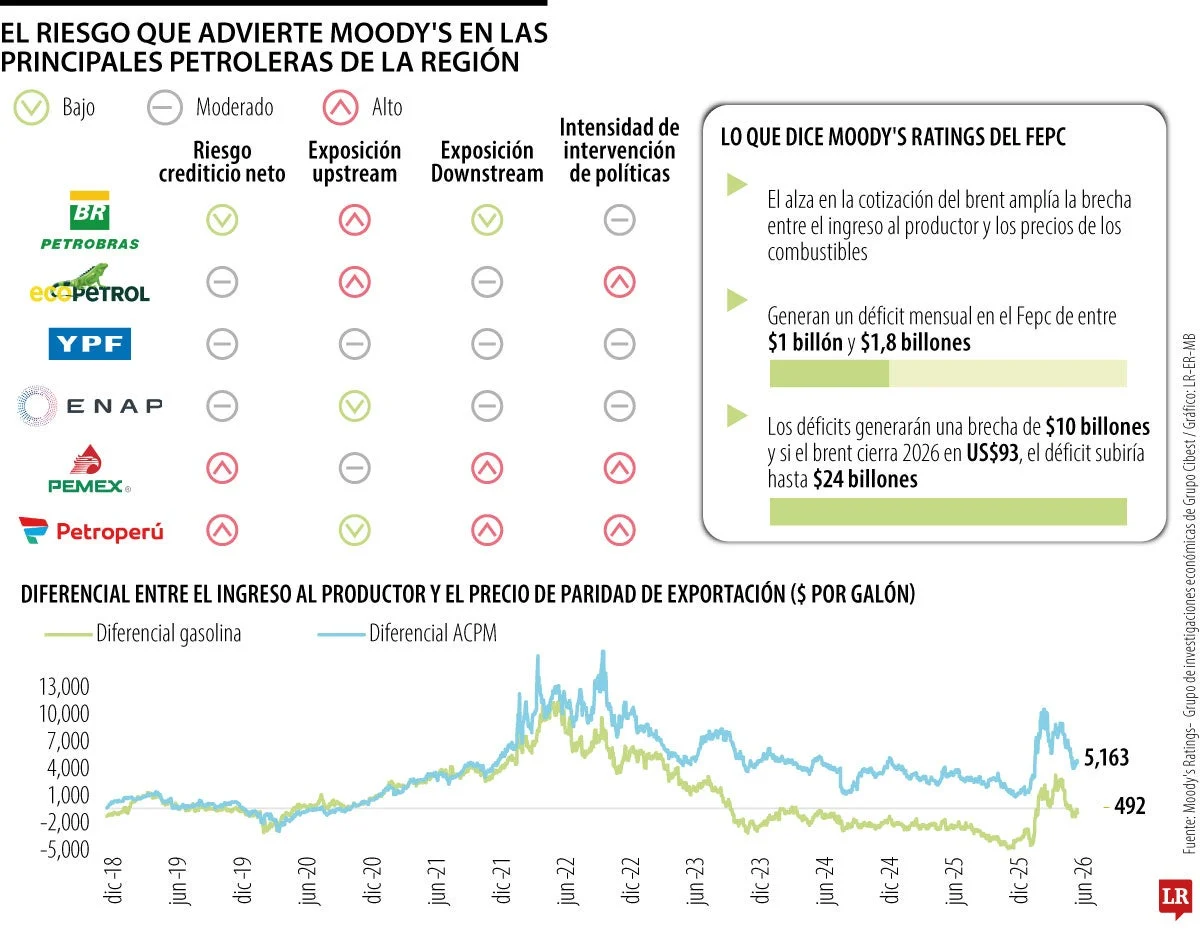
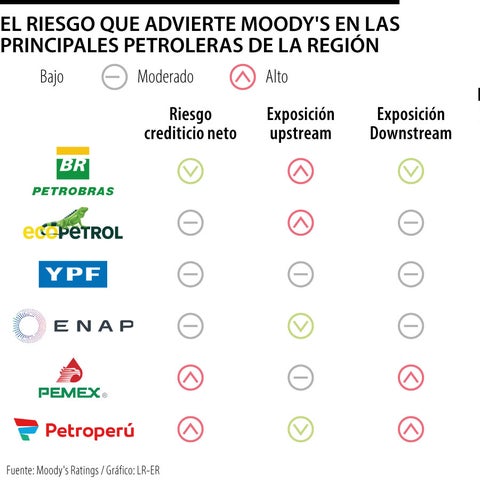
BOGOTÁ – In a comprehensive risk assessment that has sent ripples through Colombia’s financial corridors, Moody’s Ratings has issued a stark warning regarding the country’s current energy pricing policy. The credit rating agency cautioned that the national government’s decision to maintain domestic fuel subsidies—specifically by freezing prices amidst rising international oil benchmarks—is poised to significantly widen the deficit of the Fuel Price Stabilization Fund (FEPC) and jeopardize the cash flow of the state-run oil giant, Ecopetrol.
As geopolitical tensions in the Middle East continue to simmer, driving Brent crude back above the $85-per-barrel threshold, Colombia finds itself at a precarious crossroads. The nation must balance the immediate need to control inflation against the long-term imperative of fiscal sustainability. According to Moody’s, failure to align internal prices with international references could see the FEPC deficit balloon to an alarming $10 trillion COP by 2026, with even more dire scenarios on the horizon should oil prices continue their upward trajectory.
1. Main Facts: The $24 Trillion Risk
The crux of the report lies in the widening "gap" between what Colombians pay at the pump and what the fuel actually costs on the global market. While the government has made strides in previous years to close the gap for regular gasoline, diesel (ACPM) remains heavily subsidized—a move intended to prevent a spike in food prices and transportation costs.
The Deficit Escalation
Moody’s projections are based on the current volatility of the Brent crude market. With Brent trading above $85, the FEPC deficit is currently expanding at a rate of between $1 trillion and $1.8 trillion COP every month. If the government maintains the current price freeze and Brent crude averages $93 per barrel through 2026, the cumulative deficit could reach a staggering $24 trillion COP.
The Ecopetrol Conundrum
The impact is not merely a line item on the government’s balance sheet; it directly affects Ecopetrol, the nation’s most important company. Under the current mechanism, Ecopetrol essentially "lends" the value of the subsidy to the government. When the government freezes prices, Ecopetrol is forced to sell refined products at regulated rates rather than market parity. Moody’s noted that while Ecopetrol’s refining margins have been healthy—averaging between $14 and $15 per barrel in recent quarters—the inability to pass on higher crude costs to the consumer "mutes" the profitability of the downstream segment and constrains the company’s internal cash generation.
2. Chronology: From Stability to Fiscal Strain
To understand the current crisis, one must look at the timeline of Colombia’s fuel pricing evolution and the external shocks that have disrupted it.
- Late 2023 – Early 2024: The Colombian government successfully implemented a series of monthly increases in gasoline prices, bringing them close to international parity. This move was lauded by international observers as a necessary step toward fiscal responsibility.
- March 2026: Following a period of relative stability, Brent crude prices saw their first significant surge of the year, breaking the $85 barrier. This was largely driven by renewed supply chain fears stemming from Middle Eastern conflicts.
- May 2026: Export data revealed a "bittersweet" reality. Oil exports surged 32.4% compared to May 2025, totaling $1.407 billion. While this bolstered the trade balance, it simultaneously widened the subsidy gap for domestic consumption.
- June 2026: At the end of the month, data from Grupo Cibest indicated that the gap for diesel reached $5,163 per gallon, while regular gasoline—previously thought to be at parity—slipped back to $492 below the Export Parity Price (PPE).
- July 2026: Finance Minister Germán Ávila announced that there would be no fuel price adjustments for the month of July, prioritizing inflation control over deficit reduction. This announcement triggered the subsequent warning from Moody’s Ratings.
3. Supporting Data: The Price Parity Gap
The technical reality of the subsidy is best illustrated by the "Price Parity Gap"—the difference between the regulated domestic price and the international market price.
Current Price Discrepancies
According to Julio César Vera, President of XUA Energy, the disconnect is most profound in the transport sector’s primary fuel.
- Diesel (ACPM): The difference compared to international benchmarks is approximately $7,000 per gallon.
- Regular Gasoline: Despite previous adjustments, the gap has reopened to approximately $240 to $492 per gallon, depending on the specific PPE calculation at the close of June.
Macroeconomic Variables
The FEPC deficit is not only a product of oil prices but also of the exchange rate. Grupo Cibest estimates that if the government implements $500 monthly increases starting in August 2026, they could reduce the year-end deficit by $2 trillion COP.
However, in a "status quo" scenario where prices remain frozen:
- Projected 2026 Deficit: $14 trillion COP (assuming Brent at $81 and an exchange rate of $3,615 COP/USD).
- Fiscal Framework Conflict: This $14 trillion figure would nearly triple the $6 trillion estimate currently allocated in the Medium-Term Fiscal Framework (MFMP), creating a massive hole in the national budget.
4. Official Responses: The Inflation vs. Deficit Debate
The government and industry leaders remain locked in a complex debate over the "lesser of two evils": fiscal debt or inflationary pressure.
The Government’s Stance
Finance Minister Germán Ávila has defended the decision to pause price hikes, citing the need to protect the purchasing power of the lower and middle classes. In his June statement, Ávila emphasized that while the FEPC deficit is a concern, a sudden spike in diesel prices would have a "cascading effect" on the cost of food, as the vast majority of agricultural goods in Colombia are transported via diesel-powered trucks.
Industry Warnings
Frank Pearl, President of the Colombian Petroleum and Gas Association (ACP), offered a more cautious perspective on the consequences of rising Brent prices. "If a higher Brent is reflected in fuel prices, this increase would have direct effects on the costs of freight and passenger transport," Pearl explained. He warned that these costs would inevitably be passed on to the consumer, translating into "price increases for mass-consumption goods and services."
The Analyst View
Analysts at Grupo Cibest argue that the "wait-and-see" approach is becoming increasingly dangerous. They suggest that gradual, predictable increases—such as the proposed $500 per month—are the only way to mitigate the $14 trillion to $24 trillion risk without causing a shock to the consumer price index (CPI).
5. Implications: A Precarious Economic Horizon
The warnings from Moody’s and other financial institutions suggest that the current path is unsustainable. The implications of maintaining the fuel price freeze extend far beyond the gas station.
1. Credit Rating Pressure
Moody’s Ratings serves as a gatekeeper for international investment. If the FEPC deficit continues to balloon beyond the projections of the Medium-Term Fiscal Framework, it could lead to a downgrade or a "negative outlook" for Colombia’s sovereign credit rating. This would increase the cost of borrowing for the country, further straining the national budget.
2. Ecopetrol’s Investment Capacity
Ecopetrol is currently in a transition phase, attempting to diversify into renewable energy while maintaining its core oil and gas production. A constrained cash flow caused by the FEPC "debt" means the company has less capital to invest in exploration, production, and the energy transition. This could lead to a long-term decline in national oil reserves.
3. Structural Inflation
While the freeze prevents an immediate spike in inflation, it creates "repressed inflation." Eventually, the gap must be closed. The longer the government waits, the more aggressive the eventual price hikes will need to be, potentially leading to social unrest or a sharper economic contraction in the future.
4. Fiscal Crowding Out
Every peso used to pay off the FEPC deficit is a peso that cannot be spent on social programs, infrastructure, or education. With a potential $24 trillion deficit, the "opportunity cost" of the fuel subsidy could become the defining characteristic of the 2026-2027 fiscal years.
5. Foreign Exchange Volatility
As a major oil exporter, Colombia’s currency is highly sensitive to oil prices. However, if the market perceives that the government is mismanaging the windfall from high oil prices by sinking it into domestic subsidies, the Colombian Peso could face devaluative pressure despite high Brent prices, creating a vicious cycle of rising import costs and a widening parity gap.
Conclusion
The report from Moody’s Ratings serves as a clarion call for the Colombian government. While the political cost of raising fuel prices—particularly diesel—is high, the fiscal cost of inaction is proving to be even higher. As the global energy market remains volatile, Colombia’s ability to navigate this "bittersweet" landscape will determine its economic stability for the remainder of the decade. The challenge remains: how to dismantle a multi-trillion peso subsidy without derailing the fragile post-pandemic economic recovery.