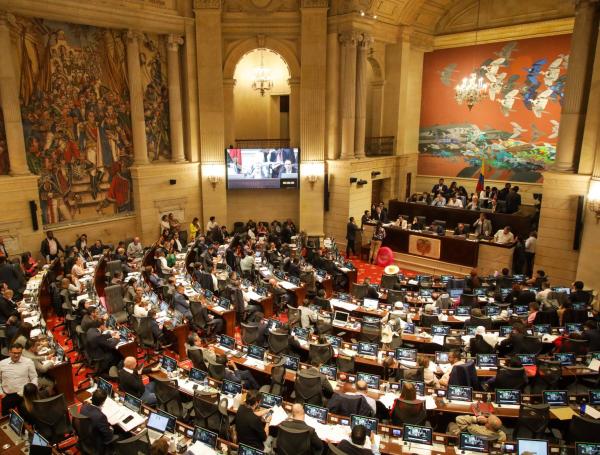
BOGOTÁ — Time is running out for the administration of President Abelardo de la Espriella. As the legislative clock ticks down toward the mandatory year-end recess on December 16, 2026, the Executive branch faces an intense, high-stakes political battle to secure congressional approval for its flagship legislative package: a sweeping tax reform and fiscal adjustment bill.
Comprising a hefty 105 articles divided into five strategic pillars, the ambitious project attempts to overhaul public finances, stimulate liquidity, curb inefficient public spending, and restructure critical components of social security and healthcare. However, the path to enactment is fraught with legislative hurdles, tight deadlines, and fierce resistance—not only from traditional opposition factions, but crucially, from key members of the government’s own fragile congressional coalition.
With the first major political test now resting heavily on the shoulders of newly appointed Interior Minister Alejandro Ordóñez, the administration must masterfully balance technical fiscal demands with delicate political negotiations. If the government fails to align its allies and overcome vocal criticisms regarding the creation of new taxes, Colombia’s economic stability heading into 2027 could face unprecedented turbulence.
Main Facts: Inside the 105-Article Fiscal Overhaul
The cornerstone of the De la Espriella administration’s economic strategy is officially styled as a "rescue law," designed to combat a looming fiscal precipice. Vice President José Manuel Restrepo has been the administration’s primary public voice, aggressively championing the initiative and warning that inaction would spell disaster for the national economy.
According to the government, the previous administration left behind a ticking financial time bomb programmed to detonate by 2027. Speaking on the necessity of the legislation, Restrepo did not mince words during the project’s presentation:
"The previous government left us a time bomb that will explode in 2027 unless we act… We present this law to save Colombia from bankruptcy, avoid the loss of 360,000 jobs, and prevent a deep recession."
The extensive 105-article bill is structured around five central pillars:
Revenue Generation: Broadening the tax base and streamlining collection mechanisms.
Liquidity Enhancement: Measures to inject capital into key commercial and industrial sectors.
Public Spending Control: Trimming state fat, which reportedly includes plans to merge underperforming ministries and reduce the overall footprint of the central government.
Social Security Reform: Adjusting structural components to guarantee long-term sustainability.
Healthcare Sector Adjustments: Modifying financing frameworks, though analysts warn that proposed changes—particularly regarding private prepaid health plans—will likely trigger intense legislative warfare.
Despite the administration’s framing of the bill as an economic life jacket, the legislative road ahead is obstructed by deep skepticism from powerful political blocs, most notably the Centro Democrático.
Chronology: The Tightrope Walk to December 16
Navigating a 105-article tax bill through the Colombian Congress under normal conditions is a notoriously arduous task. Doing so in less than two months transforms the process into a high-speed logistical puzzle.
The Standard Legislative Route vs. Urgent Realities
Because the bill contains vital tax and revenue provisions, the Colombian Constitution mandates that its legislative journey must originate in the Chamber of Representatives.
Under a standard, unhurried legislative procedure, a bill of this magnitude requires four distinct debates:
First Debate: Joint sessions of the Third and Fourth Economic Commissions of the Chamber of Representatives.
Second Debate: The full floor (Plenaria) of the Chamber of Representatives.
Third Debate: Joint sessions of the Economic Commissions of the Senate.
Fourth Debate: The full floor (Plenaria) of the Senate.
If the traditional rhythm of Capitol Hill is maintained—with Congress typically holding sessions only two days a week—the Joint Economic Commissions would theoretically need to thoroughly debate and vote on the complex text throughout the third and fourth weeks of November. Should it survive that initial filter, the bill would then advance to the full plenaries of both the Chamber and the Senate between late November and the first half of December.
The Threat of Divergent Texts and Conciliation
The schedule becomes even more precarious when factoring in inevitable amendments. Should the Chamber and the Senate approve differing versions of the text—a routine occurrence in major fiscal reforms—the chambers must appoint a bipartisan conciliation committee to draft a unified version. This unified text must then be re-submitted and voted on by both legislative bodies before the clock runs out.
If the two chambers happen to pass identical articles without discrepancies, this time-consuming conciliation step is bypassed. However, given the contentious nature of the text, experts view a seamless, frictionless passage as virtually impossible.
The "Urgency Message" Dilemma
As of late October, the Executive branch has not formally issued an urgency message (mensaje de urgencia) that would force committees to sit jointly and accelerate the timeline by a few critical days. Political analysts suggest this deliberate hesitation reflects a strategic choice by the administration: the government wants to lock down political agreements and technical consensus behind closed doors before officially accelerating a legislative train that could easily derail on the House or Senate floor.
Supporting Data and Expert Analysis
The feasibility of passing this monumental fiscal package within the truncated 2026 calendar has drawn skepticism from legislative experts and policy analysts alike.
Gonzalo Araujo, director of the strategic communications agency SONAR, points out that the text is bound to undergo significant alterations as it winds its way through Congress. According to Araujo, the administration must steel itself for continuous negotiation over a moving target—a draft that will not look identical to the one originally filed.
Furthermore, Araujo underscores that contentious topics, particularly structural alterations to the healthcare landscape and cost adjustments tied to private prepaid medicine, will act as lightning rods for fierce debate, potentially grinding committee work to a halt.
What Happens if December 16 Passes Without Approval?
If the legislative period concludes on December 16 without the bill completing its full constitutional journey, the project is not automatically archived.
Article 162 of the Colombian Constitution explicitly dictates that bills which fail to complete their passage within a single legislative session—provided they have successfully cleared at least a first debate in either chamber—may seamlessly pick up where they left off when the next legislative term convenes on March 16, 2027.
Extraordinary Sessions: Another alternative at the disposal of President de la Espriella would be to officially summon Congress to extraordinary sessions during the year-end recess to exclusively tackle pending economic business.
Nonetheless, relying on extraordinary sessions or waiting until March carries steep political and economic costs, casting doubt on the government’s narrative of an imminent 2027 financial catastrophe. For the administration to secure a clean victory in 2026, political strategist Gonzalo Araujo notes that "Congress must walk like a clock," driven by an extraordinarily disciplined Executive coalition.
Official Responses and Political Friction
The success or failure of the tax reform will ultimately hinge on congressional arithmetic, making the positioning of the governing coalition’s largest faction—the Centro Democrático—the single most critical variable for the White House.
The Centro Democrático’s Pushback
While the party generally supports structural measures aimed at reducing the size and cost of the state apparatus, its leadership has drawn a hard line in the sand regarding increased tax burdens on citizens and corporations.
Former President Álvaro Trujillo (widely regarded as the ideological anchor of the party) expressed profound apprehension regarding the introduction of new fiscal levies, arguing that the productive sector is already gasping for air. In a recent appearance on the podcast ‘Los Cuchos’, Trujillo did not mince words:
"We have always said that the Colombian businessman is suffocated by taxes. The Colombian consumer is suffocated by taxes. It is a very difficult situation."
Echoing these concerns, Senate President Honorio Henríquez delivered a blunt warning to the administration shortly after the bill was filed:
"Colombians simply cannot bear one more tax."
Meanwhile, Senator Carlos Meisel adopted a slightly more open, albeit cautious, stance during discussions with EL TIEMPO. Meisel clarified that his party is willing to listen to the government’s technical justifications "without putting a premature brake on any proposal," but swiftly added a caveat:
"They cannot ask us to sign off blindly without clearly demonstrating how the structural plan will unfold."
The Opposition and the Broader Coalition
In addition to internal friction within the Centro Democrático, the Partido Conservador and other center-right factions have announced they will scrutinize any measure threatening household budgets and consumer purchasing power. This leaves Interior Minister Alejandro Ordóñez facing a monumental diplomatic challenge: managing fractious, fragile majorities in a divided Congress where a handful of dissenting votes can decisively sink the entire legislative agenda.
Implications for Colombia’s Economic and Political Future
The debate over the 2026 tax reform and fiscal adjustment law extends far beyond parliamentary procedure; it is a referendum on the economic philosophy of the fledgling de la Espriella administration.
Macroeconomic Stability: If the administration succeeds, it secures a crucial buffer against predicted fiscal deterioration, safeguarding hundreds of thousands of jobs and calming international credit agencies. If it fails, the country faces a high-stakes psychological and fiscal battle heading into the 2027 fiscal year, amplifying market uncertainty.
Political Capital: For President de la Espriella and Interior Minister Ordóñez, the handling of this bill will define their political leverage for the remainder of their term. A fractured coalition signaling open rebellion in the legislature demonstrates the limits of Executive power when attempting to impose broad fiscal measures without exhaustive prior consensus.
The Business Climate: As the debate intensifies through November, private enterprise, healthcare providers, and individual taxpayers remain caught in limbo, watching closely to see whether the final text will alleviate or exacerbate structural financial strains.
As the calendar races toward mid-December, all eyes in Bogotá remain fixed on the Capitol. Whether the administration can forge unity out of political friction—or whether the economic rescue law will be relegated to a protracted 2027 legislative battle—remains one of the most compelling political dramas in recent Colombian history.
By Juan Sebastián Lombo Delgado Political Redaction & Investigative Unit Published: October 28, 2026 Main Facts: The Clash Between Executive Communication and Regulatory Oversight The Communications Regulation Commission (CRC)—an entity that typically operates away from…
International Labor Mobility Advances as SENA Opens Applications for Skill Homologation Across 26 Occupational Profiles In a landmark step for regional labor mobility and workforce integration within Latin America, Colombian workers will soon be able…
By Global Policy & Latin America Desk Updated: September 29, 2026 Introduction: A Collision Course in Colombia’s Post-Conflict Landscape Nearly a decade after the historic 2016 peace accord between the Colombian government and the now-defunct…