By Digital Reach Newsroom
Published: November 2026
Main Facts
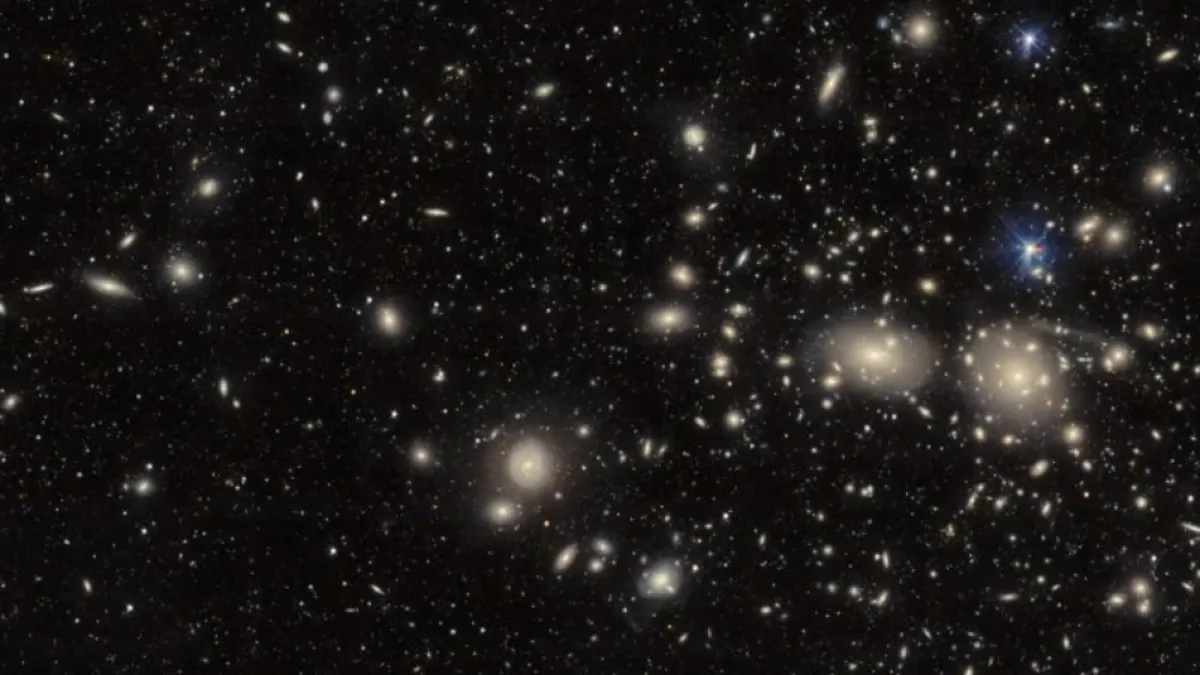
An international collaboration of astronomers, spearheaded by the University of Córdoba (UCO) and bolstered by the vital participation of the Institute of Astrophysics of Andalusia (IAA-CSIC), has achieved a groundbreaking milestone in observational astronomy. The team has successfully captured the deepest optical images ever recorded of the Coma Cluster, a colossal galactic megastructure comprising thousands of individual galaxies situated approximately 300 million light-years away from Earth.
Published in the prestigious scientific journal Astronomy & Astrophysics, these unprecedented observations lift the veil on elusive, extremely faint structures that have historically remained hidden beneath the glare of the cluster’s dominant galaxies. By resolving luminous features of remarkably low surface brightness—such as expansive stellar envelopes, intricate tidal streams, gravitational tails, and the enigmatic diffuse "intracluster light" permeating the void between galaxies—the research opens a direct window into the violent and dynamic evolutionary history of cosmic structures.
The breakthrough is not merely aesthetic; it provides astrophysicists with physical tracers to reconstruct how galaxies interact, merge, and transform under extreme gravitational conditions over geological timescales. This achievement forms the backbone of the international HERON Coma Project, a dedicated initiative designed to plumb the depths of the universe using ultra-deep optical imaging techniques.
Chronology: A Century of Discovery in Coma
To understand the magnitude of this recent breakthrough, it is essential to trace the historical timeline of how the Coma Cluster transformed from a mere patch of faint nebulosity into one of the most vital laboratories in modern astrophysics.
1. Discovery and Early Cataloging (Late 18th to Early 20th Century)
Located in the northern constellation Coma Berenices, the cluster was initially cataloged alongside other nebulae and stellar groupings. However, astronomers soon realized that this region was not merely a local cluster of gas, but an immense congregation of distinct island universes. By the early 20th century, systematic photographic surveys revealed that Coma contained thousands of galaxies packed into a relatively compact volume, making it an archetype for rich, high-density galaxy clusters.
2. The Birthplace of Dark Matter Evidence (The 1930s)
The scientific importance of the Coma Cluster skyrocketed in the 1930s. Pioneer astrophysicist Fritz Zwicky, studying the radial velocities of galaxies within the cluster, noticed something startling: the individual galaxies were moving far too fast to be held together by the gravitational pull of the visible matter (stars, gas, and dust) observed within them.
Zwicky deduced that an immense, invisible mass must be exerting a powerful gravitational anchor on the system. This profound realization provided some of the earliest empirical evidence for what we now call dark matter—a mysterious, non-luminous substance that constitutes the vast majority of matter in the universe. Ever since, Coma has served as a touchstone for testing theories of cosmology and mass distribution.

3. The Modern Era of Deep Imaging (Present Day)
For decades, studying the faint outer outskirts of galaxies within such dense environments was severely limited by the technological thresholds of telescopes and photographic plates. The advent of sensitive Charge-Coupled Devices (CCDs) and advanced digital processing eventually shifted the paradigm.
Culminating in the recent publications in Astronomy & Astrophysics, modern researchers led by the UCO and IAA-CSIC have bypassed historical limitations. By deploying innovative image-stacking methods and specialized decomposition algorithms, the international team has ushered in a new era of "ultra-low surface brightness astronomy," successfully mapping the ghostly remnants of ancient galactic collisions in unprecedented detail.
Supporting Data and Technical Methodology
Unlocking the hidden anatomy of the Coma Cluster required a sophisticated synthesis of advanced observational techniques and cutting-edge computational data processing. Because the structures of interest—such as intracluster light and stellar streams—are thousands of times fainter than the night sky background, standard astronomical imaging falls woefully short.
The Observational Breakthrough
The project relied on the combination of numerous individual exposures of the Coma Cluster, meticulously aligned and stacked to exponentially increase the signal-to-noise ratio.
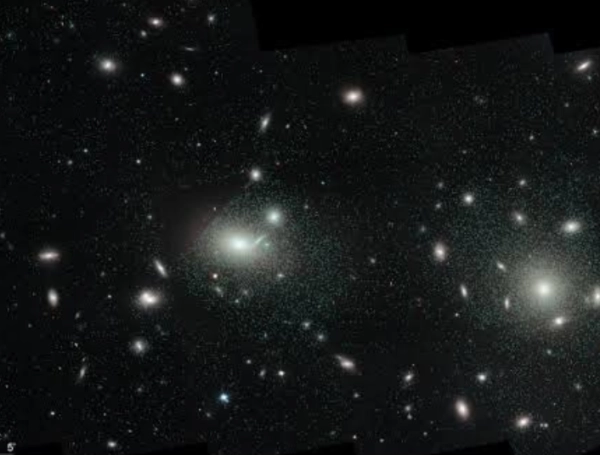
- Javier Román, a researcher in the Department of Physics at the University of Córdoba and lead author of the primary study, engineered the specialized observation and stacking protocols. This method coaxed out signals of exceptionally low intensity that had previously dissolved into instrumental noise and atmospheric interference.
- Once the ultra-deep composite image was generated, Yolanda Jiménez Teja, a researcher at the Institute of Astrophysics of Andalusia (IAA-CSIC), deployed a proprietary, state-of-the-art algorithm developed entirely within her institution. This algorithm was specifically designed to isolate, parse, and analyze the diffuse light scattered between the cluster’s member galaxies.
Quantifying the Intracluster Light
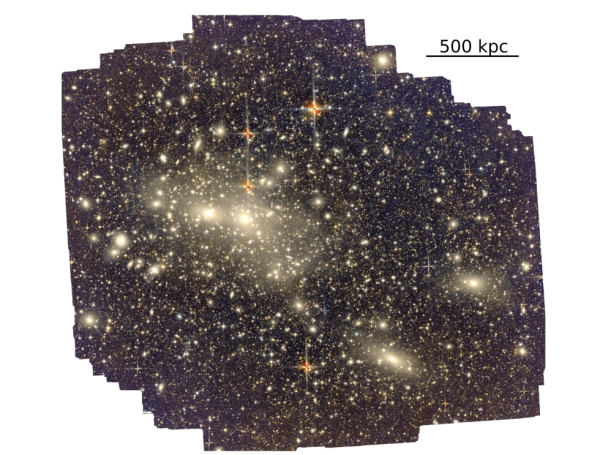
The resulting dataset represents the most extensive and profound mapping of intracluster light (ICL) ever achieved for a major galaxy cluster. ICL is essentially composed of orphan stars that have been violently stripped away from their parent galaxies due to tidal forces, gravitational interactions, and high-speed close encounters over billions of years.
By analyzing the precise color variations, spatial distribution, and morphological substructures within this oceanic spread of ancient starlight, the research team acquired quantitative metrics regarding the mass assembly history of the Coma Cluster. These variations act as a cosmic fossil record, preserving the distinct signatures of past galactic cannibalism and dynamical friction.
Official Responses and Scientific Significance
The publication of these findings has drawn widespread acclaim within the global astrophysical community, validating years of collaborative methodological refinement under the HERON Coma Project umbrella.
In an official statement detailing the breakthrough, co-author Yolanda Jiménez Teja emphasized the narrative power hidden within the background haze:

"In this image, we can distinguish different sub-structures and subtle color variations that offer us direct clues about the trajectories followed by the galaxies of Coma and the complex processes that have shaped their current configuration."
The research underscores a fundamental shift in how astronomers approach cluster evolution. Rather than viewing galaxies as isolated, static islands evolving purely through internal processes, deep-imaging projects like HERON demonstrate that galaxy clusters are dynamic, interconnected ecosystems. Every stellar stream, extended envelope, and bridge of intracluster light tells a story of gravitational disruption, energy exchange, and structural transformation.
Furthermore, because the Coma Cluster sits relatively "close" to us on a cosmic scale (300 million light-years), it serves as a high-resolution benchmark. Understanding the detailed mechanics of galaxy interactions in Coma allows astrophysicists to build more accurate models for how similar clusters form and evolve across the distant, early universe, where direct observation of such fine detail remains technologically prohibitive.
Implications for Future Astrophysical Research
The implications of capturing the deepest optical images of the Coma Cluster extend far beyond the boundaries of local galactic cartography. As observational techniques continue to improve, the methodologies pioneered by the University of Córdoba and the IAA-CSIC will undoubtedly be applied to other massive cosmic structures.
1. Refining Cosmological Models of Galaxy Assembly
Current cosmological simulations often struggle to accurately predict the exact amounts and distributions of intracluster light in dense environments. By providing empirical, high-precision maps of ICL in a cluster as massive as Coma, this study offers theoretical astrophysicists a rigorous benchmark to constrain and fine-tune computer simulations of cosmic structure formation.
2. Unraveling the Interplay Between Visible and Dark Matter
Given Coma’s historic role in the discovery of dark matter, enhanced optical mapping of its luminous components provides a more precise accounting of the cluster’s baryonic (normal) matter budget. A clearer picture of where the stars and gas reside—and how they have been dynamically rearranged by gravitational encounters—allows researchers to map the underlying gravitational potential and dark matter scaffolding with greater fidelity.
3. Paving the Way for Next-Generation Observatories
As ground-based mega-telescopes and space observatories prepare to come online over the next decade, the demand for sophisticated image-processing algorithms like those developed by the IAA-CSIC will skyrocket. The ability to mathematically separate faint, diffuse light from bright galactic cores and foreground stars is a vital technological stepping stone for deciphering the deepest secrets of the cosmos.
Ultimately, the deep gaze into the Coma Cluster reminds us that the space between galaxies is far from empty. It is a rich, luminous archive of stellar diaspora, holding the keys to understanding how the majestic architectures of our universe are forged, fractured, and perpetually reborn.