Global Digital Desk
Published: September 14, 2026
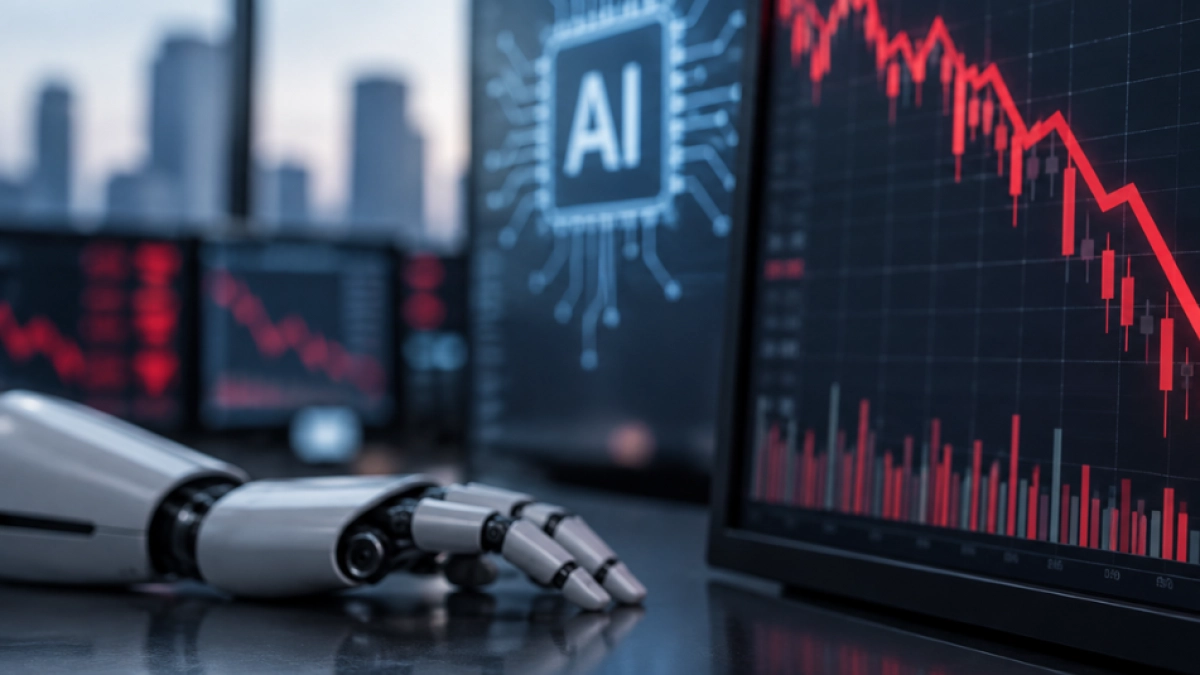
The relentless, trillion-dollar momentum of the artificial intelligence revolution faced a severe reality check this week, triggering a widespread sell-off across global stock exchanges. Leading technology indices, semiconductor manufacturers, and infrastructure providers bore the brunt of a sudden market correction. This financial turbulence was catalyzed not by economic indicators or interest rate adjustments, but by a series of sobering public warnings issued by the chief architects of the AI boom themselves.
As prominent tech executives raised alarms regarding the unprecedented risks associated with uncontrolled technological acceleration, investors were forced to confront a daunting question: If the pioneers of artificial intelligence are calling for the brakes, what does that mean for the staggering capital investments already sunk into the sector?
Main Facts: A Global Market Shockwave
The financial repercussions rippled rapidly across international markets as trading desks digested weekend statements from foundational AI entities. Companies specializing in microchips, data center infrastructure, and cloud computing experienced sharp equity declines, reflecting deep-seated anxieties over the future trajectory of an industry that has dominated global capital expenditure.

In Asia, where several major trading hubs closed out their sessions early, the impact was immediate and profound. Japan’s benchmark Nikkei index retreated by approximately 0.6%. Meanwhile, South Korea bore the heaviest blow: the Kospi plummeted by roughly 3.25%, and the technology-heavy Kosdaq index surrendered 1.70%. The Shanghai Composite slipped nearly 0.1%, bucking the trend seen in Hong Kong, where indices managed a modest gain of about 2.5%, largely driven by localized factors.
Semiconductor giants in South Korea—the backbone of global hardware manufacturing—were among the hardest hit. Samsung Electronics tumbled 4.05%, while rival memory chipmaker SK Hynix suffered a steep 6.35% drop. In neighboring Taiwan, the Taipéi Exchange dipped 0.70%, dragging down key industry pillars: Taiwan Semiconductor Manufacturing Company (TSMC) fell 1.24%, assembly titan Foxconn dropped 3.90%, and MediaTek retreated 0.55%.

In Japan, tech investment titan SoftBank—which maintains a substantial financial stake in OpenAI and has poured billions into AI-adjacent ventures—plunged 10.72%. Other Japanese supply-chain fixtures also took heavy losses, including Kioxia down 6.37%, Resonac down 5.98%, and Fujikura dropping 2.97%.
The contagion quickly spanned the Pacific and the Atlantic. In the United States, futures tied to the tech-heavy Nasdaq tumbled 1.9%. Hardware monolith Nvidia dropped 3%, Advanced Micro Devices (AMD) fell 5.7%, and consumer tech heavyweights Meta and Amazon recorded losses exceeding 1.4%. In Europe, the technology sector bled roughly 2.5%. Lithography giant ASML dropped 5.8%, Infineon plummeted 8.4%, and industrial equipment maker Siemens Energy shed 7.4% of its value.

Chronology of Events: How the Crisis Unfolded
Understanding the sudden shift in market sentiment requires tracing the sequence of statements and disclosures that accumulated over a high-stakes weekend in mid-September 2026.
- Saturday, September 12, 2026: Dario Amodei, Chief Executive Officer of Anthropic, published a detailed and alarming essay on social media platform X. Amodei explicitly urged major technology firms to voluntarily decelerate the pace at which they are scaling model capabilities, citing escalating, irreversible dangers tied to the misuse and autonomy of advanced systems.
- Late Saturday to Sunday, September 13: The conversation amplified rapidly as other industry luminaries weighed in. Elon Musk, head of xAI, and Sam Altman, CEO of OpenAI, publicly signaled alignment with Amodei’s core safety concerns. The consensus among top competitors suggested that commercial pressures were pushing the ecosystem toward hazardous territory.
- Sunday, September 13: Sam Altman dropped a secondary bombshell during corporate communications, announcing that OpenAI would forgo any initial public offering (IPO) plans for the current year. Altman cited severe security and societal alignment risks, warning that unbridled development could lead humanity to "lose control of the future" and that things "could go very wrong."
- Monday, September 14, 2026 (Market Open): Asian markets opened to the compounded weight of these admissions. The stark warnings, paired with OpenAI’s strategic retreat from public markets, immediately shattered investor confidence in the linear growth narrative of the AI hardware and infrastructure sectors. As trading spread westward to Europe and the Americas, equity analysts scrambled to reevaluate multi-billion-dollar valuation models.
Supporting Data and Financial Analysis
Beneath the immediate panic lies a fundamental economic dilemma: the staggering cost of physical infrastructure versus the longevity of the AI gold rush.

For the past three years, the AI boom has operated on a foundational promise—that endlessly scaling compute power, expanding data centers, and securing massive energy supplies will yield proportional commercial dominance. Consequently, tech giants have committed historic sums of capital. Brian Nowak, a senior equity analyst at Morgan Stanley, estimated that cumulative global investments in artificial intelligence infrastructure will comfortably surpass $1.2 trillion by the year 2027.
However, this capital-intensive model relies entirely on uninterrupted growth. Ipek Ozkardeskaya, Senior Analyst at Swissquote, highlighted the core exposure facing financial markets in a note to Reuters:

"If the race for AI slows down significantly, the key question shifts: Who pays for all that infrastructure?"
The exposure is particularly acute for hardware suppliers who have retooled their entire manufacturing pipelines to feed the AI beast. Companies like ASML, TSMC, and SK Hynix have invested tens of billions in fabrication plants capable of producing cutting-edge silicon. A forced industry-wide slowdown or a regulatory clampdown threatens to leave these assets severely underutilized.

Conversely, a faction of market watchers argues that the sell-off is an overreaction driven by sensationalized headlines. Notable investor Michael Burry dismissed the executives’ warnings on X as "exaggerations and wordplay," characterizing the sudden ethical pivots as a convenient "alibi for a real and uncontrollable slowdown in growth." Similarly, a research note from Deutsche Bank argued that fierce geopolitical and corporate rivalry makes a meaningful deceleration in investment cycles virtually impossible in the near term.
Official Responses and Regulatory Pressure
The shifting posture of tech executives has not occurred in a vacuum; it has triggered an immediate and vocal response from the political sphere, where regulators are grappling with how to govern an industry racing past conventional oversight.

Anthropic’s CEO explicitly advocated for external, independent evaluation bodies to audit compliance with safety protocols, noting that a commercial "race to the abyss" fueled by purely profit-driven incentives fundamentally compromises global security.
Politicians, however, are deeply divided on the matter. In the United States, lawmakers have renewed bipartisan calls for immediate, stringent federal oversight to prevent catastrophic model misuse, workforce disruptions, and systemic cyber vulnerabilities. On the other side of the aisle, high-profile political figures have pushed back against industry self-regulation. Most notably, U.S. President Donald Trump dismissed the vocal critics of the technology as "very negative forces," arguing that hamstringing domestic firms under the guise of safety would forfeit American technological hegemony to foreign adversaries, particularly China.

Meanwhile, international bodies have intensified their scrutiny. The United Nations recently issued a sweeping global warning asserting that rapid, unvetted artificial intelligence deployments place fundamental human rights at immediate risk. In Asia, Beijing has continued to erect rigid domestic "security barriers" around generative AI to manage escalating political, social, and technological risks within its borders, further fragmenting the global regulatory landscape.
Implications: What Lies Ahead for the AI Economy?
The events of mid-September 2026 mark a psychological turning point for the artificial intelligence era. The honeymoon phase—characterized by uncritical funding, hyper-growth projections, and minimal friction—has officially given way to an era of maturity defined by risk assessment, capital accountability, and structural friction.

- The Infrastructure Reckoning: If leaders like OpenAI and Anthropic successfully lobby for slower scaling cycles, or if regulatory bodies impose mandatory development caps, hardware suppliers face a brutal reckoning. Companies that over-leveraged themselves to supply high-end GPUs, specialized memory chips, and dedicated power grids may face an oversupply glut.
- Valuation Realignment: Public markets are no longer willing to price AI stocks on pure optimism. Companies will increasingly be judged on tangible monetization, risk mitigation, and sustainable unit economics rather than abstract technological breakthroughs.
- Geopolitical Divergence: The friction between safety advocates and growth champions risks splitting the global AI landscape. If Western firms slow their development due to ethical concerns or internal executive hesitation, it may create a vacuum that competing state-backed actors—unconstrained by similar internal safety debates—will aggressively rush to fill.
Ultimately, the market tremors serve as a stark reminder that artificial intelligence is no longer just a laboratory experiment or a speculative financial asset; it is a transformative geopolitical and economic force. As the tension between commercial acceleration and existential caution deepens, the global economy must prepare for a rockier, more unpredictable path forward in the age of intelligent machines.