The rapid, ubiquitous expansion of generative artificial intelligence has fundamentally altered the landscape of modern productivity. Tasks that once demanded hours of exhaustive searching, deep analytical processing, and creative synthesis can now be executed in seconds. Yet, this unprecedented level of digital convenience has ushered in a profound and urgent debate: What happens to human capability when individuals begin to delegate not merely repetitive chores, but core cognitive processes, critical decisions, and intellectual reasoning to machines?
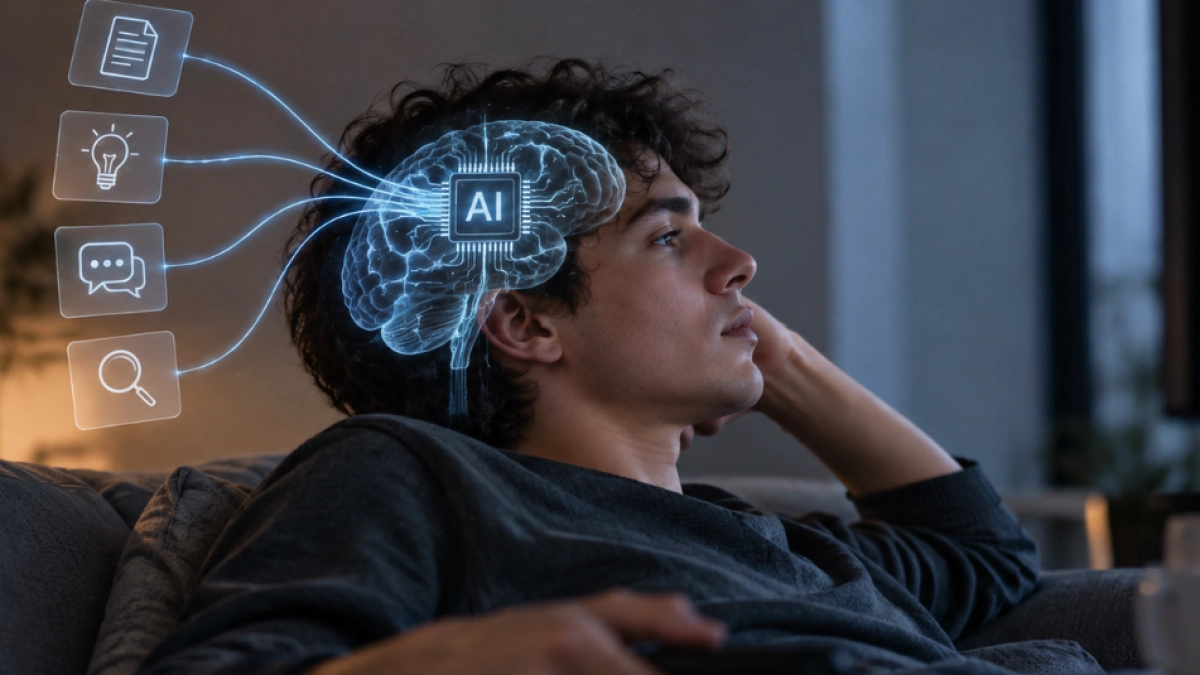
According to Belén Ortega, a prominent business leader and artificial intelligence specialist, this widespread abdication of mental effort introduces a silent yet severe hazard known as "cognitive atrophy." Drawing a parallel to physical deconditioning, Ortega argues that just as the human body loses muscle tone and endurance when deprived of movement, intellectual faculties weaken when a technological tool perpetually assumes the burden of thinking, remembering, creating, problem-solving, and formulating ideas.
"If you outsource your judgment to artificial intelligence, you fall into cognitive atrophy," Ortega warned during a recent interview discussing the release of her new book, Human/IA. La IA tiene alma y es el ser humano (Human/AI. AI has a soul and it is the human being), presented at the Paseo La Plaza.
Main Facts
The core debate surrounding generative artificial intelligence centers on the friction between operational efficiency and the degradation of critical thinking skills. As algorithms grow more sophisticated, the line between helpful technological augmentation and psychological dependency continues to blur.
The Core Phenomenon: "Cognitive atrophy" describes the gradual loss of mental agility resulting from the continuous outsourcing of memory, creativity, critical thinking, and problem-solving to AI systems.
The Societal Risk: Specialists warn that reliance on automated decision-making risks creating a new socio-intellectual divide, segregating populations not merely by economic status, but by independent cognitive capability.
The Strategic Boundary: Experts advocate for a clear separation of duties—delegating routine, repetitive tasks to machines while fiercely protecting human-led strategy, emotional intelligence, and ultimate decision-making authority.
Methodological Safeguards: To counteract systemic errors, hallucinations, and homogenization, users must employ rigorous prompt engineering—specifically commanding models not to invent facts and to ask clarifying questions before generating solutions.
Chronology of a Paradigm Shift: From Search Engines to Autonomous Reasoners
To understand how modern society arrived at the threshold of cognitive dependency, it is necessary to examine the evolutionary timeline of human-computer interaction over the past two decades.
The Information Age (Early 2000s): Search engines like Google democratized information access. While they accelerated retrieval times, users still bore the primary responsibility of filtering, analyzing, and synthesizing raw data into coherent ideas.
The Rise of Automation (2010s): Machine learning began streamlining logistics, data entry, and predictive text. Automation primarily targeted physical and routine administrative workflows, leaving white-collar critical thinking largely untouched.
The Generative Boom (2022–2024): The advent of large language models (LLMs) and diffusion generators shifted the technological paradigm from retrieval to generation. AI began writing essays, coding software, drafting legal briefs, and painting art.
The Homogenization Warnings (2024): Academic studies, including a notable 2024 collaborative research effort linked to the University of Toronto, began documenting the darker side of generative tools. Researchers revealed that heavy reliance on LLMs yields statistically more homogenous outputs, stifling independent thought and narrowing creative variance.
The Arrival of the Cognitive Atrophy Discourse (2025–2026): Thought leaders like Belén Ortega formally introduced frameworks addressing the psychological toll of AI reliance. Books, public forums, and policy discussions began focusing less on what AI can do for us, and more on what it causes us to stop doing ourselves.
Supporting Data and Academic Insights: The Threat of Homogenized Thought
The anxiety surrounding an over-reliance on artificial intelligence is grounded in emerging empirical research. The 2024 University of Toronto-linked study investigating the intersection of large language models, human creativity, and idea diversity provided a sobering empirical foundation for these concerns.
While the data confirmed that participants utilizing AI achieved immediate boosts in output volume and operational speed, the long-term qualitative metrics revealed a troubling trade-off. The ideas generated by users heavily reliant on AI tended toward ideological and creative convergence—meaning responses became standardized, predictable, and devoid of the erratic, idiosyncratic sparks that characterize genuine human innovation.
Furthermore, Ortega’s thesis expands upon these academic findings by introducing the socio-economic dimension of intellectual stratification. She cautions that the future may not simply pit the wealthy against the impoverished, but rather divide society along intellectual lines.
"The issue is that we are going to have an upper and a lower class, not only economically, but also intellectually," Ortega emphasized.
Those who maintain rigorous intellectual hygiene—deliberately choosing to read, write, calculate, and philosophize without machine mediation—will widen the gap between themselves and individuals who allow automated systems to atrophy their problem-solving capacities.
Official Responses and Expert Recommendations: Navigating the AI Era
Faced with the prospect of systemic intellectual decline, technology ethicists, business leaders, and educators are scrambling to establish frameworks for responsible interaction. Rather than endorsing a Luddite rejection of technology, experts advocate for deliberate boundaries.
1. Differentiating Task Allocation
Ortega stresses the importance of drawing a strict demarcation line based on the nature of the task:
Delegate to AI: Repetitive, operational, data-heavy, and mechanical chores where human emotional investment is absent.
Retain Human Control: Any task involving strategic foresight, ethical dilemmas, human relationships, or critical judgment.
The Steering Metaphor:"The rudder of life is held by oneself. We cannot delegate command to artificial intelligence, because it makes disasters; it crashes the ship," Ortega asserts.
2. Cultivating Intellectual Discipline
Developing personal criteria must become a daily habit. Users should regularly audit their workflow to assess how often they resort to automated solutions versus tackling problems independently. Because there is no universal metric for acceptable AI usage, every professional and student must calibrate their reliance based on personal growth goals.
3. Advanced Prompt Engineering as a Safeguard
To minimize errors, biases, and the notorious "hallucinations" common in generative models, users must shift from passive consumers to active directors. Ortega recommends enforcing two strict conversational rules when interacting with an AI model:
Explicitly command the system: "Do not invent facts."
Require the model to query the user: "Ask me two or three necessary questions to properly fulfill your role."
By forcing the AI to seek context and acknowledge its knowledge boundaries, users prevent themselves from blindly accepting the first generated output as absolute truth. Continuous human supervision, active questioning, and rigorous editing remain non-negotiable skills.
Implications for the Future of Work and Education
As automation deepens its roots across global industries, the traditional portfolio of marketable job skills is undergoing a radical transformation. Routine technical proficiency is rapidly depreciating in value, displaced entirely by machine execution.
Consequently, human-centric competencies are taking center stage:
Strategic Communication: The ability to articulate complex visions, inspire teams, and negotiate delicate human dynamics.
Critical Thinking: The capacity to dissect arguments, spot logical fallacies, and evaluate the veracity of automated insights.
Creative Synthesis: Connecting disparate, non-linear concepts in ways that algorithms—which rely on historical probability datasets—cannot replicate.
Supervisory Governance: Managing, auditing, and correcting autonomous systems to ensure ethical and accurate outcomes.
Ultimately, the future does not demand a futile war between human intelligence and artificial intelligence. Rather, it requires a sophisticated synthesis. As Ortega advises, individuals must organize technological tools hierarchically—deploying basic assistants for daily logistics, secondary systems for execution, and maintaining absolute sovereignty over strategic design.
The survival of human ingenuity depends not on hiding from technology, but on ensuring that in building smarter machines, we do not forget how to think for ourselves.
Disclaimer: This content was generated with the assistance of artificial intelligence, based on publicly available information released to media outlets. It underwent rigorous review by reporting staff and an expert editor.
By Daniel Otero (Head of Editorial, Revista Motor) Published: September 11, 2026 The scope and effectiveness of automotive technology are historically measured by its democratization—how quickly features once reserved for ultra-luxury flagships cascade down to…
The release of Spider-Man: Brand New Day has not only dominated the global box office but has also triggered a massive cultural ripple effect in the digital realm. As fans of the Marvel Cinematic Universe…
In an era defined by constant connectivity, the boundary between engagement and addiction has become increasingly blurred. If you find yourself mindlessly scrolling through your phone in the bathroom, during your commute, or long after…