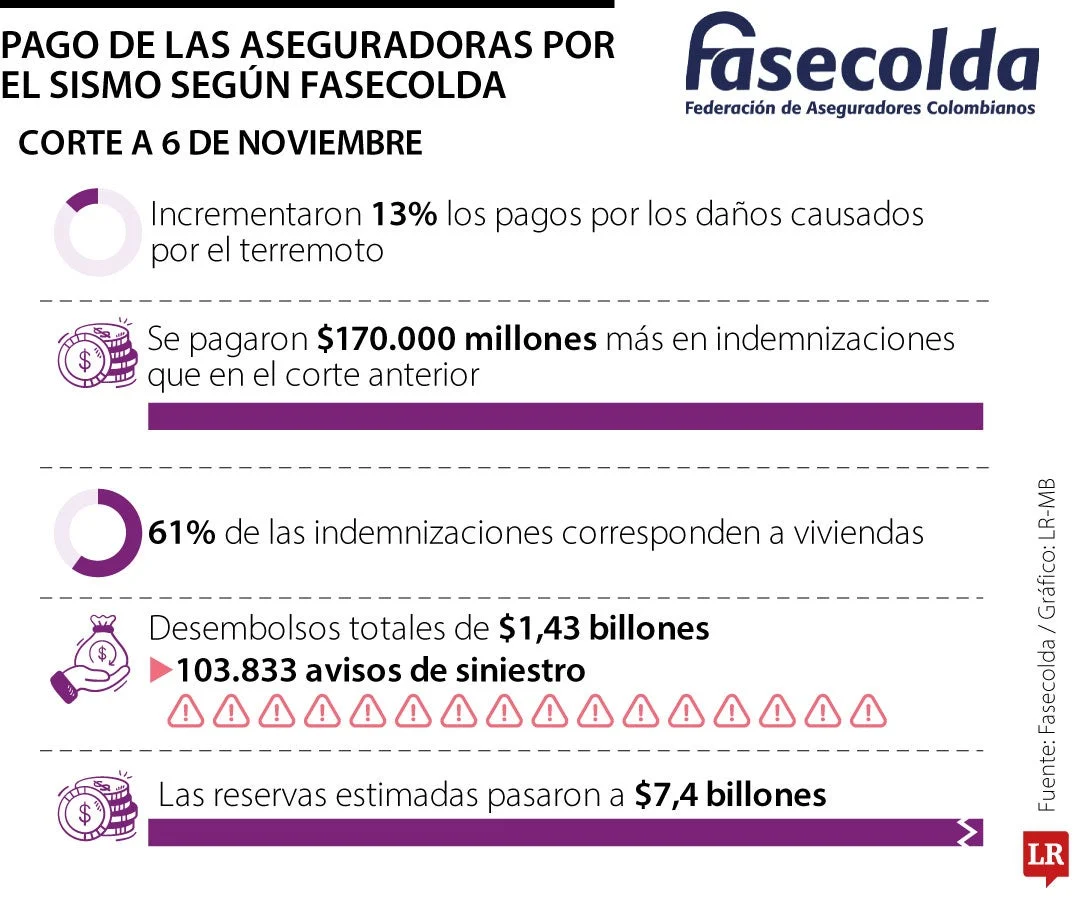
BOGOTÁ — More than three months after a powerful seismic event rocked the nation in August, the country’s insurance sector continues to grapple with the massive logistical and financial undertaking of restoring stability to affected communities. According to the latest data released by the Federación de Aseguradores Colombianos (Fasecolda) in its 13th official report, total insurance disbursements to policyholders have reached an impressive $1.43 trillion (pesos) as of November 6.
The figures underline a dual reality for the insurance industry: while payouts are accelerating rapidly to meet the immediate needs of citizens and businesses, the total volume of claims continues to expand, pushing the necessary reserves for pending claims up to $7.4 trillion—a 3.7% increase compared to previous evaluations. This comprehensive report breaks down the financial trajectory, geographical impact, sectoral distribution, and official directives governing one of the most significant disaster-recovery operations in recent memory.
1. Main Facts and Executive Summary
The aftermath of the August earthquake has triggered an unprecedented wave of insurance activity across the country. As of the November 6 cutoff date, the core metrics defining the catastrophe’s footprint and the insurance sector’s response include:
- Total Disbursements: Insurance companies have successfully distributed $1.43 trillion in indemnifications to affected policyholders, representing an overall increase of approximately 13% in paid claims compared to the prior reporting cycle.
- Surging Claims Volume: The total number of reported claims has risen to 103,833, marking an increase of 910 new notices during the first week of November alone.
- Geographic Spread: The disaster’s reach is extensive, with damages officially registered across 31 departments and 524 municipalities.
- Escalating Reserves: To cover future and pending claims, the total value of necessary technical reserves has grown by 3.7%, reaching $7.4 trillion.
- Weekly Payout Velocity: During the first week of November alone, insurers disbursed $170,000 million in indemnifications, reflecting a 13.5% acceleration in payout velocity.
- Property vs. Life Sectors: The vast majority of claims are concentrated in property insurance—specifically housing, commerce, industry, and co-properties—while the Life and Persons sector has recorded 309 specific claims totaling $4.563 billion.
2. Chronology of the Crisis and Operational Response
To understand the current state of disaster recovery, it is essential to trace the timeline of events from the moment the earth shook in August to the systematic rollout of insurance indemnifications captured in Fasecolda’s 13th report.
The Immediate Aftermath (August)
When the seismic event struck in August, its initial impact caught both citizens and infrastructure off guard. Tremors were felt across a vast swath of the country, immediately generating tens of thousands of emergency calls to local authorities, disaster relief agencies, and insurance carriers. In the first few days following the catastrophe, insurance companies activated emergency protocols, deploying catastrophe adjusters and establishing mobile claims units in the hardest-hit regions.
Scaling Up Operations (September–October)
During the second and third months, the sheer volume of destruction became fully apparent. Insurers faced a bottleneck of inspections as thousands of property owners reported structural cracks, compromised foundations, and commercial disruptions. Fasecolda reports indicate that during this phase, insurers focused heavily on triage—prioritizing habitable safety assessments, temporary housing provisions for displaced families, and emergency business interruption disbursements to keep local economies afloat.
Acceleration and Current Status (November)
By the time the November 6 cutoff rolled around, the claims management process had shifted into a high-efficiency phase. The 13th report highlights a noticeable acceleration in payout speed, evidenced by the $170,000 million distributed during the first week of November alone. Insurers have transitioned from initial damage assessment to mass liquidations, though the arrival of 910 new claims during this same week demonstrates that property owners are still discovering latent structural damages or processing delayed paperwork.
3. Supporting Data and Sectoral Breakdown
The financial architecture of the earthquake recovery involves complex allocations across multiple asset classes and economic sectors. Fasecolda’s data provides a granular view of where the money is going and which segments of the economy are bearing the brunt of the financial impact.
Property, Commerce, and Industrial Sectors
When measured by the type of asset affected, property-related insurance—encompassing residential homes, commercial enterprises, industrial facilities, and co-properties—has accounted for a staggering $1.39 trillion in total disbursements, spread across 99,950 individual claims.
- Residential Housing: Housing represents the single largest volume of claims. Out of the total disaster notices, 64,109 involve insured residential properties, accounting for a commanding 61% of all reported claims. This highlights the high vulnerability of domestic dwellings and underscores the critical importance of home insurance in earthquake-prone zones.
- Commercial and SME Sector: Small and medium-sized enterprises (SMEs) along with commercial establishments have received cumulative payouts close to $561 billion. More importantly, this sector accounts for outstanding technical reserves exceeding $4.1 trillion, reflecting the high replacement and repair costs associated with commercial inventory, machinery, and business structures.
- Co-properties (Propiedad Horizontal): Multi-family residential complexes and shared commercial buildings have secured substantial relief, with co-properties receiving aggregate payouts totaling $327.400 million. Given the dense population living in apartment complexes across the affected regions, restoring common areas and structural facades has been a primary operational focus.
The Life and Persons Sector
While property damage dominates the headline figures, the human toll and personal insurance claims are equally critical. The Life and Persons sector recorded 309 distinct claims, resulting in payouts totaling up to $4.563 billion—representing roughly 58% of the total evaluated value for life-related claims in this context.
A closer examination of the life insurance segment reveals that fatalities accounted for 51.6% of all claims within this category. This tragic statistic emphasizes that while property can be rebuilt or repaired, the loss of human life remains an irreplaceable cost of major natural disasters, cushioned only partially by the financial safety nets provided by life policies.
4. Regional Impact Analysis
The geographic distribution of the earthquake’s destruction is highly uneven, concentrating the heaviest financial commitments and payouts in specific departments. Fasecolda’s regional breakdown illustrates stark contrasts in how different parts of the country experienced and recovered from the seismic shock.
Quindío: The Epicenter of Payouts
Quindío emerged as the region receiving the highest proportion of damage compensation, accounting for 26% of all payouts nationwide. Historically sensitive to seismic activity, the department’s infrastructure suffered widespread impacts, prompting insurance companies to fast-track evaluations and liquidations in the area to prevent regional economic collapse.
Risaralda and Valle del Cauca: Heavy Commitments
- Risaralda: This department commands 19% of the current insurance payments, placing it second in terms of active financial relief. Commercial and residential zones in Risaralda experienced significant structural stress, requiring extensive engineering assessments.
- Valle del Cauca: Representing 13% of current payments, Valle del Cauca contributes heavily to the overall financial volume. Given its dense industrial footprint and major urban centers, claims here often involve high-value commercial properties and complex supply chain interruptions.
Combined, these three regions—Quindío, Risaralda, and Valle del Cauca—account for more than half of the total payout distribution, illustrating a clear western-central geographic concentration of the disaster’s severity.
5. Official Responses and Industry Guidelines
Amid the ongoing distribution of trillions of pesos, industry leadership has stepped forward to guide policyholders through the bureaucratic and operational hurdles of disaster recovery. Gustavo Morales, Executive President of Fasecolda, issued a series of critical recommendations and warnings to ensure that citizens are protected from predatory practices while maximizing their legitimate insurance recoveries.
The Role of the Policyholder
Mr. Morales emphasized that the most effective path to a successful claim lies in direct, proactive communication between the insured party and their insurance company or licensed broker.
"The role of the insured in this catastrophe is to be in direct contact with their insurance company or intermediary, because every case is different," stated Morales. "Be attentive to the documentation and information requested by your insurer: delivering it on time is the key to advancing your claim."
A Strong Warning Against Fraudulent Intermediaries
One of the most pressing concerns highlighted by Fasecolda leadership is the emergence of predatory third-party actors attempting to exploit distressed citizens. Morales issued a stark warning regarding unauthorized fixers and fraudulent claims adjusters:
"And be very careful with those who charge you to process this paperwork or promise you a higher indemnification. Do not be fooled: filing a claim is entirely free, and you do not need to hire third-party intermediaries."
This official stance aims to shield vulnerable policyholders—many of whom are dealing with the trauma of property loss—from losing a percentage of their legitimate payouts to unscrupulous agents or legal chicanery. Insurers have reiterated that their internal claims departments are fully equipped to handle submissions directly without requiring paid outside assistance.
6. Implications for the Future of Insurance and National Resilience
As Colombia continues to navigate the long-term recovery phase following the August earthquake, the unfolding events carry profound implications for the national insurance market, regulatory bodies, and public policy regarding disaster preparedness.
1. Pressure on Technical Reserves and Reinsurance
With total necessary reserves expanding to $7.4 trillion, insurance companies are closely monitoring their capital adequacy and reinsurance backing. While the sector remains robust and solvent, catastrophic events of this magnitude test the risk-modeling capabilities of underwriters. It is anticipated that property insurance premiums in seismic-prone zones may see upward pressure in upcoming renewal cycles as reinsurers reevaluate the country’s risk profile.
2. Underinsurance and the Protection Gap
The massive concentration of residential claims (61% of all notices) brings to light the ongoing challenge of the "protection gap"—the difference between the actual value of property and the amount for which it is insured. While formal policyholders are receiving vital relief, many homes and small businesses in Colombia remain completely uninsured or underinsured, forcing government bodies to shoulder the burden of unrecovered public infrastructure and impoverished households.
3. Streamlining Digital Claims Processing
The speed at which insurers distributed $170,000 million during the first week of November demonstrates the increasing adoption of digital tools, remote damage appraisals, and expedited payment gateways. Moving forward, the insurance industry is expected to invest heavily in technological infrastructure that allows for instantaneous claims triage during natural disasters, minimizing administrative delays and reducing the friction between policyholders and carriers.
Conclusion
The August earthquake stands as a sobering reminder of Colombia’s vulnerability to seismic activity. However, the coordinated response of the insurance sector—marked by $1.43 trillion in payouts, proactive guidance from Fasecolda, and steady cooperation from policyholders—demonstrates the vital economic cushion that insurance provides in times of national crisis. As the remaining $7.4 trillion in reserves is deployed over the coming months, the focus will remain on transparent processing, fraud prevention, and building a more resilient built environment for the future.