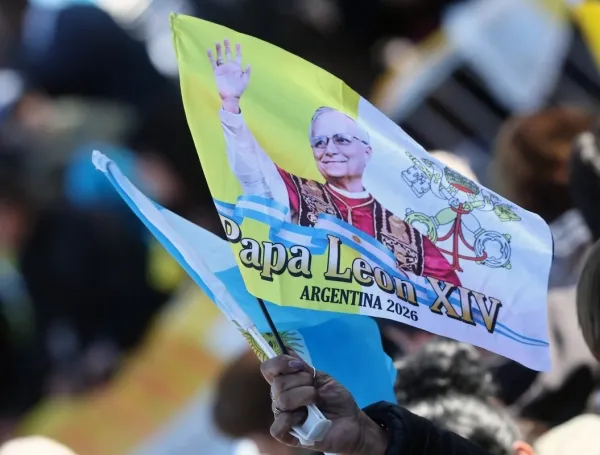
BUENOS AIRES — In an event charged with profound emotional and spiritual significance, Pope Leo XIV touched down on Argentine soil this Sunday, marking the dawn of the first papal visit to the South American nation in nearly four decades.
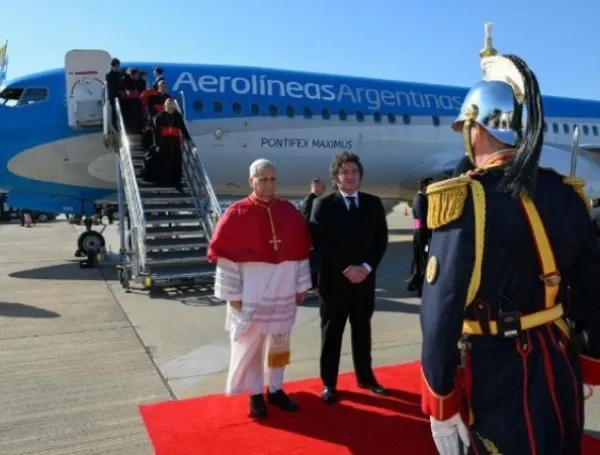
Aversion to long-standing travel hiatuses and intense geopolitical anticipation culminated at precisely 4:34 p.m. local time, when the Boeing 737 MAX 8 of Aerolíneas Argentinas, carrying the pontiff from neighboring Uruguay, glided onto the tarmac at the Jorge Newbery Airport in Buenos Aires.
The arrival was met with an immediate, thunderous outpouring of joy across the capital: the simultaneous repique (pealing) of church bells rang out from every corner of the city, welcoming the supreme pontiff under the official journey motto: “Welcome everyone: go and announce.”
This momentous visit breaks a nearly 40-year papal drought in Argentina, echoing back to the historic 1987 journey undertaken by Pope John Paul II. For a nation grappling with profound economic transformations, social shifts, and deep-seated political polarization, the arrival of Pope Leo XIV has served as a momentary pause for collective reflection and national unity.
Main Facts of the Papal Arrival
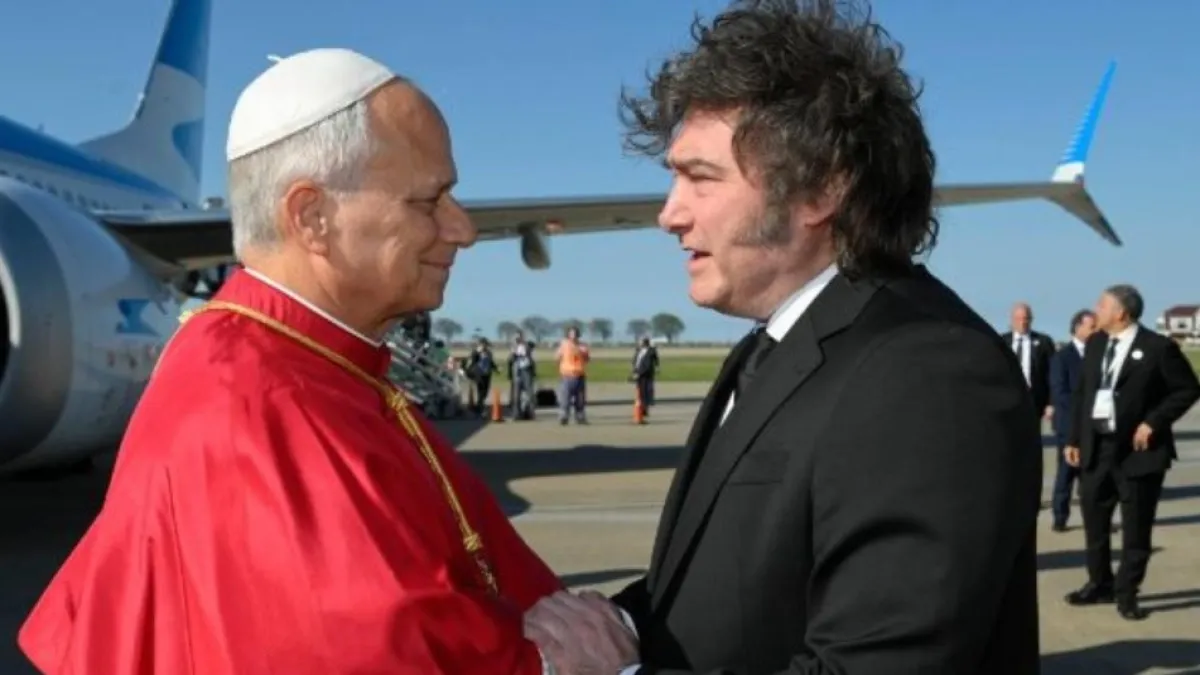
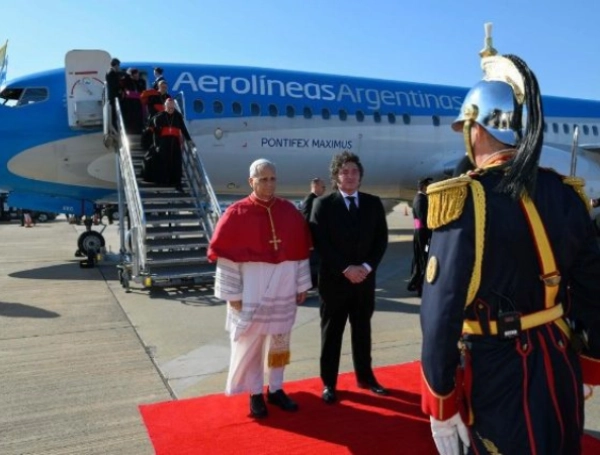
The meticulous choreography of the papal welcome unfolded under tight security and immense media scrutiny. Upon stepping off the aircraft, Pope Leo XIV was greeted directly on the tarmac by Argentine President Javier Milei.
The official reception party was framed by a solemn military guard of honor and featured prominent members of the executive branch, including the Secretary General of the Presidency, Karina Milei. The handshake between the libertarian president and the head of the Catholic Church set an initial tone of institutional respect and guarded optimism, bridging ideological lines for the sake of the high-profile state visit.
Date of Arrival: Sunday, November 8, 2026.
Point of Origin: Uruguay.
Landing Site: Jorge Newbery Airport, Buenos Aires (Aeroparque).
Aircraft: Boeing 737 MAX 8 (Aerolíneas Argentinas).
Duration of Visit: Four days (Sunday through Wednesday).
Key Historical Context: First papal visit to Argentina since John Paul II in 1987.
Official Slogan: “Bienvenidos todos: vayan y anuncien” (Welcome everyone: go and announce).
Following the initial tarmac greetings, the pontiff’s motorcade launched directly into a relentless, high-intensity schedule designed to maximize his engagement with both civil authorities and the faithful across multiple provinces.
Chronology of the Apostolic Itinerary
Spanning four days, the itinerary combines high-level state diplomacy, grassroots pastoral outreach, and massive public liturgies.
Sunday, November 8: Protocols and Civic Engagement in Buenos Aires
The first day was heavily anchored in the political heart of Argentina. Following his arrival, Pope Leo XIV traveled to the Plaza San Martín to lay a floral wreath at the monument honoring General José de San Martín, the legendary hero of South American independence.
From there, the pontiff moved to the Casa Rosada, the executive seat of government, for a closed-door bilateral meeting with President Javier Milei. The dialogue addressed institutional cooperation, poverty alleviation, and social cohesion.
Later in the afternoon, the Mayor of Buenos Aires formally presented the pontiff with the keys to the city. The first day concluded at the Palacio Libertad, where Leo XIV addressed an assembly of civil society representatives and the resident diplomatic corps, emphasizing the Church’s commitment to dialogue and the common good.
Monday, November 9: Reaching the Margins and Mass Liturgies
Shifting from statecraft to profound pastoral ministry, Monday began with a deeply symbolic journey to the periphery of Greater Buenos Aires. The Pope visited the Cottolengo Don Orione, a specialized residential care facility for individuals with severe disabilities located in Claypole, situated 25 kilometers south of the capital. There, he offered private blessings and comfort to residents, caregivers, and health workers.
Returning to the capital, Leo XIV presided over a massive open-air holy mass at the iconic Monumento de los Españoles, drawing hundreds of thousands of pilgrims. The remainder of Monday afternoon featured targeted sectoral meetings with leaders from the labor movement, interfaith representatives, and the full assembly of the Argentine Episcopal Conference (Conferencia Episcopal Argentina).
Tuesday, November 10: Pilgrimage to Córdoba
On Tuesday, the apostolic journey expanded beyond the capital region as the Pope flew 700 kilometers north to Córdoba, Argentina’s second most populous city and a historic hub of education, culture, and religious heritage.
In Córdoba, Leo XIV celebrated a public open-air mass for the faithful of central Argentina and convened a closed regional pastoral assembly with local priests, seminarians, and consecrated religious to discuss the challenges of evangelization in modern Latin America.
Wednesday, November 11: Final Blessing at Luján
The intensive four-day visit culminates on Wednesday with a final, deeply emotional pilgrimage to the Basilica of Our Lady of Luján (Nuestra Señora de Luján), located 70 kilometers west of Buenos Aires. As the spiritual heartland of Argentine Marian devotion, the basilica serves as the fitting backdrop for the final mass and farewell ceremonies before the pontiff concludes his official agenda and departs South America.
Supporting Data and Institutional Framework
The sheer logistical scale of organizing a papal tour of this magnitude requires unprecedented coordination between the Holy See’s Secretariat of State, the Argentine federal government, provincial governors, and municipal security forces.
Distance Traveled Domestically: Over 1,500 cumulative air and ground kilometers across Buenos Aires, Claypole, Córdoba, and Luján.
Security Personnel Deployed: More than 12,000 federal police, gendarmerie, and local security officers guarding motorcade routes and mass gathering sites.
Accredited Media: Over 1,800 local and international journalists registered to cover the historic itinerary.
Public Attendance Estimates: Projected cumulative attendance exceeding 1.5 million people across the various open-air masses and public addresses.
The Vatican press office confirmed that the choice of destinations—spanning marginalized care facilities, historic monuments, industrial labor sectors, and traditional shrines—was deliberately crafted to mirror Pope Leo XIV’s pastoral philosophy of "a church that goes forth" to the edges of society.
Official Responses and Political Reactions
The visit has naturally elicited broad political and social commentary across Argentina, framing the interaction between the Vatican and President Javier Milei’s administration as a delicate dance of diplomacy.
President Milei, whose early administration clashed philosophically with traditional social-democratic currents often associated with Catholic social teaching, adopted a highly respectful and cooperative tone during the welcoming ceremony. Government insiders noted that the administration viewed the visit as an essential validation of national stability on the international stage.
"We are profoundly honored to receive the Holy Father after nearly four decades," stated a brief press release issued by the Casa Rosada following the bilateral talks. "This historic encounter underscores our shared commitment to human dignity, institutional stability, and the overcoming of historical divisions."
Meanwhile, civil society organizations, labor unions, and human rights groups have expressed cautious optimism that the Pope’s presence will draw renewed national attention to persistent poverty rates, inflation pressures, and the social safety net.
Church leadership in Argentina has sought to depoliticize the visit, emphasizing that the primary objective is spiritual renewal rather than political mediation. Archbishop of Buenos Aires and key organizers reiterated during pre-arrival briefings that the core message of the journey is reconciliation, urging citizens of all political stripes to use the historic moment to bridge ideological chasms.
Implications for Argentina and the Region
The arrival of Pope Leo XIV carries significant geopolitical, cultural, and spiritual implications that will reverberate long after the papal aircraft departs for Rome on Wednesday evening.
1. Social Cohesion and National Healing
For a country historically prone to fierce political tribalism—colloquialized as la grieta—the papal visit serves as a rare unifying cultural event. The simultaneous ringing of church bells and the massive turnout at the Monumento de los Españoles demonstrate a deep-seated public appetite for unity, peace, and spiritual solidarity that transcends partisan lines.
2. Dialogue Between Faith and Libertarian Economics
The direct engagements between Pope Leo XIV and President Javier Milei represent a fascinating intellectual and moral dialogue. While Milei champions radical free-market libertarianism, the Church continues to advocate for distributive justice, state responsibility toward the vulnerable, and labor rights. Observers suggest that the private dialogues in the Casa Rosada established an important framework for ongoing engagement between the Argentine state and ecclesiastical social structures.
3. Pastoral Reinvigoration of the Local Church
With Argentina having gone nearly 40 years without a direct papal visit, generations of younger Catholics had only experienced the papacy through media broadcasts or international youth days. This physical presence provides a monumental morale boost to local parishes, seminaries, charitable foundations, and volunteer networks, revitalizing grassroots community work across the country.
As the bells of Buenos Aires faded into the Sunday evening air and the pontiff’s motorcade navigated the historic streets toward the Nunciature, it was abundantly clear that these four days will be etched permanently into the modern historical consciousness of Argentina. Whether measured in geopolitical terms or through the quiet grace of individual encounters at facilities like the Cottolengo Don Orione, the visit of Pope Leo XIV has already redefined the national conversation.
By Global News Desk Updated: September 17, 2026 Main Facts The diplomatic relationship between the United States and Colombia has entered a markedly different phase, characterized by heightened cooperation, renewed security measures, and robust financial…
BUENOS AIRES — In what official Vatican and local organizers have described as the most multitudinous mass of his pontificate thus far, Pope León XIV addressed an estimated two million faithful gathered at the iconic…
Asunción, Paraguay — In a seismic political earthquake that has upended the highest echelons of power in South America, the Public Ministry of Paraguay formally charged former President Santiago Peña on Saturday. The dramatic move…