By Science Desk | July 17, 2026
For decades, the global scientific community has operated under a reassuring assumption: that there exists a "ceiling" to how severely the Earth’s atmosphere reacts to the volatile energy emanating from the Sun. This belief suggested that even in the event of an extreme solar storm, our planet’s magnetic shield would eventually saturate, preventing the most catastrophic impacts on our modern, interconnected infrastructure.
However, a groundbreaking study from the University of Lancaster, published in the journal Nature, has shattered this consensus. Researchers now warn that the supposed limit on solar-terrestrial interaction is likely an illusion—a byproduct of flawed measurement techniques. The implications are stark: our global technology, from power grids to GPS navigation, may be significantly more vulnerable to extreme space weather than previously estimated.
The Nature of the Threat: Understanding Solar-Terrestrial Dynamics
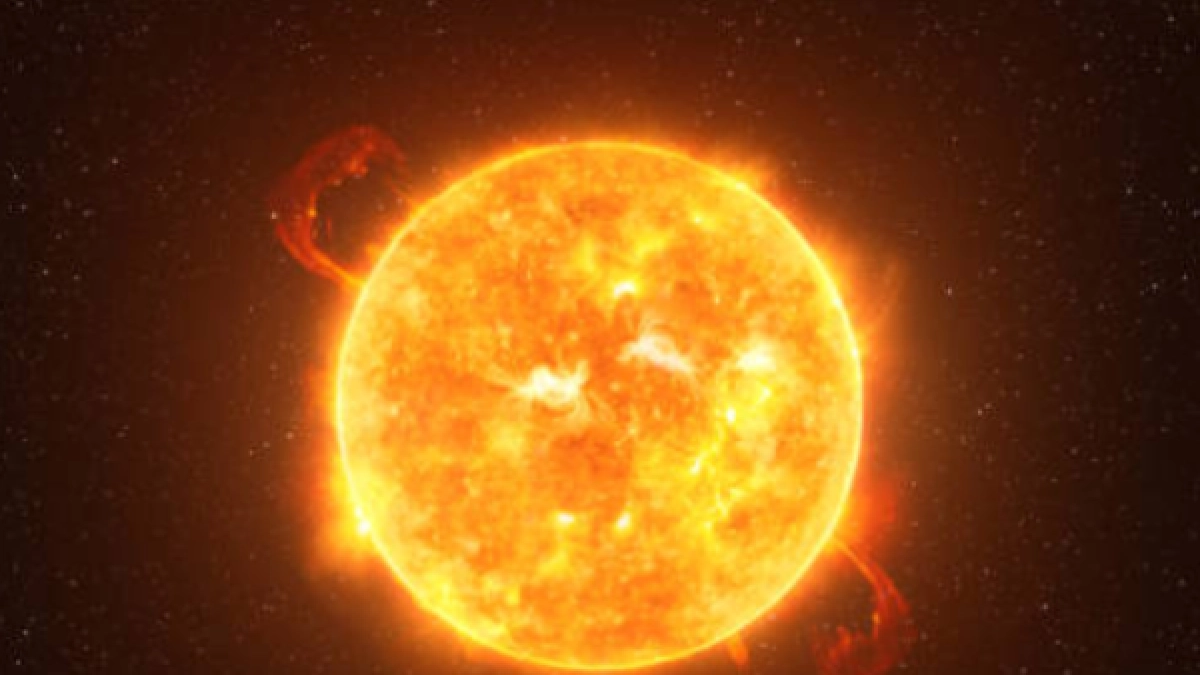
Space weather is not merely a scientific curiosity; it is a critical variable in the stability of 21st-century civilization. It is driven by fluctuations in electrical fields within Earth’s magnetosphere and upper atmosphere, often triggered by solar flares and coronal mass ejections (CMEs).
When these solar phenomena strike the Earth’s magnetic field, they cause geomagnetic storms—temporary, violent disturbances in the plasma environment surrounding our planet. These storms can induce powerful electrical currents in the upper atmosphere, which, in turn, can wreak havoc on terrestrial systems.
The Mechanism of Disruption
- Satellite Interference: High-energy particles can cause satellite drag, forcing them to deviate from their orbits or, in extreme cases, causing them to re-enter the atmosphere prematurely.
- Communication Blackouts: Ionospheric disturbances often lead to signal degradation or total loss of connectivity for radio, mobile telephony, and GPS systems.
- Power Grid Failures: Intense geomagnetically induced currents (GICs) can flow through long-distance power lines, potentially overloading transformers and leading to massive, multi-regional blackouts.
- Radiation Exposure: Pilots and astronauts operating at high altitudes or in space face elevated radiation risks during these periods of intense solar activity.
Chronology of a Misconception: Why We Got It Wrong
The belief that Earth possessed a "safety buffer" against solar storms originated from decades of data collected at the L1 (Lagrange Point 1). Located approximately one million miles closer to the Sun than Earth, the L1 point is the standard location for space weather monitoring satellites.

The Statistical Illusion
For years, scientists observed a pattern: as the intensity of the solar wind increased, the electrical currents in the upper atmosphere would increase up to a certain point, after which they would plateau. Researchers interpreted this as a physical limit of the Earth’s response.
However, the team at the University of Lancaster, led by Maria Walach, argues that this plateau is a statistical mirage. Their research suggests that the "limit" is a result of regression to the mean.
- The L1 Discrepancy: The solar wind measured at the L1 point often weakens by the time it reaches Earth due to natural expansion and cooling in the vacuum of space.
- The Averaging Effect: When scientists averaged the data from thousands of solar events, the intensity of the solar wind arriving at Earth appeared lower than what was initially measured at L1, creating the false impression that the Earth’s atmosphere was "capping" the response.
- The Reality Check: By utilizing over a million data points collected by NASA spacecraft in orbit directly around Earth, the researchers identified a direct, linear relationship between solar wind intensity and atmospheric current strength. There is no plateau. The stronger the solar wind, the stronger the impact on our atmosphere—period.
Supporting Data: Evidence from Earth’s Orbit
The strength of the Lancaster study lies in its reliance on localized, high-fidelity data. By moving the focus from the L1 point to the immediate vicinity of Earth, the researchers were able to observe the true "coupling" between the Sun’s energy and our magnetic field.

- Linear Correlation: The findings demonstrate that the ionosphere and magnetosphere do not "saturate." Instead, they respond proportionally to the energy input.
- High-Energy Events: While "1-in-1,000-year" events are rare, the data suggests that our current risk models—which are used to harden infrastructure against solar storms—may be fundamentally underestimating the magnitude of the potential damage.
- Data Reliability: The study’s use of massive datasets from orbiting NASA assets provides a high degree of confidence, suggesting that previous models were based on a flawed premise rather than physical reality.
Official Responses and Scientific Context
The scientific community has reacted to these findings with a mix of urgency and calls for further research. While the study does not suggest an immediate, doomsday scenario, it does highlight a critical gap in our planetary defense strategy.
The Expert View
"The magnetic field of our planet protects us effectively against many effects of space weather," explains Dr. Maria Walach. "However, in extreme cases, we see satellites fall unexpectedly or lose communication. If there is no upper limit to our planet’s response, we must revise our extreme-event models immediately."
Other space weather experts note that while we have grown more dependent on space-based technology, we have also become better at monitoring the Sun. The challenge, however, is that "knowing" a storm is coming is only half the battle. If the impact is stronger than our infrastructure is designed to withstand, early warning systems may only serve to track the onset of a disaster rather than prevent it.

Implications for Global Technology
The findings have profound consequences for industries that rely on space-based or long-line terrestrial infrastructure.
1. The Energy Sector
Modern power grids are highly susceptible to GICs. If extreme storms produce currents far exceeding current safety designs, the risk of "cascading failures"—where one transformer blow-out triggers a chain reaction across the grid—is much higher than previously estimated. Governments and utility companies may need to accelerate the installation of surge protection and grid-hardening technologies.
2. Telecommunications and Global Positioning
The world economy runs on precision timing provided by GPS satellites. If a solar storm creates a higher-than-expected level of atmospheric turbulence, the degradation of GPS accuracy could disrupt everything from automated shipping and aviation to banking transactions and mobile networks.

3. Policy and Future Planning
The study highlights that we are essentially operating in a "data desert" regarding extreme events. Because these occurrences are so rare, we lack the empirical evidence to know exactly how a worst-case scenario would unfold. The consensus is shifting toward the need for more robust, redundant systems that can handle "black swan" space weather events.
Looking Forward: A Call for Resiliency
As we continue to launch thousands of satellites into low-Earth orbit and expand our dependency on digital infrastructure, the "invisible threat" of space weather is becoming increasingly tangible. The Lancaster study serves as a necessary wake-up call for engineers, policymakers, and space agencies.
The realization that there is no natural "ceiling" to solar-terrestrial interaction means that the burden of safety now rests entirely on human innovation. We can no longer rely on the assumption that nature will limit the damage. Instead, we must design for the extremes.

"We have to be prepared," says Walach. "These events are infrequent, but the history of our planet shows that they do happen. Understanding that the potential for impact is greater than we thought is the first step toward building a more resilient technological civilization."
As we look toward the future, the integration of real-time, high-accuracy space weather monitoring into global infrastructure management will no longer be an elective upgrade—it will be a prerequisite for the survival of the modern age.