BOGOTÁ — As Colombia’s financial sector navigates a complex macroeconomic landscape marked by shifting interest rates and evolving credit risks, the nation’s banking system finds itself under the intense scrutiny of investors and regulators. The current financial season—highlighted by third-quarter earnings reports from key institutions—paints a nuanced picture of resilience, cautious optimism, and persistent structural headwinds.
Amid these corporate disclosures, the central bank, Banco de la República, has released forward-looking projections that point toward a generalized recovery in credit demand, anticipated to materialize by the third quarter of 2026. This anticipated rebound, particularly led by a resurgence in the commercial loan portfolio, provides a much-needed horizon of growth for institutional lenders. However, this optimism is tempered by warnings from monetary authorities regarding compressed margins, funding costs, and the delicate management of fixed-rate consumer portfolios.
Main Facts: The Current State of Colombia’s Financial System
The Colombian financial sector is at a critical juncture. The reporting season for the third quarter has revealed how major banking groups and financial institutions are coping with the lingering effects of previous monetary tightening cycles, inflation adjustments, and fluctuating risk perceptions.
Key Highlights of the Q3 Earnings Season
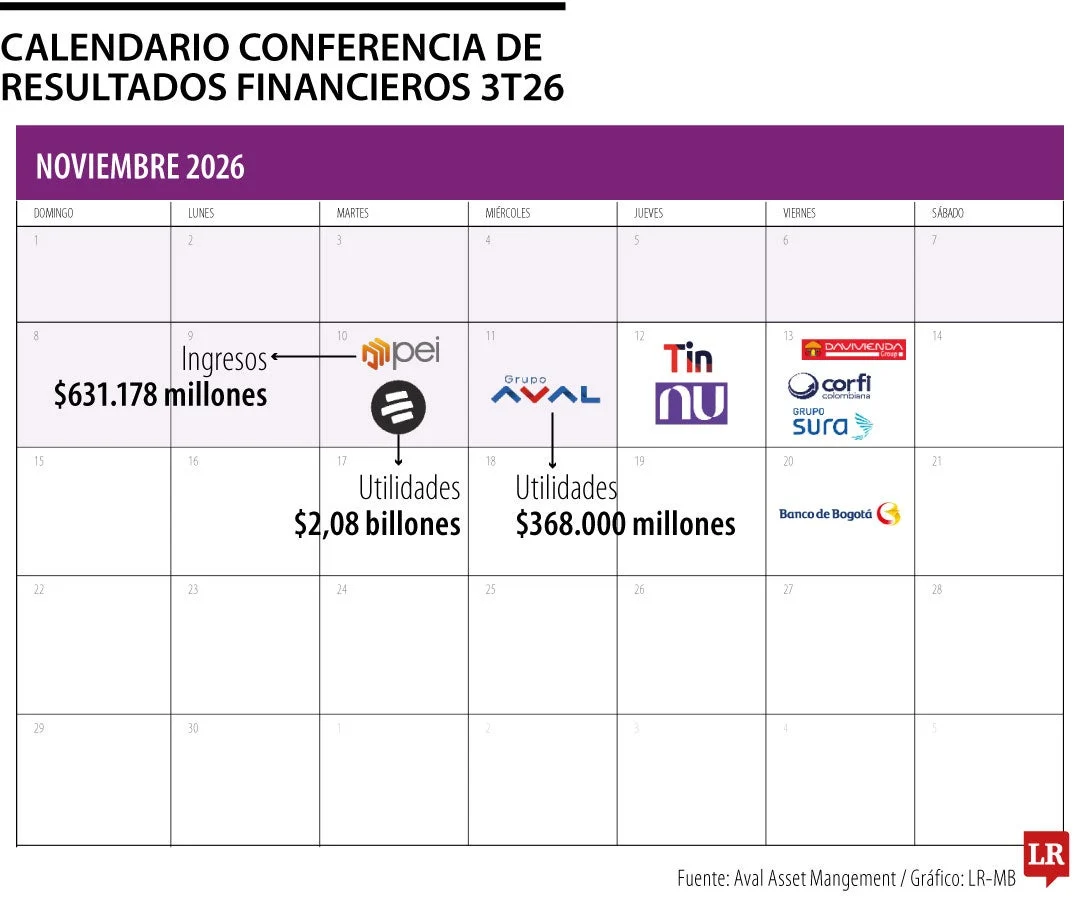
- Early Reporters Set the Tone: Major industry players, including Grupo Cibest, Grupo Aval, and PEI (Patrimonio Estratégico Inmobiliario), have already unveiled their financial scorecards for the third quarter.
- Mixed Profitability Signals: While return on equity (ROE) metrics remain remarkably robust for top-tier institutions—such as Grupo Cibest’s 21.7% ROE—absolute net incomes have faced downward pressures due to higher funding costs and necessary provisioning.
- Banco de la República’s Projections: The central bank forecasts a broad-based recovery in overall credit demand, expected to peak in momentum by the third quarter of 2026. This dynamic is primarily anchored in an anticipated acceleration of commercial lending, driven by improved business confidence and a stabilizing macroeconomic environment.
- Structural Vulnerabilities: The Emisor (Banco de la República) has explicitly warned that rising interest rates across various maturities could squeeze the financial margins of credit establishments. Institutions heavily exposed to long-term, fixed-rate consumer loans funded by short-term liabilities face the most acute exposure.
Chronology of the Third-Quarter Earnings Season
The release of financial results for the third quarter follows a tightly packed corporate calendar, offering market analysts a step-by-step X-ray of the Colcap-listed banking sector. This timeline dictates how market sentiment evolves as the year draws to a close.
[Early Q3 Disclosures] ➔ Grupo Cibest, Grupo Aval, & PEI release initial balances
         │
         ▼
[November 11, 2026]    ➔ Sura publishes its Q3 financial performance report
         │
         ▼
[November 12, 2026]    ➔ Davivienda shares its structural earnings report
         │
         ▼
[November 19, 2026]    ➔ Banco de Bogotá completes the major banking cycle
         │
         ▼
[Q3 2026 Horizon]      ➔ Anticipated general recovery of credit demand (Banco de República projection)
The Earnings Calendar Breakdown
The dissemination of third-quarter financial results has been carefully staggered throughout November 2026, allowing market makers, institutional investors, and analysts to absorb data incrementally:
- The Pioneer Disclosures: Grupo Cibest, Grupo Aval, and PEI initiated the reporting cycle, giving the market its first formal glimpse into asset quality, loan-loss provisions, and fee-income generation for the period ending September.
- November 11, 2026: Sura stepped up to release its comprehensive quarterly figures, shedding light on the broader investment and insurance-linked holding dynamics influencing the financial ecosystem.
- November 12, 2026: Davivienda unveiled its financial report, offering crucial insights into consumer credit performance, mortgage portfolio behavior, and digital banking monetization.
- November 19, 2026: Banco de Bogotá is slated to close out the reporting calendar for the heavyweights of the Colcap index. Once this report is made public, the market will possess a complete macro-prudential map of the Colombian banking sector, setting the definitive tone for fourth-quarter expectations and strategic budgeting for the upcoming fiscal year.
Supporting Data: Financial Metrics and Central Bank Analysis
To fully understand the trajectory of Colombia’s credit markets, one must examine the hard data emerging from both corporate balance sheets and central bank econometric models.
Grupo Cibest: A Case Study in Resilience and Contraction
As one of the bellwethers of the current reporting season, Grupo Cibest delivered a performance that encapsulates the balancing act required of modern Latin American banking giants:
- Net Income: For the third quarter of 2026, Grupo Cibest posted a net utility of $2.08 trillion.
- Year-over-Year (YoY) Performance: This figure represents a minor contraction of 3.0% compared to the same period in 2025.
- Quarter-over-Quarter (QoQ) Performance: More notably, the net income experienced a sharper decline of 23.8% when measured against the second quarter of 2026.
- Return on Equity (ROE): Despite the contraction in net earnings, Grupo Cibest maintained a high profitability ratio, posting an ROE of 21.7%.
- Forward Guidance: Demonstrating institutional confidence, the holding company projected that it will close the full fiscal year of 2026 with an ROE comfortably resting between 21% and 22%.
Macroeconomic Tailwinds and Headwinds
According to sector analyses compiled alongside the central bank’s policy notes, the impending credit recovery is not without its structural boundaries:
- The Commercial Loan Engine: The anticipated rebound in credit demand by Q3 2026 will be spearheaded by corporate and commercial borrowers. As industrial sectors optimize capital expenditure (CapEx) and supply chains stabilize, corporate demand for working capital loans is projected to rise.
- Risk Perception Shift: Lenders report a noticeable dampening in systemic risk perception. Corporate defaults, which spiked during the high-inflationary cycles of previous years, have begun to normalize.
- The Cost of Fondeo (Funding): While loan demand is recovering, profit margins will face strict ceilings. High funding costs—driven by competitive deposit rates—combined with the regulatory imperative to maintain robust, prudent provisions for a mild portfolio deterioration, will prevent explosive earnings growth.
Official Responses and Regulatory Perspectives
The leadership at Banco de la República, operating in its capacity as the nation’s monetary authority and systemic regulator (El Emisor), has maintained a cautious yet constructive stance regarding the evolution of credit markets.
The Emisor’s Assessment on Interest Rate Sensitivity
In recent regulatory briefings, technical teams at the central bank underscored a structural vulnerability that commercial lenders must manage over the medium term:
"An upward movement in interest rates across diverse maturity profiles inevitably compresses the financial income of credit establishments. Those institutions most severely exposed are precisely the ones engaged in granting long-term, fixed-rate consumer loans while simultaneously relying on volatile, short-term funding mechanisms."
This official warning serves as a policy signal to bank treasuries. Institutions that fail to match their asset-liability durations run the risk of structural margin squeezes, regardless of how robust top-line credit demand appears to be.
Industry Executives React to Q3 Realities
Executives from the banking conglomerates reporting this season have echoed the central bank’s measured tone. In earnings calls with equity analysts, chief financial officers emphasized that while volume growth (credit demand) is returning, risk management and credit quality preservation remain the paramount strategic pillars.
- On Portfolio Quality: Executives noted that while consumer portfolios showed early signs of stress earlier in the year, proactive loan-restructuring programs and tighter underwriting standards have successfully capped non-performing loan (NPL) ratios.
- On Digital Transformation: Investments in digital infrastructure continue to absorb operational expenditures, yet banks view these outlays as essential for reducing long-term operational costs and capturing fee-based revenue from digital ecosystems.
Implications for the Economy, Borrowers, and Investors
The convergence of Banco de la República’s mid-term credit projections, the ongoing third-quarter earnings disclosures, and macroeconomic policy constraints carries profound implications for multiple stakeholders across the Colombian economy.
1. For Corporate Borrowers and Consumers
- Credit Availability: Businesses seeking commercial expansion loans will likely encounter a more receptive banking sector by mid-to-late 2026. Banks, eager to deploy liquidity into recovering commercial portfolios, will actively compete for creditworthy corporate clients.
- Interest Rate Realities: Borrowers should not expect an immediate return to ultra-low interest rates. Because the central bank remains vigilant against inflationary pressures and structural term mismatches, lending rates will remain at levels that demand rigorous financial discipline from retail and corporate borrowers alike.
2. For Commercial Banks and Financial Institutions
- Asset-Liability Management (ALM): The warning issued by Banco de la República forces risk committees to re-evaluate their exposure to fixed-rate, long-term lending. Banks will need to innovate by introducing more flexible rate structures or hedging instruments to protect net interest margins (NIM).
- Provisioning Prudence: Even as credit demand recovers, maintaining conservative provisioning buffers will remain non-negotiable. Analysts suggest that investors will reward institutions that balance aggressive lending growth with uncompromising asset quality control.
3. For Investors and Equity Markets
- Colcap Valuation Dynamics: The final pieces of the Q3 earnings puzzle—culminating with the reports from Davivienda and Banco de Bogotá—will provide institutional equity funds with the data needed to reweight their portfolios in the Colcap index.
- Sustained Profitability Expectations: Despite contractions in quarterly absolute net income (such as Grupo Cibest’s 3% YoY drop), the market views sustained double-digit ROEs (surpassing 20%) as a sign of underlying structural strength. Investors with a medium-to-long-term horizon will look closely at how well individual banks manage their efficiency ratios and cost of funding as the 2026 credit recovery timeline approaches.
Conclusion
As Colombia’s financial system processes the final disclosures of the third-quarter earnings reporting season, a clear strategic roadmap is emerging. The structural health of institutions like Grupo Cibest, Grupo Aval, Sura, Davivienda, and Banco de Bogotá demonstrates a sector capable of absorbing volatility while maintaining high profitability standards.
Looking forward, the authoritative projection by Banco de la República pointing toward a generalized recovery in credit demand by the third quarter of 2026 offers a promising economic horizon. However, the path to this recovery will require strict adherence to prudent risk management, sophisticated asset-liability matching, and disciplined cost-of-fondeo controls to ensure that volume growth translates into sustainable, long-term shareholder and societal value.