By Mateo Chacón Orduz Subeditor, Life & Education Updated: September 17, 2026
Main Facts: A Counterintuitive Collapse in Educational Equity
At first glance, the latest data from the 2025 PISA (Programme for International Student Assessment) reading tests in Colombia and across Latin America appears to harbor a glimmer of hope: the performance gap between society’s wealthiest students and its most impoverished learners has shrunk.
However, a granular examination of the numbers reveals a far more unsettling phenomenon. This narrowing of the socio-economic achievement gap is not the result of disadvantaged students making inspiring strides upward. Instead, it is driven by a steep, alarming performance collapse among students from high-income families.
According to the comprehensive report "Reading in Latin America and the Caribbean: Low Performance and Persistent Inequalities. Results of PISA 2025," authored by Romina Paola Durán and Fiorella Giuliana Santini of the Institute for Educational Evidence (IEE), the top 25 percent of socio-economically advantaged Colombian students saw their reading scores plummet by roughly 16 points between 2022 and 2025. In stark contrast, the score for the bottom 25 percent—the most vulnerable segment of the population—worsened by a modest 3 points.
This inversion forces educational experts and policymakers to confront an uncomfortable question: Why are the students who theoretically possess the most resources, access to literature, and stable learning environments suffering a sharper and faster decline in reading comprehension than those with significantly less?
Chronology and Context: From Pandemic Closures to Digital Distraction
To understand the trajectory that led to the 2025 PISA results, one must retrace the systemic shocks experienced by the current cohort of 15-year-old students over the past half-decade.
2020–2021: The Pandemic Crucible
When the COVID-19 pandemic forced global lockdowns, Colombia instituted some of the most prolonged school closures among countries evaluated by the OECD, keeping classrooms shuttered for a staggering 152 days. The students who sat for the PISA 2025 assessments were between nine and 10 years old—crucial formative years in primary education—when the pandemic struck. This was the exact window during which fundamental literacy and writing skills are hardwired.
2022–2024: Post-Pandemic Drift and Unaddressed Deficits
Following the reopening of schools, Colombia, like much of the region, failed to deploy a robust, targeted national recovery plan specifically designed to rebuild critical reading skills. Compounding this lack of academic triage was the permanent entrenchment of digital devices into the daily lives of children. Tools initially introduced as emergency educational aids during lockdowns transformed into perpetual sources of distraction.
2025: The PISA Reality Check
By the time the 2025 PISA assessments were administered, the cumulative effects of post-pandemic learning gaps, unchecked screen time, and changing cognitive habits manifested directly in the testing data. Rather than recovering ground, the nation’s educational metrics stagnated on the surface while suffering severe structural shifts underneath.
Supporting Data: The Metrics of Decline and Inequality
The numbers compiled in the IEE report paint a vivid picture of persistent structural inequalities layered over a new, downward trend among the privileged.
The Score Gap: In 2025, Colombian students in the lowest socio-economic quartile achieved an average reading score of 364, compared to 453 for the highest quartile—a gap of 89 points. In 2022, that gap stood at 102 points (367 vs. 469). While the 13-point reduction superficially suggests progress, it was catalyzed entirely by the 16-point drop among the rich rather than gains by the poor.
Regional Context: This trend is not isolated to Colombia. Across 7 of the 11 Latin American countries with comparable data (including Argentina, Chile, Mexico, Paraguay, Peru, Uruguay, and Colombia), the narrowing of socio-economic gaps was similarly driven by the downward slide of privileged students.
Minimum Competence Thresholds (Level 2): PISA defines Level 2 as the baseline threshold where a student can identify the main idea of a moderate-length text, locate explicit information, and reflect on the purpose and form of written material.
Among Colombia’s most disadvantaged quartile, 73 percent failed to reach Level 2.
Among the most favored quartile, 31 percent also failed to clear this minimum bar.
Overall, 54 percent of all Colombian 15-year-olds fell below Level 2 in 2025, virtually unchanged from 51 percent in 2022. Colombia’s national average slipped from 409 points in 2022 to 399 in 2025.
Regional Standing: Colombia’s 89-point socio-economic gap remains the second widest in Latin America, trailing only Brazil (93 points), and far eclipsing the regional average of roughly 78 points.
Official Responses and Expert Analysis
The paradoxical nature of these results has triggered urgent warnings from educational researchers and analysts across the continent.
Romina Durán, Head of Research at the Institute for Educational Evidence, emphasizes that the region’s reading crisis requires a systemic overhaul rather than isolated interventions:
"In Latin America and the Caribbean, PISA 2025 shows that reading remains a shared challenge. In 10 of the 13 participating countries, at least half of 15-year-olds fall below Level 2… Rather than viewing these results in isolation, we need a sustained agenda that connects early childhood literacy with the development of reading competencies across the entire educational trajectory."
Fiorella Santini, data analyst at the institute, highlights the masked reality behind stable national averages:
"The national average score in reading shifted from 409 to 399 points between 2022 and 2025, a variation lacking statistical significance. However, internal disparities remain stark: 73 percent of students in the most disadvantaged quartile are below Level 2, compared to 31 percent among the most favored. That is a 42-percentage-point difference. Persisting inequalities in basic competencies remain deeply entrenched."
Education analyst Francisco Cajiao points directly to changing cognitive habits as a primary driver behind the unexpected drop among affluent youth:
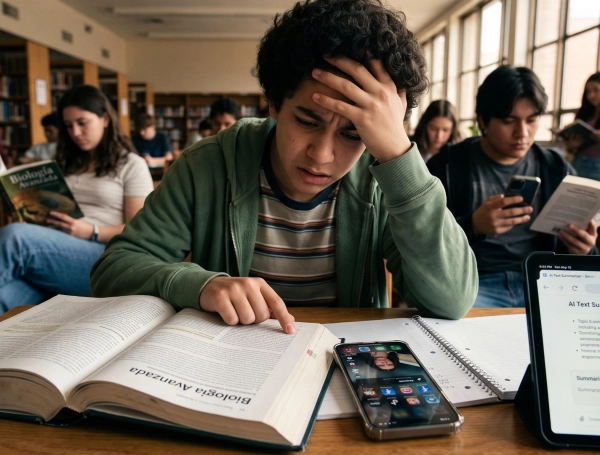
"The constant use of these technologies appears to be altering how young people relate to information. Continuous exposure to short videos and fast-paced entertainment conditions the brain to process massive quantities of information in short bursts. Consequently, activities requiring sustained concentration, such as deep reading, are increasingly unappealing to students."
OECD indicators reinforce Cajiao’s observation: instances of students "hurriedly reading"—answering rapidly and incorrectly simply due to a lack of patience in processing text—nearly doubled between 2018 and 2025, rising from 6.6 percent to 11.4 percent.
Furthermore, artificial intelligence integration has complicated academic performance. OECD data reveals that 56 percent of Colombian students use AI chatbots weekly to assist with schoolwork (well above the 46 percent OECD average). Students who rely heavily on AI for summarization and drafting tasks score, on average, 20 points lower in science and demonstrate weakened retention and analytical skills.
Finally, Professor Alejandro Ganimian of New York University underscores the structural mandate moving forward:
"This report invites us to view reading as a responsibility spanning the entire school trajectory. The challenge is ensuring children learn to read in the early grades and receive the necessary support to comprehend increasingly complex texts. To guide this effort, we must look at both learning outcomes and their distribution: closing gaps requires elevating the opportunities of those facing the greatest hurdles."
Implications: A Wake-Up Call for Educational Policy
The 2025 PISA results dismantle the comfortable assumption that socio-economic privilege automatically safeguards students against systemic educational decay. The downward trajectory of Latin America’s wealthiest youth signals that cognitive fragmentation, driven by unchecked screen time, the superficial consumption of digital content, and the uncritical outsourcing of intellectual labor to artificial intelligence, represents a cross-class threat.
For Colombia, the implications are profound. Merely celebrating a narrowing achievement gap born from the descent of the elite is a statistical illusion. True educational equity will only materialize when public policy successfully lifts the academic floor for the most vulnerable while simultaneously re-establishing rigorous cognitive discipline, deep-reading habits, and critical thinking standards across all social strata. Without a synchronized strategy addressing both early literacy foundations and modern technological distractions, the region risks raising a generation proficient in navigating interfaces, yet fundamentally unable to comprehend the world around them.
Executive Summary: Capitalizing on the Currency Shift In a landscape defined by shifting macroeconomic tides, the Colombian peso has experienced a significant appreciation against the U.S. dollar, reaching its strongest valuation in half a decade.…
By Angie Rodríguez Translated and Enriched for Global Insights Main Facts: The Modern Adult Friendship Crisis Hacer nuevos amigos (making new friends) has quietly transformed into one of the most complex sociological challenges of the…
By Gabriel Gutiérrez Updated: September 27, 2026 Main Facts In the high-stakes landscape of Colombian secondary education, achieving a perfect score on the Saber 11 national examination—administered by the Colombian Institute for the Evaluation of…