By Mateo Chacón Orduz
Sub-editor of Education, Life Section
The latest results from the Programme for International Student Assessment (PISA) 2025 have arrived, and for Colombia, they bring a familiar, sobering message. While global powerhouses such as Singapore, the Chinese provinces of B-S-J-Z (Beijing, Shanghai, Jiangsu, Zhejiang), and Macao continue to set the gold standard in academic performance, Colombia finds itself languishing in the lower rungs of the global ranking.
The PISA tests, conducted by the Organisation for Economic Co-operation and Development (OECD) every three years, assess 15-year-olds across 91 nations and economies. These exams are more than just a scorecard; they are a diagnostic map revealing the widening chasm between the world’s elite educational systems and those struggling to provide the foundational skills required for the 21st century. Colombia’s position in the 2025 cycle confirms a persistent narrative: a nation stuck in a "middle-low" trap, neither at the absolute bottom of the global barrel nor anywhere near the high-achieving leaders.

The Global Hierarchy: Who Leads and Who Lags?
To understand the scope of the divide, one must look at the extremes. In Mathematics, Reading, and Science, the top ten spots are dominated by East Asian economies. These regions have cultivated a rigorous academic culture characterized by high expectations, significant investment in teacher quality, and a cultural emphasis on cognitive development.
Conversely, the bottom ten performers in these same categories share a common denominator: chronic underinvestment, unstable political environments, and significant social inequality. Colombia occupies a precarious space in the middle-low bracket. It is not currently in the "bottom ten," but it is statistically closer to those struggling nations than it is to the OECD averages. This proximity is a red flag for policymakers and economists alike, as it suggests that the country’s human capital—the very engine of future economic growth—is not being developed at the competitive speeds required in an increasingly globalized labor market.
Chronology of a Crisis: From Pandemic Disruption to Structural Stagnation
The 2025 results cannot be divorced from the recent past. The trajectory of Colombian education over the last decade has been defined by a series of disruptions, beginning with the 2022 PISA cycle, which was heavily impacted by the immediate aftermath of the COVID-19 pandemic.

However, experts argue that the 2025 results are, in many ways, more telling than the previous ones. Francisco Cajiao, a preeminent educational analyst, suggests that the students who sat for the 2025 exam were at a particularly vulnerable stage during the pandemic lockdowns.
"The results of 2022 were immediate; they caught students who had already built some foundational skills," Cajiao explains. "But the 2025 cohort? These are the students who endured the most critical period of their early childhood and primary schooling in total isolation. They were in the middle of learning how to read, write, and grasp the basics of arithmetic when the world shut down. We are now seeing the long-term, structural damage of that disruption. This is the ‘true’ cost of the pandemic."
The Policy Gap: Where Did the Focus Go?
While the pandemic provides a convenient explanation for global educational regression, it does not fully account for the variations seen in Latin America. Neighboring countries such as Chile and Uruguay have demonstrated pockets of improvement, suggesting that despite regional hardships, policy choices matter.
Cajiao is critical of the current administration’s priorities. "We are looking at four years where the government invested significant political capital and resources into higher education, but the focus on basic and secondary education—the very stages measured by PISA—was alarmingly thin," he asserts.
The critique is pointed: by prioritizing university access without first ensuring that the pipeline from primary and secondary schools produces students with adequate literacy and numeracy, the government has arguably built a house on sand. The "quality" of education is not merely a matter of enrollment; it is a matter of what occurs inside the classroom. If students reach the age of 15 unable to solve basic algebraic problems or analyze a complex text, the transition to higher education becomes an uphill battle marked by high dropout rates and skill mismatches.
Supporting Data: The Digital Distraction
Beyond the traditional metrics of reading and math, the 2025 PISA report highlights a new, disruptive variable: the impact of Artificial Intelligence (AI) and mobile devices on student concentration. Data from the assessment indicates that the uncontrolled use of digital tools has led to a significant decline in "deep work" capabilities.
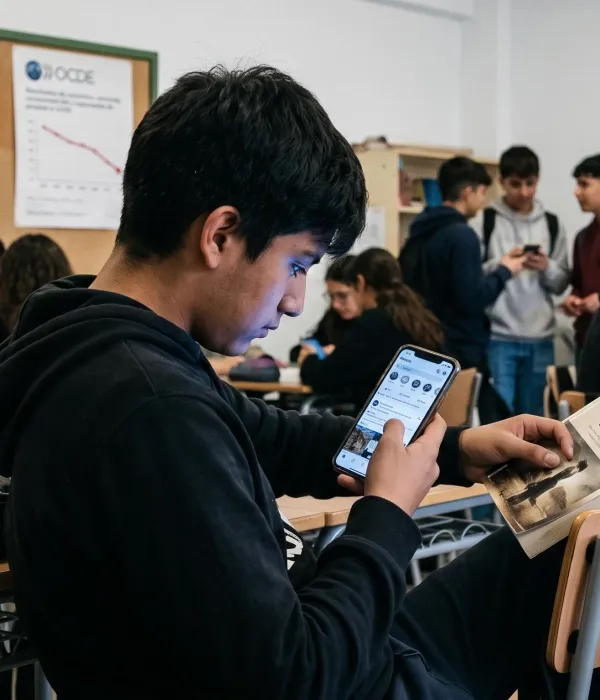
Students today face an unprecedented cognitive load. The constant notifications, the ease of access to AI-generated answers, and the reduction of attention spans have all contributed to a "distraction penalty" in the classroom. When combined with the pre-existing deficiencies in basic education, this digital fatigue creates a perfect storm. The data shows that high-performing nations have implemented stricter policies regarding cell phone usage in schools, whereas countries like Colombia have struggled to integrate technology meaningfully, often allowing devices to serve as barriers to, rather than facilitators of, learning.
The Long-Term Implications: A Nation at Risk
The implications of this stagnation are not merely academic—they are existential for Colombia’s development. Education is the primary determinant of social mobility. When a generation of 15-year-olds performs poorly in standardized assessments, the societal consequences ripple outward for decades.
1. The Productivity Trap
A workforce that lacks high-level analytical skills is inherently less productive. In a world moving toward automation and AI, the demand for "manual" or "rote" labor is decreasing. If Colombia’s youth are not prepared for complex, problem-solving-oriented roles, the country will struggle to attract high-value foreign investment.

2. The Science and Technology Deficit
Innovation is built upon a bedrock of scientific literacy. If students are struggling to master basic scientific concepts by age 15, the pipeline for the next generation of engineers, researchers, and tech entrepreneurs is effectively leaking. This leads to a dependence on foreign technology rather than the creation of home-grown solutions.
3. Institutional Decay
As Cajiao points out, the quality of public leadership is directly tied to the quality of the educational system. "It is very difficult to find people qualified to perform in high-responsibility public offices when the foundational system is failing," he notes. The lack of critical thinking skills, nurtured through robust schooling, leaves the citizenry more vulnerable to misinformation and less capable of engaging in the complex, evidence-based debates required for a healthy democracy.
A Call for Systemic Reform
The 2025 PISA results serve as a wake-up call that the status quo is insufficient. To break free from the "middle-low" trap, Colombia must pivot from a policy of "access-first" to one of "quality-first."

This requires a multi-pronged approach:
- Teacher Empowerment: Investing in the continuous training and competitive compensation of educators in the primary and secondary sectors.
- Curricular Modernization: Moving away from rote memorization toward a curriculum that emphasizes critical thinking, digital literacy, and resilience in the face of complex problems.
- Closing the Digital Divide: Implementing clear guidelines on the use of technology in schools to ensure that devices are used for cognitive development rather than social distraction.
- Holistic Support: Recognizing that a student’s performance is linked to their environment, necessitating investments in nutrition, mental health, and the physical infrastructure of schools, particularly in rural and marginalized urban areas.
Conclusion: The Choice Ahead
Colombia stands at a crossroads. The 2025 PISA data provides a stark, empirical look at the current state of its youth. The country can either continue to accept mediocre results as an inevitable outcome of its history, or it can treat this report as the catalyst for a radical, sustained overhaul of its basic education system.
The cost of inaction is clear. A nation that fails to educate its people is a nation that decides to limit its own future. As the global economy evolves, the window for catching up is narrowing. For the sake of the next generation, the lessons of PISA 2025 must be translated into immediate, evidence-based policy changes, shifting the focus from the quantity of graduates to the depth of their knowledge and their ability to navigate a rapidly changing world. The path to the top of the table is long and arduous, but for a nation with Colombia’s potential, it is a journey that must begin today.