By Mauricio Reina
Special for EL TIEMPO
The release of the latest PISA (Programme for International Student Assessment) results has once again acted as a grim wake-up call for Colombia. In a landscape where the global educational discourse is shifting toward innovation and critical thinking, the country finds itself anchored in a persistent, low-quality equilibrium. With 71 percent of students failing to reach minimum proficiency in mathematics—and over 50 percent falling short in reading and science—the nation’s educational trajectory has become a source of national concern.
To dissect the causes behind these figures, we sat down with Felipe Barrera, a renowned expert in educational policy with an extensive background at Fedesarrollo, Harvard University, and currently, Vanderbilt University. Barrera’s assessment is blunt: Colombia’s educational system is not merely underperforming; it is failing to convert increased public spending into tangible human capital.
The Core Facts: A Stagnant Reality
The data from the 2025/2026 PISA reports confirms a trend that has plagued the Colombian system for two decades: stagnation. Since the country first participated in these international evaluations in 2006, the needle has barely moved. Despite significant increases in the national education budget and the political influence exerted by the teachers’ union, Fecode, the learning outcomes remain stubbornly low.

The implications of this reality are profound. As Barrera points out, the quality of a country’s education is the primary engine for its long-term economic development and social mobility. When a generation of students graduates without the analytical tools to solve complex problems or the critical thinking skills to participate in a modern democracy, the nation loses its most valuable resource.
A Brief Chronology of Educational Stagnation
The failure of the Colombian education system is not a sudden phenomenon but the result of cumulative policy inaction and structural barriers.

- 2006: Colombia makes its debut in the PISA rankings. The results set a low baseline, which policy analysts hoped would improve through reform and investment.
- 2010–2018: Efforts to modernize the curriculum and invest in teacher training are launched, yet they struggle to penetrate the systemic inefficiencies of the public school system.
- 2020–2022: The global pandemic forces a shift to virtual learning. While this affected students worldwide, the lack of robust infrastructure in rural and low-income areas of Colombia deepened existing gaps.
- 2023–2026: Post-pandemic assessments reveal that, while many countries saw a "rebound" effect, Colombia’s performance remained trapped in its historical average.
- September 2026: The latest PISA results confirm that the "lost years" of the pandemic have compounded with structural flaws, leaving students ill-equipped for the future.
Supporting Data: Why Spending Isn’t Enough
A common misconception is that the quality of education is directly proportional to the amount of money spent. However, the Colombian case study suggests that resource allocation is only half the battle.
Barrera highlights that the lack of improvement is not for a lack of funding. The budget for the education sector has seen consistent growth over the last several years. The core issue lies in the three pillars of teacher quality:

- Recruitment: The system fails to attract the best talent to the teaching profession.
- Pedagogical Training: The education provided in teacher-training institutions is often disconnected from the requirements of the modern classroom.
- Support and Accountability: Once teachers are in the classroom, they lack the necessary support systems, and there is an absence of incentives tied to student performance.
Furthermore, the "double segregation" of the system—between public and private sectors, and between income levels—prevents the mixing of social strata that is essential for a cohesive and high-performing educational model.
The Role of Fecode and the Political Debate
The relationship between the teachers’ union (Fecode) and the state is a complex and contentious one. While unions are fundamental to democracy, Barrera argues that Fecode’s focus in Colombia has drifted away from the primary objective: the student.
"In countries like Finland," Barrera explains, "the union defends the rights of the teacher, but it is simultaneously a fierce advocate for educational quality and student success. In Colombia, we have yet to see that dual commitment."
During the previous administration, the government frequently dismissed international metrics like PISA as "neoliberal instruments." Barrera offers a sharp analogy: "If you are overweight, stepping on a scale and realizing you are heavy doesn’t mean the scale is the problem. You don’t solve your health issue by selling the scale. You change your lifestyle." The refusal to acknowledge the validity of these indicators has hindered the ability to implement evidence-based corrective measures.

The Impact of Digital Distraction
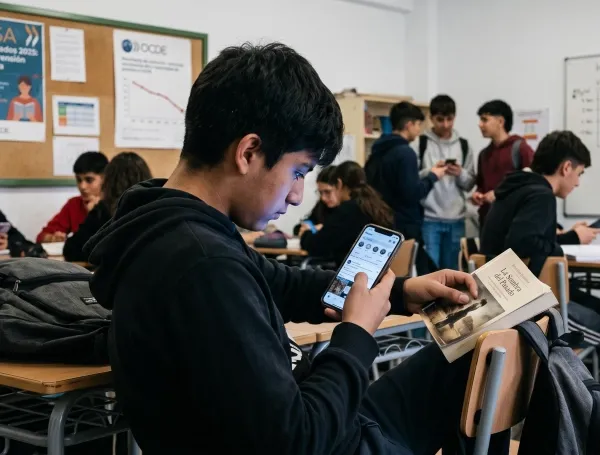
Beyond the structural issues, the PISA results reflect a global phenomenon: the impact of the digital age on cognitive development. Barrera points to the "TikTok effect"—the dominance of algorithms that prioritize immediate gratification over sustained analytical focus.
"We are dealing with a generation whose capacity for deep, critical analysis is being challenged by the speed and superficiality of digital content," he notes. While this is a global trend, countries with weaker educational foundations, like Colombia, are less equipped to mitigate these cognitive side effects.

Implications: A Path Forward
The situation is grave, but not irreversible. To pivot away from this cycle of mediocrity, Barrera proposes a radical shift in strategy for the current administration, led by Minister of Education Ilva Myriam Hoyos:
1. Reform Teacher Incentives
The government should implement voluntary recertification programs for teachers. Those who successfully undergo rigorous training and demonstrate improved student outcomes should be rewarded with salary increases and performance-based bonuses.
2. Strengthen "Concession" Schools
Schools in association—public schools managed by private entities—are among the most effective tools for dismantling segregation. By allowing private pedagogical expertise to be applied within the public system, the government can offer high-quality options to families across all income levels. Barrera warns that legislative efforts to limit these schools are a step in the wrong direction and must be halted.
3. Focus on Quality Over Coverage
While access to education is crucial, "coverage" without "quality" is a hollow victory. The state must stop measuring success by the number of students in seats and start measuring it by the cognitive gains those students make each year.
Conclusion: The Cost of Inaction
The stagnation of Colombia in the PISA rankings is more than a statistic; it is a tragedy of wasted potential. Every student who passes through a system that fails to provide analytical skills is a loss for the country’s future productivity, economic development, and democratic health.
As the nation looks toward the future, the question is not whether there is enough money, but whether there is enough political will to confront the structural, union-related, and pedagogical hurdles that have kept Colombia at the bottom of the ladder for too long. If the country does not act now to redefine its educational priorities, it risks condemning future generations to the same mediocre outcomes that have defined the last twenty years.