MADRID — In a political climate charged with unprecedented tension, Spain stands at a critical crossroads. Following the first nationwide general strike since 2012, the Permanent Delegation of the Spanish Congress took decisive—yet fiercely contested—action this Thursday. Meeting in the wake of Parliament’s dissolution ahead of the high-stakes November 29 general elections, lawmakers narrowly approved emergency legislation designed to safeguard the right to housing.
The legislative victory, achieved by a razor-thin margin of 35 votes to 34 within the 69-member special body, underscores a nation sharply divided over how to tame a spiraling cost-of-living and housing affordability crisis. The approved measures offer crucial protections for vulnerable populations, yet they have immediately drawn fierce opposition from conservative factions and property owners, setting the stage for an explosive electoral showdown at the end of the month.
Main Facts
The core of the newly approved legislation centers on two primary pillars aimed at curbing predatory practices and protecting vulnerable citizens:
- Eviction Moratorium: The decree suspends all court-ordered evictions for vulnerable individuals and families until the year 2030, offering long-term breathing room to those most at risk of losing their homes.
- Targeting "Vulture Funds": The legislation introduces stringent restrictions and regulatory measures against speculative institutional investment firms, widely known as "vulture funds," which critics accuse of inflating property prices and aggressively displacing long-term tenants.
Despite these approvals, the Permanent Delegation dealt a blow to another cornerstone of the government’s housing agenda. A complementary text proposing the automatic renewal of residential lease agreements was decisively rejected—mirroring its failure during earlier parliamentary examinations—by a 35-to-34 vote. This defeat was largely celebrated by landlord associations and real estate groups, who argued that forced renewals infringe upon private property rights and market freedoms.

The political stakes could not be higher. The approved decree-ley had previously been rejected by the broader parliament in early October, a legislative defeat that effectively collapsed the government’s consensus and precipitated Prime Minister Pedro Sánchez’s decision to call snap elections for November 29.
Furthermore, the conservative Partido Popular (PP), currently leading opinion polls to unseat Sánchez’s eight-year-old leftist administration, has already pledged to completely repeal these housing measures if they return to power.

Chronology of the Crisis
The journey toward the current legislative and social boiling point has been marked by escalating frustration, tragic catalysts, and unprecedented labor mobilization.
Late September 2026: The Spark
The grassroots movement that ultimately paralyzed the country was born in late September, following the emotionally charged eviction of Maricarmen Abascal. The 87-year-old Madrid resident was forced out of the apartment she had called home for seven decades. The eviction sparked national outrage, intensifying public sympathy for vulnerable tenants and thrusting the housing emergency to the forefront of the national conversation. The trauma of the event was compounded when Abascal passed away just days after being uprooted from her lifelong community.
Early October 2026: Parliamentary Deadlock
Capitalizing on public anger, leftist factions attempted to fast-track progressive housing reforms through the national parliament. However, a fractured legislature rejected the government’s proposed decree-laws in early October. Recognizing that governance had become untenable without a fresh mandate, Prime Minister Pedro Sánchez dissolved Parliament and scheduled snap general elections for November 29, triggering the transition of legislative powers to the Diputación Permanente.
November 11, 2026: The First General Strike in 14 Years
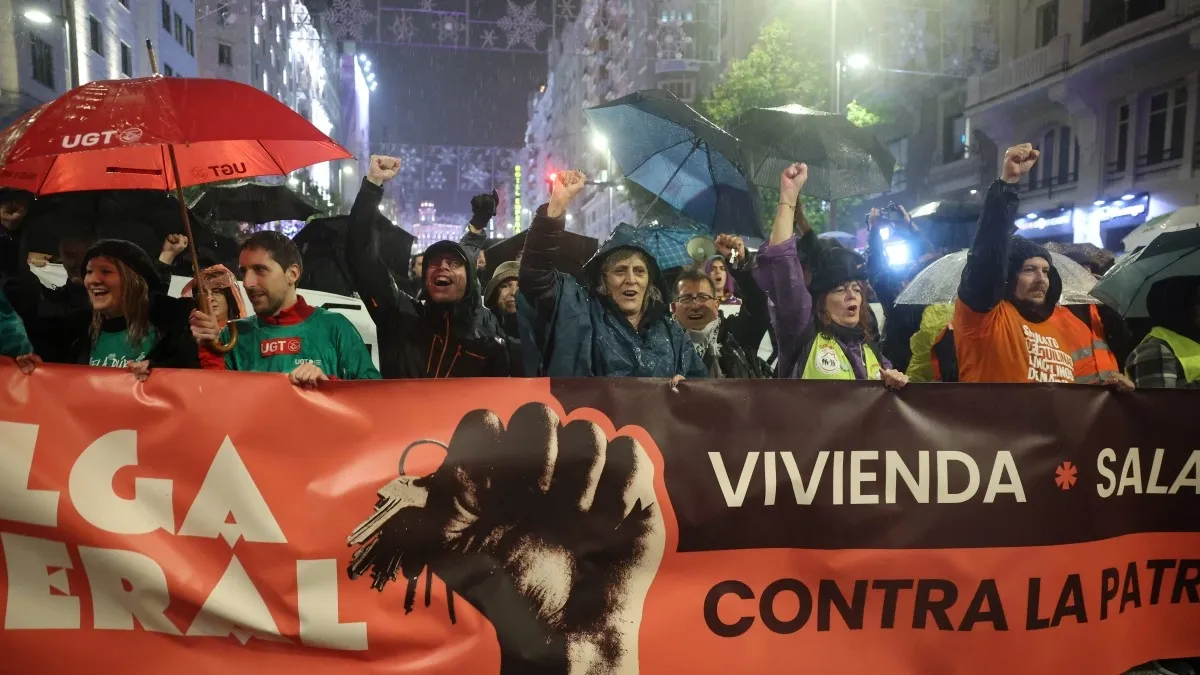
Frustration boiled over into the streets as Spain ground to a halt during the country’s first nationwide general strike since 2012. Convocated by major labor unions to protest both the housing crisis and eroding purchasing power, the strike shut down transport, commercial, and industrial sectors.
- Hundreds of thousands of demonstrators marched peacefully across major urban centers.
- Official estimates placed turnout at roughly 120,000 participants in Madrid and 55,000 in Barcelona.
- While the overwhelming majority of the protests were peaceful, late-day clashes between fringe groups and law enforcement resulted in 52 arrests and more than 650 recorded incidents of localized confrontation and property damage.
November 12, 2026: Emergency Legislative Action
One day after the historic nationwide strike, the Permanent Delegation of the Congress convened under immense public pressure. Recognizing the political optics and the raw anger of the electorate, the congressional body voted to pass the anti-eviction and anti-speculation measures, while simultaneously striking down the automatic lease renewal proposal.
Supporting Data & Economic Context
The socio-economic indicators driving the Spanish populace to the streets reveal a profound structural imbalance between earnings and the cost of living.

- Inflation Pressures: According to official data released in October 2026, Spain’s inflation rate climbed to 4.9%, steadily eroding the real purchasing power of the working and middle classes.
- The Housing Burden: For the average Spanish citizen, housing has become an unsustainable financial sinkhole. A vast majority of disposable income is routinely swallowed by escalating monthly rent payments or mortgage servicing, leaving families with minimal financial cushion.
- Demographic Impact: The crisis is no longer confined to low-income brackets; young professionals, families, and fixed-income retirees find themselves priced out of major metropolitan areas like Madrid, Barcelona, Valencia, and Málaga.
- Political Polarization: The division within the 69-member Permanent Delegation (35-34 votes) perfectly encapsulates a nation split down the middle: half demanding aggressive state intervention to guarantee housing as a fundamental human right, and the other half warning that market interference will stifle construction, reduce rental supply, and violate private property guarantees.
Official Responses and Political Reactions
The legislative maneuverings and street protests have triggered sharp, polarized responses from the nation’s political heavyweights.
The Leftist Coalition: Defending the Social Shield
Prime Minister Pedro Sánchez’s government has framed the emergency decrees as an indispensable moral and social shield. Proponents argue that the state has a fundamental obligation to protect citizens from predatory financial speculation and homelessness, particularly during periods of high inflation. The administration maintains that suspending vulnerable evictions until 2030 and reining in institutional landlords are non-negotiable steps to preserve social cohesion in Spain.

The Conservative Opposition: Promises of Repeal
On the opposing side, the Partido Popular (PP) has adopted a stance of uncompromising opposition. Viewed as the frontrunner in current opinion polls ahead of the November 29 ballot, the PP has directly blamed Sánchez’s economic policies for exacerbating the crisis. Conservative leaders argued that the government’s interventionist approach discourages private investment in residential real estate, ultimately shrinking supply and driving prices even higher. The PP has formally committed to repealing the newly enacted housing measures on day one if they secure victory at the polls.
Labor Unions and Civil Society: Continued Vigilance
Labor leaders and housing activists, while celebrating the partial legislative victory of the anti-eviction decree, have made it clear that the general strike was merely a warning shot. Activist networks have vowed to maintain mobilization through the election cycle, ensuring that regardless of which political coalition wins on November 29, the housing crisis remains the central mandate for the incoming administration.

Implications for Spain’s Future
As Spain looks toward the pivotal November 29 general elections, the events of mid-November 2026 mark a watershed moment in contemporary Spanish political history.
- Electoral Realignment: Housing has officially usurped traditional wedge issues to become the defining battleground of modern Spanish politics. The outcome of the upcoming elections will determine whether Spain continues down a path of heightened state market regulation or pivots toward a market-driven, conservative economic model.
- Social Stability: The success of the general strike demonstrates a revitalized labor and civic movement capable of mobilizing hundreds of thousands of citizens. Any future government that attempts to roll back housing protections or ignore affordability metrics will face immediate and sustained domestic unrest.
- The European Context: Spain’s housing crisis mirrors broader urban affordability crunches across Western Europe. However, the severity of Spain’s legislative deadlock—culminating in snap elections and emergency decrees—serves as a bellwether for how demographic pressures, inflation, and wealth inequality can rapidly destabilize traditional governance structures.
With the ink barely dry on the congressional decree and the campaign trail for November 29 now fully underway, Spain remains a nation holding its breath, balancing the urgent human demand for shelter against the fierce ideological debates of its political class.