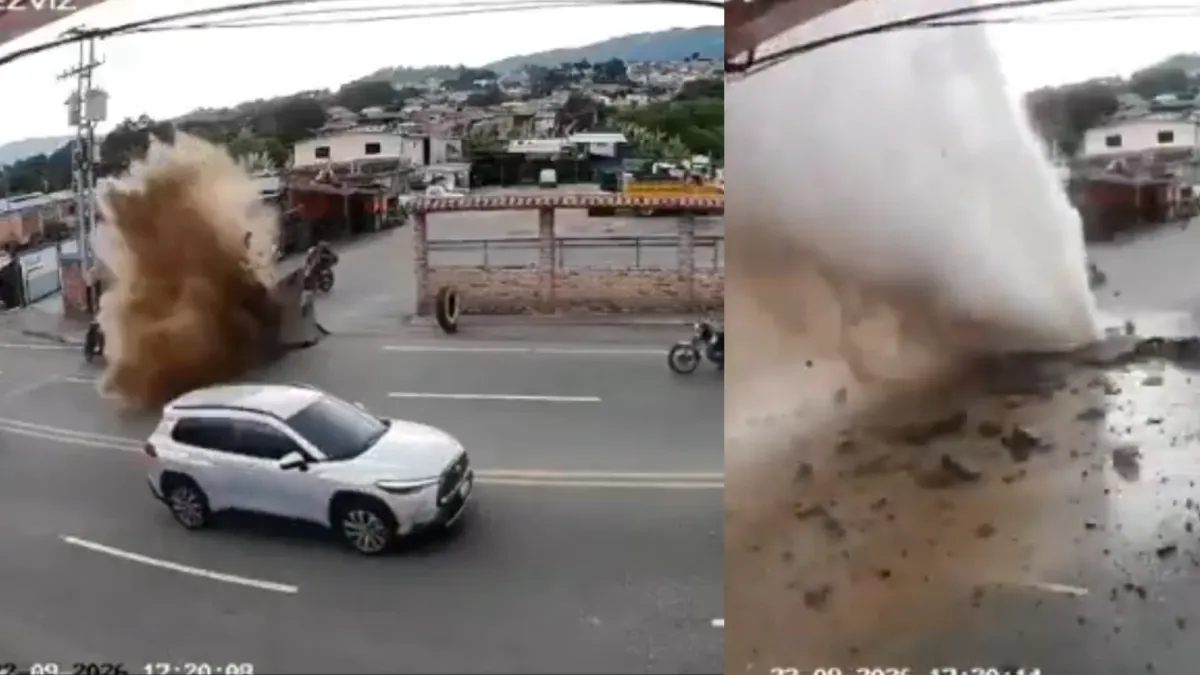
TÁCHIRA, VENEZUELA — A routine Tuesday afternoon transformed into a scene of sudden devastation in the southwestern region of Venezuela when a major aqueduct pipeline ruptured, sending a colossal geyser crashing onto a busy roadway. The catastrophic failure of the high-pressure main, measuring an imposing 40 inches in diameter, unleashed torrents of muddy water that fragmented the asphalt, battered civilian infrastructure, injured multiple residents, and exposed the fragile state of local public utilities.
Captured vividly by security cameras and widely shared across global social media platforms, the incident has reignited urgent conversations surrounding the systemic neglect and structural decay plaguing municipal infrastructure throughout the region. As engineering experts assess the damage and local authorities scramble to restore normalcy, the human and material toll of the disaster continues to unfold.
Main Facts: Anatomy of a Infrastructure Crisis
The crisis erupted on Tuesday, September 22, in the Las Vegas sector of Táriba, located within the Andean state of Táchira. According to reports verified by international news agencies such as Sputnik Mundo, the disaster centered around a vital primary water conduit.
- The Infrastructure: A high-pressure, 40-inch-diameter master aqueduct pipeline.
- Immediate Casualties: At least two individuals sustained injuries amidst the chaotic deluge.
- Collateral Damage: The immense force of the hydraulic impact severely compromised seven neighboring buildings and directly struck moving vehicular traffic, leaving structural scars and shattering windows.
- Regional Impact: The rupture instantly crippled the potable water supply, leaving multiple municipalities across the Táchira region entirely dry as emergency shutdown protocols were implemented.
The sheer volume and pressure of the escaping water transformed a standard thoroughfare into a destructive torrent, displacing heavy slabs of concrete and sending debris hurtling through the air like shrapnel.

Chronology of Terror: A Second-by-Second Account
Surveillance footage recovered from the scene provides a harrowing, cinematic timeline of the disaster, capturing the suddenness with which urban infrastructure can turn lethal.
Phase 1: The Pre-Disaster Calm
In the moments leading up to the explosion, the street life in Táriba proceeded with ordinary momentum. A white pickup truck traveled down its designated lane, while two motorcycles shared the opposing corridor. Simultaneously, a motorcycle emerged from a nearby parking lot, closely followed by a black automobile. Pedestrians walked casually near commercial storefronts, entirely unaware that beneath their feet sat a ticking hydraulic time bomb.

Phase 2: The Fracture and the Geyser
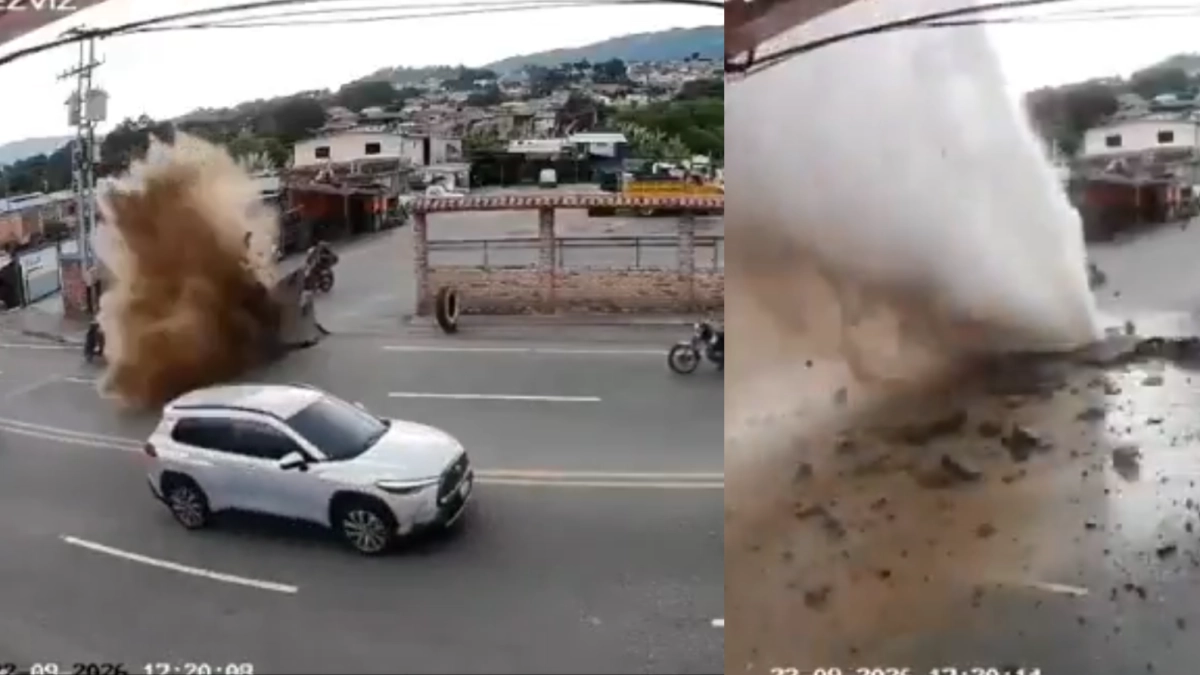
Without warning, the subsurface pavement fractured violently. Security footage reveals the road splitting apart as an unchecked, high-pressure column of dense, coffee-colored mud burst into the atmosphere. The pressure momentarily subsided before erupting into a second, even more violent discharge that sent chunks of asphalt flying through the air.
Phase 3: Panic in the Streets
The reaction on the ground was immediate and instinctual. One motorcyclist, realizing he was directly in the path of the hydraulic blast, instinctively threw himself off his moving vehicle and sprinted desperately toward safety. Nearby, a white car veered erratically out of its lane, coming to a dead stop as the wall of water crashed against it. Inspection of the vehicle later confirmed that the blast wave and flying debris had completely shattered its rear window.

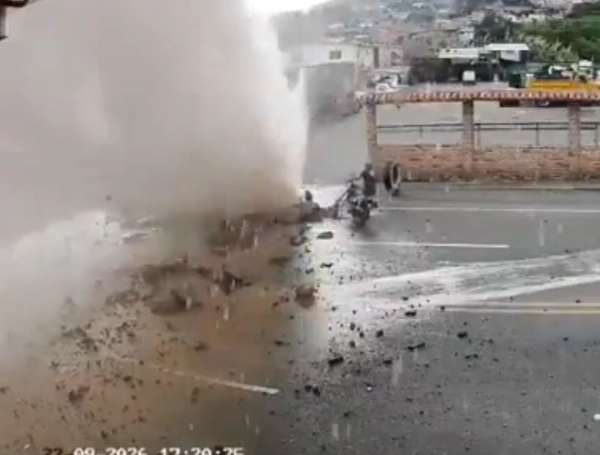
As pedestrians fled toward the relative safety of nearby parking structures and alleys, the color of the water transitioned from thick, debris-laden mud to a clearer, though no-less-destructive, torrent. For roughly 40 relentless seconds, the geyser shot skyward, defying gravity and blanketing the intersection in chaos.
Phase 4: The Aftermath
As the pressure finally began to drop due to emergency line closures upstream, the dazed motorcyclist who had abandoned his bike crept back into the intersection. Moving cautiously to avoid residual flooding or shifting debris, he retrieved his vehicle while emergency responders were already being dispatched to the disaster zone.
Supporting Data: Why Do Major Water Mains Burst?
While the catastrophic failure in Táchira shocked the local community, hydraulic and municipal engineering experts note that sudden water main breaks are governed by predictable physical laws and maintenance failures. Industry standards, corroborated by plumbing and municipal infrastructure organizations like Roto-Rooter, point to several primary culprits behind such large-scale structural ruptures:
1. Extreme Weather and Thermal Stress
While tropical regions like Venezuela experience different climate pressures than freeze-prone temperate zones, severe temperature fluctuations can stress subterranean materials. In regions subjected to freezing, water expands inside pipes, generating internal pressures capable of fracturing even industrial-grade steel and reinforced concrete.

2. The "Water Hammer" Phenomenon (Golpe de Ariete)
A hydraulic shock wave, commonly known as a water hammer, occurs when water moving at high velocity is abruptly forced to stop or change direction—often due to rapidly closing valves or poor pipeline securing. When pipes are inadequately anchored, this kinetic energy transforms into destructive pressure spikes, producing metallic clanking sounds within walls or beneath streets and systematically weakening pipe joints until they explode.
3. Chronic Over-Pressure
Aging municipal systems are frequently subjected to fluctuating or excessive internal water pressures to meet broader distribution demands. This continuous mechanical stress pushes aging conduits past their yield strength, steadily fatiguing the metal or concrete matrix.
4. Material Corrosion and Mineral Accumulation
Perhaps the most pervasive threat to municipal longevity is the gradual degradation of legacy infrastructure. Older iron and steel pipelines suffer from interior corrosion accelerated by mineral-rich hard water. Over decades, sediment and chemical scaling erode the internal lining of the pipes, thinning their walls and creating structural vulnerabilities that inevitably result in catastrophic blowouts under high pressure.
Official Responses and Emergency Interventions
In the wake of the disaster, local municipal authorities, civil protection agencies, and utility work crews rushed to the Las Vegas sector to secure the area and initiate recovery operations.

Emergency protocols required the immediate isolation of the damaged network segment, shutting down the primary pumping stations feeding the 40-inch main. While this containment action successfully halted the street-level flooding, it introduced a secondary crisis: a total blackout of the potable water supply across multiple municipalities in Táchira.
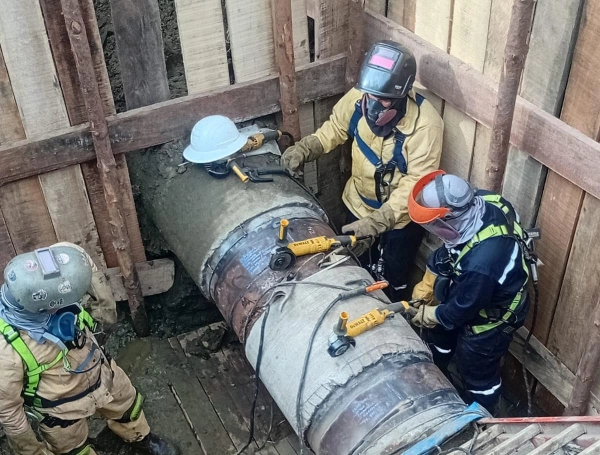
Public works teams deployed heavy machinery to clear displaced asphalt, remove damaged vehicles, and begin excavation work to expose the ruptured section of the aqueduct. Preliminary assessments focused on stabilizing the surrounding soil foundations to prevent secondary sinkholes from forming near the affected residential and commercial buildings. Local officials promised a comprehensive structural review of the seven buildings impacted by the hydraulic blast to determine whether their foundations had been compromised.

Implications: A Symptom of Broader Infrastructural Decay
The explosive failure in Táriba serves as a stark micro-cosm of a macro-level crisis. Across Venezuela, public services and critical infrastructure have suffered from years of underinvestment, economic turbulence, and a severe shortage of specialized technical maintenance.
Water distribution networks—reliant on aging pipelines installed decades ago—are increasingly prone to catastrophic failures. When a 40-inch transmission main fails in such a violent manner, it highlights a critical failure in preventative maintenance programs, leak-detection technologies, and pipeline rehabilitation cycles.

Furthermore, the human cost cannot be overlooked. The fact that the disaster resulted in injuries and structural damage in a populated urban zone underscores the inherent dangers citizens face when municipal maintenance lags behind basic safety requirements.
As repairs grind forward and residents grapple with ongoing water shortages, the incident in Táchira stands as an urgent warning. Without substantial capital injection, modernization, and rigorous engineering oversight, municipal water networks will remain ticking time bombs beneath the feet of unsuspecting citizens.