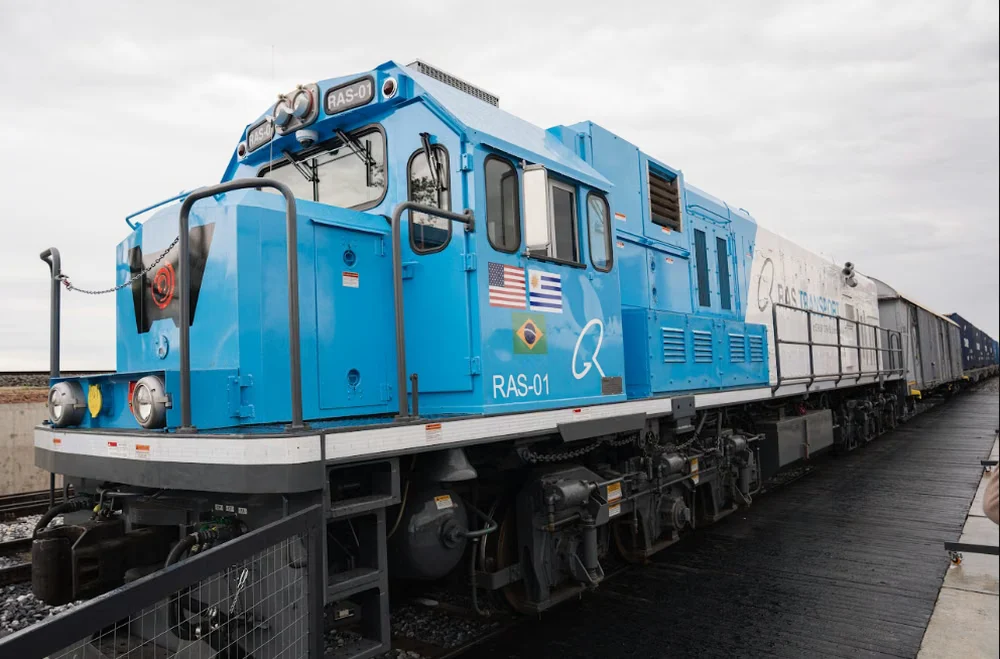
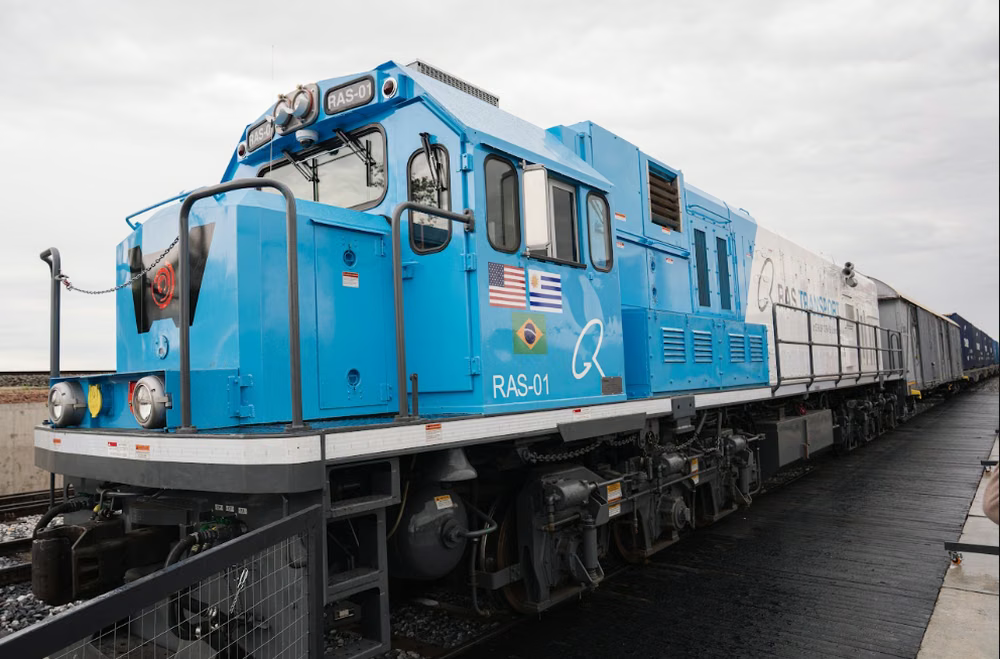
MONTEVIDEO — In a landmark development for South American supply chain infrastructure, Uruguayan multinational logistics provider Grupo RAS officially inaugurated a state-of-the-art freight rail service this week. Backed by a robust investment of $102 million spanning rolling stock and specialized transfer terminals, the multi-phased project introduces seven high-efficiency locomotives manufactured by the U.S.-based industrial giant Wabtec.
The strategic initiative aims to fundamentally reshape Uruguay’s domestic transport matrix by offering an alternative, highly competitive freight network. More broadly, the ambitious venture is designed to anchor the Port of Montevideo as a premier regional logistics hub, capable of capturing, consolidating, and redistributing cargo originating not only from within Uruguay but also from neighboring agricultural and industrial powerhouses such as Argentina, Brazil, and Paraguay.
1. Main Facts and Project Overview
The core of Grupo RAS’s new rail enterprise centers on modernizing multimodal logistics in the region. By seamlessly integrating the new rail network with established highway transport grids and port facilities, the multinational seeks to drastically trim transit times, lower operational expenses for producers, and maximize cargo efficiency.
- Total Initial Investment: $102 million dedicated to rolling stock, advanced locomotives, and sophisticated transfer terminals.
- Fleet Acquisition: Seven state-of-the-art freight locomotives supplied by American manufacturer Wabtec.
- Primary Objective: To broaden Uruguay’s cargo transport alternatives, lower logistics costs, and funnel goods from the Southern Cone (Argentina, Brazil, and Paraguay) directly to the Port of Montevideo.
- Corporate Scale of Grupo RAS: Operating directly across 50 cities and ports in 12 countries, Grupo RAS boasts an annual revenue exceeding $500 million. Impressively, over 80% of its revenues are generated abroad, while 95% of its corporate investments are funneled back into Uruguay.
2. Chronological Roadmap: Phased Rollout and Regional Expansion
According to Grupo RAS President Ruben Azar, the rollout of the rail freight service has been meticulously structured into progressive developmental phases to align with ongoing national infrastructure improvements.
Phase One: Connecting the Port and Industrial Parks
In its immediate operational phase, the rail service links the Port of Montevideo directly with the company’s proprietary industrial park located within the country. This initial phase focuses primarily on the efficient containerized transport of manufactured goods and raw materials, proving the viability of rail over congested urban and suburban highways.
Phase Two: Tapping into the Timber Industry via the Río Negro Bridge
The second phase of the project is contingent upon the finalization of government construction and renovation works on the critical railway bridge crossing the Río Negro. Once these infrastructure milestones are cleared by public authorities, operations will aggressively expand northward toward Tacuarembó. In this region, Grupo RAS aims to capture major freight volumes from heavy industries, specifically targeting companies linked to forestry and wood manufacturing.
Phase Three: Reaching the Brazilian Border at Rivera
Looking further ahead, the ultimate frontier of the domestic network is Rivera, strategically positioned on the border with Brazil. By establishing rail connectivity here, the company plans to intercept and absorb southbound Brazilian cargo, channeling it efficiently through Uruguay’s transport corridors down to the Atlantic-facing docks of Montevideo.
Beyond these immediate phases, Grupo RAS has already outlined a pipeline of future regional developments. These include the construction of a dedicated rail and container terminal in Rivera, a specialized liquid bulk terminal designed with a regional scope, and continued expansions into free trade zones and heavy transport fleets. Together, these forthcoming initiatives are projected to push Grupo RAS’s cumulative investments past the $600 million mark over the next two years.
3. Supporting Data and Economic Implications
The introduction of private rail freight into Uruguay arrives at a critical economic juncture. For decades, South American logistics have suffered from an over-reliance on road transport, which — while flexible — is notoriously vulnerable to fuel price volatility, high maintenance costs, highway wear and tear, and environmental inefficiencies.
Multimodal Synergy and Cost Reduction
By marrying rail capabilities with robust port services and existing trucking networks, Grupo RAS expects to unlock economies of scale for Uruguayan producers. Rail transport inherently excels at moving high-volume, heavy commodities over medium-to-long distances. For the country’s powerful agro-export sector — which handles grains, cellulose, meat, and forestry products — shaving percentages off logistical overhead directly translates to enhanced international competitiveness.
Reinvesting Global Revenue Locally
A striking component of the Grupo RAS business model is its inward capital commitment. Despite pulling over 80% of its half-billion-dollar annual revenue from international operations across 12 countries, the company channels 95% of its capital expenditures back into the Uruguayan economy. This strategy reinforces local job creation, fortifies national engineering and operational capacity, and positions local talent at the forefront of regional logistics management.
4. Official Responses and Institutional Perspectives
The inauguration event drew a high-profile assembly of political figures, civic leaders, and top-tier representatives from the transportation and logistics sectors, underscoring the national significance of the project.
President Yamandú Orsi: "The Future of National Transport"
Uruguayan President Yamandú Orsi, who attended the ribbon-cutting ceremony, offered a strong endorsement of the venture in an interview with El Observador. Orsi framed the project as a testament to the resilience and vision of domestic entrepreneurship.
"This project implies continuing to grow and trusting in Uruguayan business leaders," Orsi stated.
Acknowledging the historical arc of the country’s infrastructure, the President added: "The rail sector is an opportunity that belonged to the past, but it will undoubtedly be the future."
Minister of Transport and Public Works Lucía Etcheverry: A Public-Private Milestone
Weighing in on the regulatory and structural dimensions of the undertaking, Minister of Transport and Public Works Lucía Etcheverry hailed the launch as a historic milestone. She emphasized the critical nature of collaboration between the state and private enterprises.
"This project implies a very strong commitment from our company, redoubling our belief in the country," noted Etcheverry, echoing the government’s dedication to facilitating smooth operations.
The Minister insisted on the state’s responsibility to guarantee private railway operators like Grupo RAS seamless access and management of the underlying rail infrastructure, ensuring that public-private partnerships translate into tangible economic dividends.
Grupo RAS Leadership: A Vision for Regional Integration
Rounding out the official remarks, Grupo RAS President Ruben Azar reiterated the firm’s overarching philosophy.
"It is a project that will develop in phases and possesses a truly national vision," Azar explained. "What it will do is add competitiveness to several of Uruguay’s agro-export chains. But it also carries a regional vision, with the epicenter of the Port of Montevideo now connected by rail and backed by an operator equipped to fully leverage everything the port has to offer."
Azar concluded with a passionate nod to corporate identity: "We are a Uruguayan company that goes out to compete globally, and we reinvest the vast majority of the income we earn abroad right here in Uruguay."
5. Broader Strategic Implications for the Southern Cone
The success of Grupo RAS’s $102 million rail bet has implications that stretch far beyond Uruguay’s borders, touching upon geopolitical trade routes and integration frameworks within MERCOSUR.
- Redefining Regional Corridors: For decades, landlocked regions of Paraguay, southern Brazil, and northern Argentina have relied heavily on expensive fluvial or long-haul trucking routes to reach deep-water Atlantic ports. By positioning Montevideo as an efficient rail-to-port terminal, Uruguay offers a streamlined, secure alternative that could divert substantial trade flows.
- Environmental Sustainability: Shifting freight from highway asphalt to steel rail lines substantially lowers the carbon footprint of supply chains. As global markets increasingly demand verified ESG (Environmental, Social, and Governance) compliance in agricultural and industrial supply chains, a modernized rail network enhances the green credentials of exports originating from the region.
- Catalyzing Competitiveness: By lowering logistical bottlenecks, small- and medium-sized producers in Uruguay gain equitable access to global markets, leveling a playing field traditionally dominated by multinational conglomerates with dedicated private transport lines.
As Grupo RAS advances through its phased rollout — moving from container parks in Montevideo to timber hubs in Tacuarembó and eventually to the Brazilian frontier in Rivera — the eyes of the South American logistics community will remain fixed on Uruguay. What began as a bold corporate investment is rapidly evolving into a masterclass in modern, multimodal infrastructure development, proving that rail transport in Latin America is ready to reclaim its title as an engine of economic destiny.