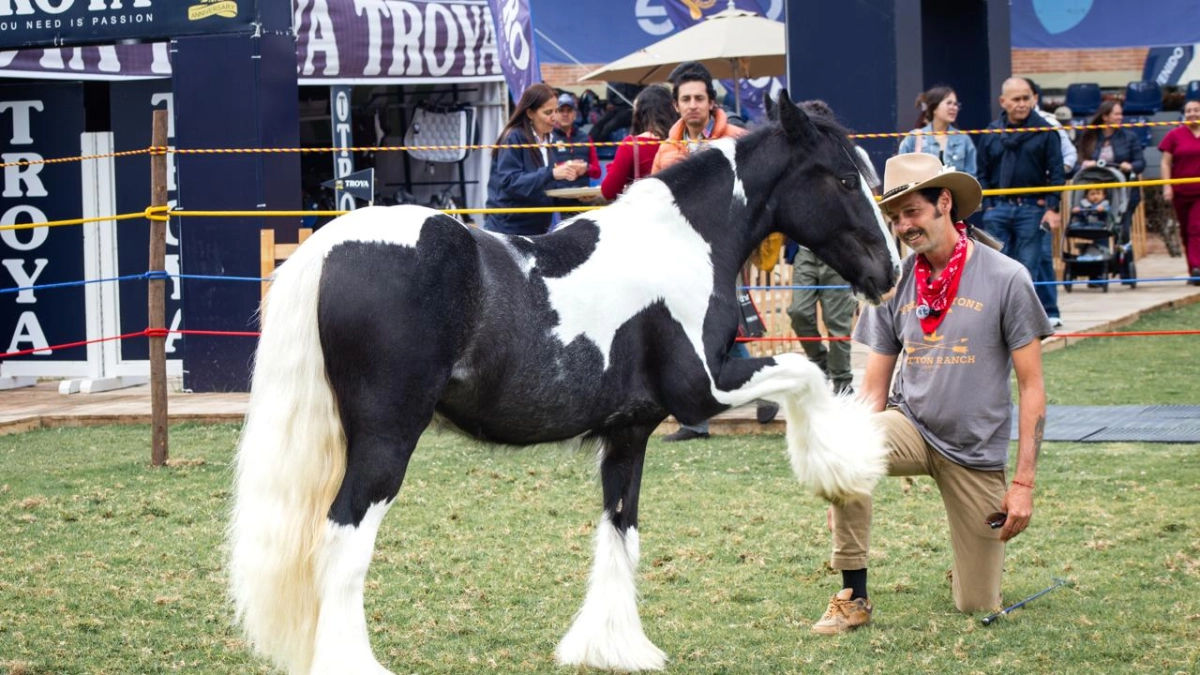
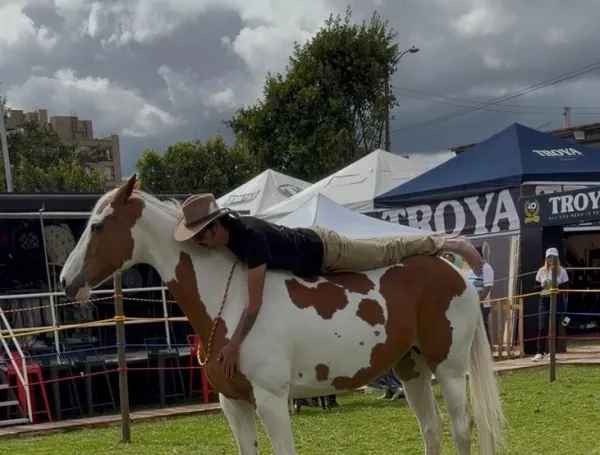
BOGOTÁ — For two transformative weekends in September (18–20 and 25–27), the Colombian capital will become the epicenter of the global equestrian community. The prestigious Cantón Norte de Caballería will open its gates to host the inaugural World Congress of Horse Trainers (Congreso Mundial de Domadores), an unprecedented international gathering dedicated to the philosophy of working with horses in absolute freedom, fostering deep communication, and championing ethical equine welfare.
Organized by the non-profit Fundación Caballos con Alas—an organization committed to advancing equine welfare, professional equestrian education, assisted therapies, and sustainable rural development—the event promises to bridge the gap between traditional breaking techniques and modern, empathetic horsemanship.
At the creative helm of this ambitious gathering is Juan Pablo Saiz, a renowned Colombian horse trainer with over two decades of multifaceted experience spanning equine shows, specialized training, and audiovisual productions. Through meticulous planning and a lifelong dedication to the craft, Saiz has curated a lineup of world-renowned masters to guide attendees through an immersive journey of learning, reflection, and practical application.
Main Facts: The Intersection of Global Mastery and Local Vision
The World Congress of Horse Trainers is designed to be intimate yet impactful. Rather than a massive stadium event, organizers have deliberately capped attendance at approximately 150 participants, ensuring a targeted and deeply interactive environment. Out of these spots, roughly 50 are reserved for international attendees, creating a cross-cultural melting pot of passionate equestrians, therapists, and rural developers.
The event features an elite roster of international speakers whose philosophies are anchored in mutual respect, patience, and non-violent communication with equines:
Jean-François Pignon (France): A globally celebrated pioneer in working with horses in total freedom, renowned for his breathtaking harmony and synchronization with herds without ropes or bridles.
Cristóbal Scarpati and Ailina Wegrzyn (Argentina): Masters of traditional yet deeply intuitive south-of-the-equator horsemanship, focusing on subtle body language and psychological alignment.
Christina Marz (Austria): A European voice advocating for anatomical and psychological harmony between horse and rider.
Waldo Junqueira Franco (Brazil): A certified instructor of the legendary Monty Roberts methods, bringing structured, trust-based communication techniques to the forefront.
Pablo Saladarriaga (Colombia): Representing the host nation’s elite tier of thoughtful horsemen, contributing local perspective and technical mastery.
According to Saiz, the core mission of the Congress is twofold: to provide direct, hands-on access to masters who were previously only accessible via digital screens, and to plant the seed of a kinder, more conscious equestrian culture in Colombia and across Latin America.
Chronology: From Digital Inspiration to an International Reality
The journey toward bringing the World Congress of Horse Trainers to Bogotá is a story of persistence, self-reflection, and a digital-age renaissance in horsemanship.
Phase I: The Years of Solitary Learning (Early 2000s – Early 2010s)
For over twenty years, Juan Pablo Saiz walked the path of a dedicated equestrian. In the early stages of his career, access to high-level progressive training methods was scarce in South America. Saiz relied heavily on the nascent digital landscape, watching video clips and tutorials of international masters—many of whom are now his co-panelists at the Congress.
"During long periods, I learned virtually by observing each of these guests," Saiz reflects. "They became my mentors and masters without even knowing it. I would watch their videos and immediately run out to the paddock to practice what I saw."
Phase II: The Realization and the Spark (2023–2025)
Despite years of hands-on practice, Saiz recognized a persistent limitation in modern equestrian education: the reliance on passive, digital consumption. He realized that countless other trainers, handlers, and horse lovers across Latin America shared his hunger for direct, interactive mentorship. The vision for a live, immersive global summit began to take shape. Collaborating with the Fundación Caballos con Alas, the planning phase shifted from a conceptual dream to concrete logistical execution, securing the historic Cantón Norte de Caballería as the ideal venue.
Phase III: The Upcoming Immersive Weekends (September 18–20 and September 25–27, 2026)
The culmination of this multi-year vision will unfold over two intensive three-day blocks. The first weekend will focus on foundational communication, herd dynamics, and the psychological principles of working in freedom. The second weekend will delve deeper into advanced problem-solving, emotional regulation, and integrating these philosophies into daily equestrian practices and therapeutic environments.
Supporting Data and Demographics
To understand the scope and intentionality of the World Congress of Horse Trainers, one must examine the metrics and logistical framework established by the organizing committee:
Duration: Two distinct three-day blocks (September 18–20 and September 25–27).
Capacity: Strictly limited to 150 participants to preserve the quality of interaction, real-time troubleshooting, and hands-on practice.
International Representation: Approximately 33% of the audience (50 attendees) will travel from outside Colombia, ensuring vibrant global networking.
Organizational Backbone: Spearheaded entirely by Fundación Caballos con Alas, underscoring a mission-driven approach focused on welfare rather than commercial excess.
Historical Context: More than 5,000 years of documented human-equine evolution provide the historical backdrop for the congress’s core teaching: that the horse is not merely a tool, but an evolutionary mirror.
Official Perspectives and Interviews: The Philosophy of Self-Mastery
In an exclusive interview with EL TIEMPO, Juan Pablo Saiz elaborated on the deeper philosophical underpinnings of the event, shedding light on what modern trainers often misunderstand about their equine partners.
The Mirror Effect: Domans vs. Self-Mastery
When asked how horses act as allies for emotional regulation, human development, and communication, Saiz offered a profound psychological insight drawn from his decades in the paddock:
"The horse has been our ally in human evolution for over 5,000 years, and they evoke profound emotions within us. In conscious taming, horses taught me that to train a horse, I first had to train myself—managing my own fears and insecurities. When working with a horse, the animal acts as a mirror and a reader of our emotions."
Saiz emphasized that effective communication starts not with physical cues, but with breath control. Because respiration is directly tied to human emotional states—shifting whether a person is experiencing anxiety, love, or grief—learning to breathe from the abdomen becomes a vital tool for regulating both human anxiety and equine response. In this sense, horsemanship transforms into a holistic philosophy of life: to train a horse is, in essence, to train oneself.
The Greatest Human Error: Anthropomorphism
Addressing the most common pitfall humans face when interacting with horses, Saiz pointed directly to our psychological projection onto animals:
"The biggest mistake is falling into anthropomorphism: pretending to treat the horse as if it were a human being and assigning human personalities to it. When we do this, we stop allowing them to be horses and force them to behave like people. It is a common flaw we commit more to satisfy our own psychological needs than for the actual well-being of the animal."
Implications: A New Era for Latin American Horsemanship
The implications of the World Congress of Horse Trainers extend far beyond the arenas of the Cantón Norte de Caballería. By bringing global pioneers like Jean-François Pignon, Cristóbal Scarpati, and Christina Marz directly into dialogue with Latin American practitioners, the event acts as a catalyst for systemic change in regional animal husbandry.
Shift from Force to Choice: Traditional breaking methods have historically relied on dominance, coercion, and breaking the animal’s spirit. The congress champions methodologies where the horse participates willingly through mutual trust and clear communication in freedom.
Elevation of Equine Welfare Standards: Through the advocacy of Fundación Caballos con Alas, the event reinforces the integration of ethical standards in sports, rural development, and equine-assisted therapies, which are rapidly growing sectors across Colombia.
Community Building: By fostering a tight-knit cohort of 150 dedicated practitioners, the congress establishes a sustainable regional network equipped to mentor future generations of ethical horsemen and women.
Event Details and Registration
For those interested in securing one of the remaining spots or learning more about the daily schedules, masterclasses, and logistical accommodations, official channels remain open:
As Bogotá prepares to welcome the masters of freedom training, the message is clear: the future of horsemanship is not written in the reins of control, but in the quiet, resonant space of mutual understanding.
By Edwin Caicedo | Environmental and Health Journalist Published: September 16, 2026 1. Main Facts: Breaking the Cycle of Darkness in a Forgotten Territory For generations, the more than 200 residents of La Victoria—a rural…
By Cultural & Environmental Desk Published: September 8, 2026 Main Facts In a groundbreaking study that has recently captured the attention of the global conservation community, researchers at the prestigious University of Kyoto have successfully…
By Global News Desk Published: September 10, 2026 Main Facts: The Legacy of August 10 It has been exactly one month since a powerful 7.4-magnitude earthquake struck western Colombia, shattering communities, reshaping landscapes, and leaving…