By Edwin Caicedo
Environmental and Health Journalist
Updated: September 10, 2026
Main Facts: The Human Face of Devastation in Las Terrazas
One month after a powerful 7.4-magnitude earthquake shook Colombia’s Chocó department, the city of Quibdó bears deep structural and psychological scars. Yet, amidst the sobering reality of imminent demolitions, a poignant display of human endurance has emerged in the hardest-hit sectors.
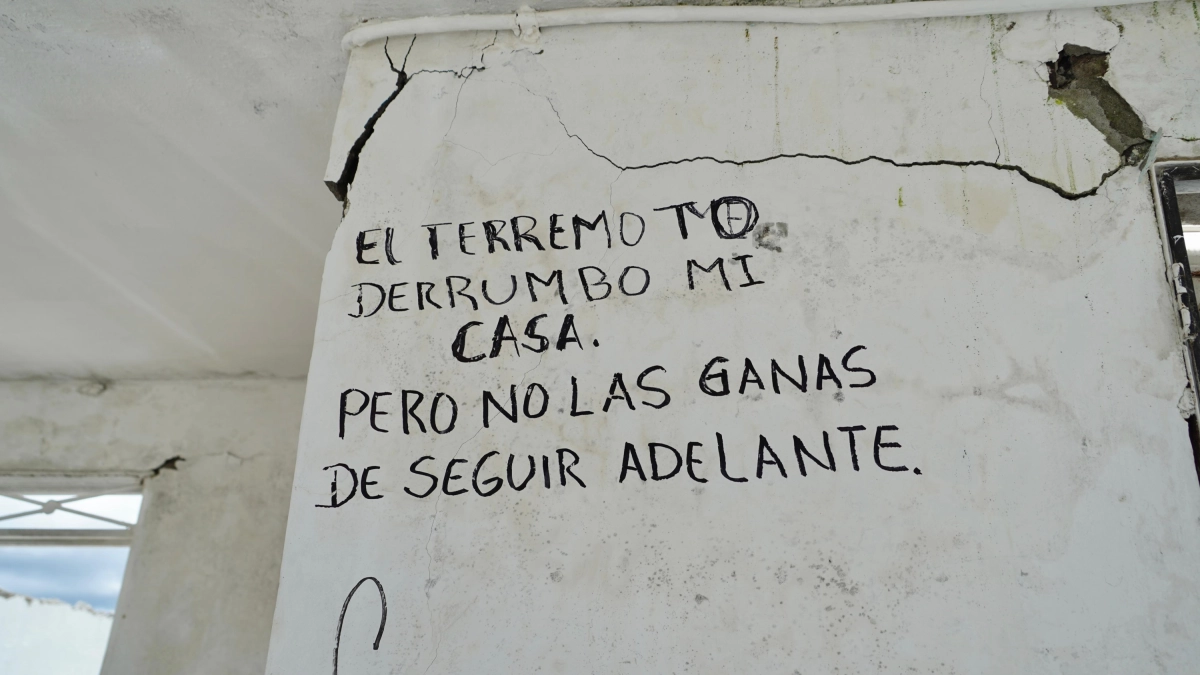
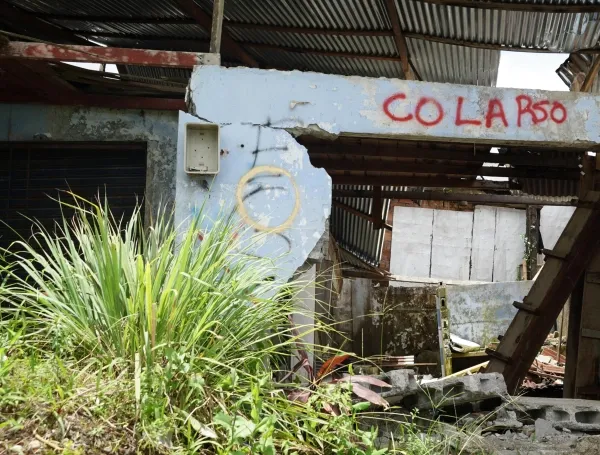
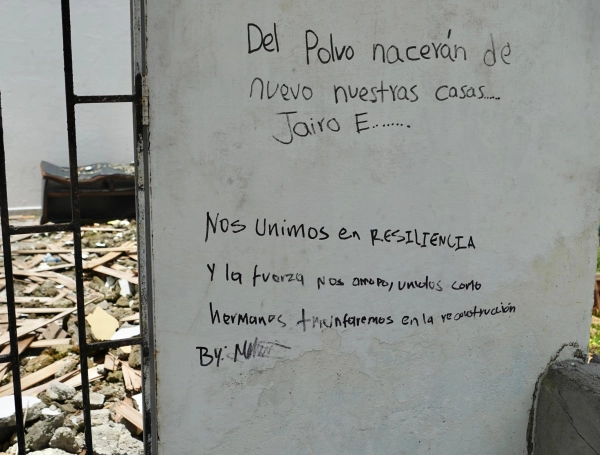
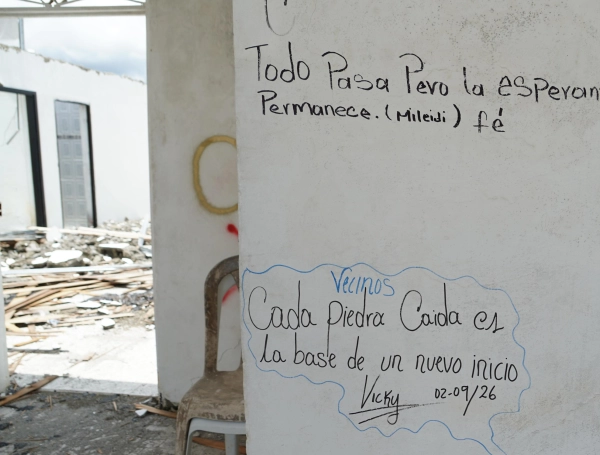
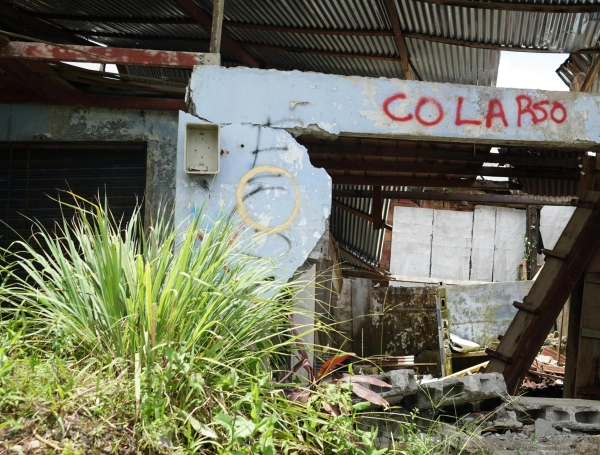
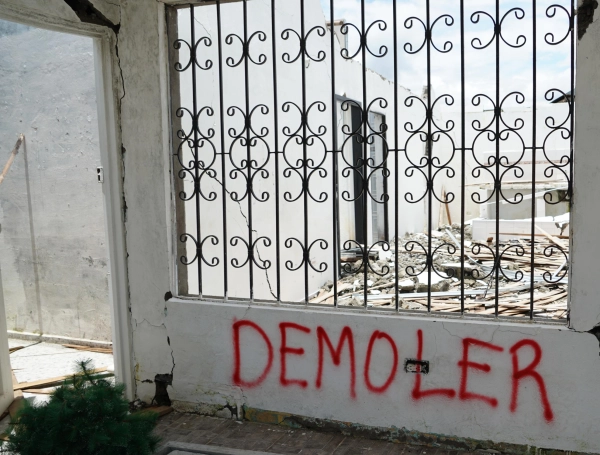
In the neighborhood of Las Terrazas—a zone slated for total demolition due to extreme structural compromises—the cracked and fractured walls of homes awaiting the wrecking ball have been transformed into canvases of hope. Where crumbling facades and dangerous overhangs threaten public safety, residents have left handwritten, often-signed messages expressing profound resilience, faith, and an unwavering determination to rebuild.
"The earthquake destroyed my house, but not my will to keep moving forward," reads one stark message scrawled across a damaged exterior wall.

Another firmly lettered inscription invokes spiritual solace: "God is our refuge, our strength, our ever-present help in trouble." Nearby, a communal sentiment of solidarity echoes off the dust: "We unite in resilience, and strength protects us; united as brothers, we will triumph in reconstruction."
Individual residents have also stamped their personal grief and optimism onto the crumbling masonry. "Everything passes, but hope remains. Faith," wrote Mileidi. "Each fallen stone is the foundation of a new beginning," noted Vicky.

Offering a broader reflection, a resident named Pipo wrote: "You must never lose hope, no matter how difficult the situation… The great storms make us strong and never last forever." Summing up the collective poetic tragedy of the barrio, Jairo left a hauntingly simple promise: "From dust, our homes will be born again."
These powerful displays stand in sharp contrast to the stark statistics released by municipal authorities, painting a vivid picture of a community caught between profound loss and the arduous road to recovery.
Chronology of a Crisis: One Month After the Tremor
To understand the current atmosphere in Quibdó, it is necessary to retrace the timeline of the disaster and its immediate aftermath over the past four weeks:
- Day Zero (August 2026): A 7.4-magnitude earthquake violently strikes the Chocó department, with its epicenter and severe shockwaves heavily impacting Quibdó. Critical infrastructure fails instantly, homes are structurally compromised, and initial emergency protocols are activated.
- Weeks 1–2: Search-and-rescue operations transition into damage assessments. The scale of the disaster becomes apparent as thousands of structural inspections reveal widespread habitability issues across residential, educational, and medical facilities. Temporary shelters are hastily established for displaced families.
- Week 3: Humanitarian aid begins scaling up significantly, channeled largely through local religious institutions and municipal logistics networks. Public frustration mounts over delayed heavy machinery required to demolish unstable buildings, leaving neighborhoods like Las Terrazas and Jardín in anxious limbo.
- One Month Mark (September 10, 2026): The Alcaldía (Mayor’s Office) of Quibdó releases comprehensive updated data from the Single Registry of Victims (RUD). While stabilization phases are mapped out, residents in Las Terrazas take to their doomed walls to write messages of faith, marking a symbolic psychological transition from emergency response to the long-term planning of reconstruction.
Supporting Data: The Magnitude of the Tragedy
The emotional resilience witnessed in Las Terrazas is set against a backdrop of staggering infrastructural and economic damage. According to the official balance provided by the Mayor’s Office of Quibdó, with data cut off on September 9, the scope of the disaster encompasses multiple sectors of public and private life:
Human Toll and Displacement
- 34,608 individuals (representing 14,889 families) have been officially registered as affected or displaced.
- 8 fatalities and 145 injuries were recorded in the immediate aftermath.
- 498 people (156 families) remain housed in temporary shelters.
Housing and Structural Assessments
Out of 3,839 formal housing inspections conducted across the city:
- 1,103 buildings were classified as safe and habitable.
- 1,017 structures present restrictions or minor-to-moderate damage.
- 890 properties are categorized as uninhabitable but structurally capable of being reinforced.
- 829 properties—including a vast majority of the homes in Las Terrazas—have completely collapsed or are in imminent danger of collapse, requiring immediate, total demolition.
Public Infrastructure and Essential Services
- Education: 84 out of 130 official educational institutions suffered structural damage, disrupting the academic continuity of approximately 29,939 students.
- Health: 19 healthcare points sustained damage, forcing 14 of them to close entirely (such as the Ismael Roldán Hospital, which continues to struggle with closed hospitalization areas and power outages).
- Civic Infrastructure: The tremor impacted 16 public buildings, 13 sports complexes, 4 universities, 11 community centers, 2 bridges, and the municipal aqueduct.
- Local Economy: Out of 619 census-tracked commercial establishments, 598 (96.6%) reported some level of damage, placing the livelihoods and jobs of numerous local businesses in immediate jeopardy.
Humanitarian Response and Solidarity
Despite severe logistical constraints, relief efforts have mobilized substantial resources:

- 690 tons of humanitarian aid have been successfully distributed.
- Over 79.384 billion pesos have been collected in monetary donations through the Faith Corporation of the Diocese of Quibdó.
- More than 2,000 volunteers have contributed over 420 hours of community labor to assist affected neighborhoods.
Official Responses and Institutional Strategy
Faced with a crisis that far exceeds local administrative budgets, municipal and regional leaders have outlined a dual-phase strategy prioritizing immediate stabilization before undertaking full-scale reconstruction.
Quibdó Mayor Rafael Bolaños Pino emphasized the immense logistical hurdles facing the city, noting that the primary bottleneck preventing a swift transition to reconstruction is the lack of specialized heavy machinery and technical capacity.
"Our purpose is to advance responsibly. First, we must stabilize the conditions of the territory in order to rebuild safely and consolidate the development of the city," Mayor Bolaños Pino stated.
The administration has underscored that Quibdó cannot manage the crisis alone. The local government is urgently calling for coordinated intervention, financial backing, and technical resources from the National Government, international cooperation agencies, and the private sector.
Financial Projections for Recovery
Preliminary estimates from the municipal administration outline a monumental financial requirement:
- The Stabilization Phase: Estimated at over 200,000 million pesos, this phase covers emergency demolitions of high-risk structures (such as Las Terrazas), debris removal, road clearing, and the provision of continuous physical and mental health services to traumatized populations.
- The Reconstruction Phase: Comprehensive physical, economic, and social reconstruction of Quibdó is projected to cost approximately 3 trillion pesos—a figure that currently represents a preliminary assessment of total needs rather than secured funding.
Implications: The Long Road Ahead for Quibdó
The one-month anniversary of the Chocó earthquake marks a critical turning point for Quibdó. The implications of this disaster extend far beyond the physical clearing of rubble; they touch upon the structural vulnerabilities of regional development, social equity, and psychological recovery.
Social and Mental Health Ramifications
The displacement of thousands of families, coupled with the permanent loss of neighborhoods like Las Terrazas, threatens to fracture traditional community networks. While messages of resilience scrawled on ruined walls provide a temporary psychological balm, mental health experts warn that the trauma of displacement, loss of livelihood, and living under the constant threat of aftershocks or secondary collapses—such as those reported in neighboring areas like the Jardín district—will require long-term institutional intervention.
Economic Viability and Employment
With nearly the entirety of the local commercial sector reporting structural impacts and hundreds of jobs hanging in the balance, Quibdó faces an acute economic crisis. If small businesses cannot access rapid credit, tax relief, and physical rebuilding support, the demographic stability of the city could be threatened by economic migration.

Infrastructure Modernization
The earthquake has exposed historical deficits in urban planning and construction standards in Chocó. As national and local authorities deliberate on the multi-trillion-peso reconstruction roadmap, a central debate centers on whether the rebuilding process will incorporate modern, earthquake-resistant engineering standards capable of withstanding future seismic events in a historically vulnerable region.
For now, as the heavy machinery prepares to erase the final physical traces of Las Terrazas, the words written by Mileidi, Vicky, Pipo, Jairo, and their neighbors remain on the fractured walls. They stand as a testament to a resilient community that refuses to let a natural disaster extinguish its collective spirit—insisting, even in the dust, on the promise of a new beginning.