
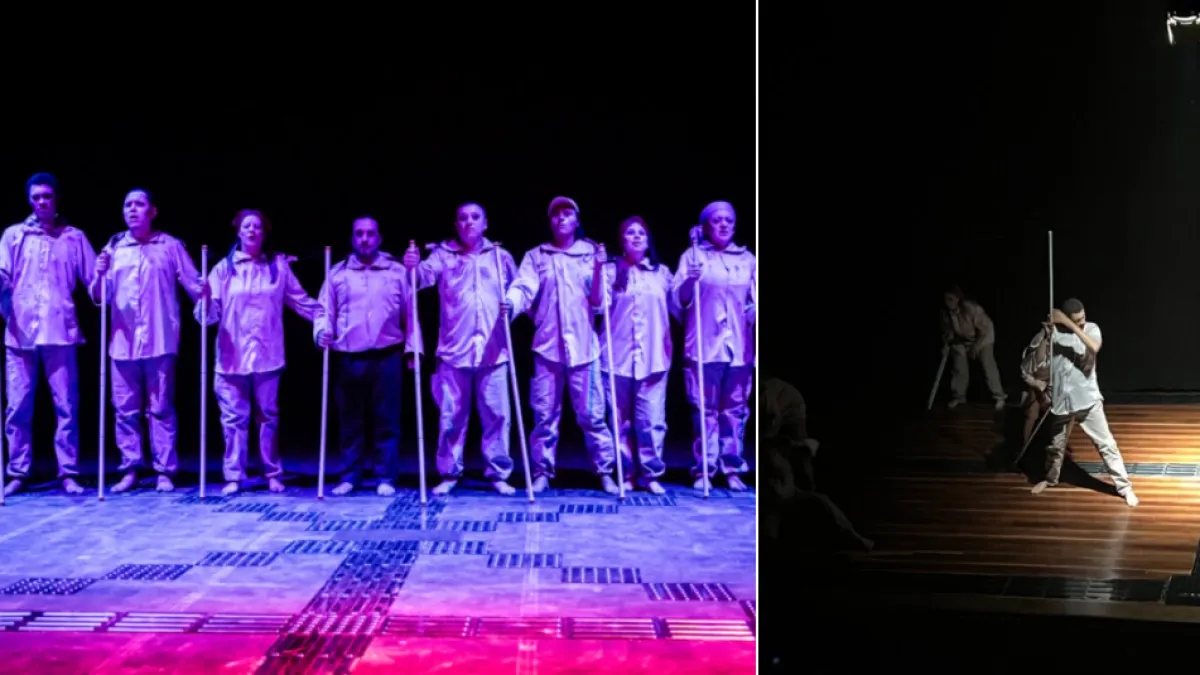
Bogotá, Colombia — In a groundbreaking fusion of avant-garde performance, historical memory, and radical social inclusion, the renowned Bogotá-based theater collective Café A Ciegas is set to stage its most ambitious project to date: El Laberinto de los Sin Sentidos (The Labyrinth of the Nonsenses).
For three nights only—from September 17 to September 19—the capital’s cultural scene will bear witness to a theatrical milestone. Hosted at the Teatro La Factoría Tino Fernández in the Galerías sector, this production is celebrated by its creators as the first dramatic piece written, interpreted, and directed entirely by artists with sensory disabilities in Colombia and across Latin America.
More than just a play, El Laberinto de los Sin Sentidos is an artistic and political statement. It challenges the conventional boundaries of stagecraft, dismantles persistent societal prejudices regarding disability, and offers a profound meditation on the shadows of Colombia’s complex national history.

Main Facts
The upcoming Bogotá engagement represents a pinnacle moment for Café A Ciegas, an independent troupe that has quietly revolutionized the nation’s performing arts landscape. With a cumulative history exceeding 300 performances and drawing roughly 3,500 spectators throughout its various past creations, the group continues to expand its cultural footprint.
At the heart of the production is a compelling and layered narrative. The story follows Tomás, a blind child whose journey serves as a vehicle to explore themes of abandonment, systemic discrimination, and the inherent ambiguities of the human condition. This fictional narrative does not exist in a vacuum; it is deeply intertwined with Matías, a celebrated novel by Bogotá-born writer Fernando Ponce de León—hailed by the collective as one of the top one hundred masterpieces of 20th-century Colombian literature.
Furthermore, the play bridges intimate human suffering with collective trauma. It reconstructs the haunting memory of the seizure and retaking of the Palacio de Justicia (Palace of Justice), marking one of the most controversial, painful, and fiercely debated chapters of the Colombian armed conflict.

The artistic vision driving this monumental work belongs to José David Díaz, a blind musician, composer, and actor boasting a career that spans more than two decades. Recognizing the logistical hurdles of staging a complex, multi-layered narrative with visually impaired actors, Díaz engineered a brilliant technical solution: a custom-designed 10-by-10-meter scenic matrix. Equipped with integrated podotactile pathways spanning both the stage and the backstage zones, this matrix allows the actors to navigate the space with absolute precision, safety, and autonomy.
Chronology
To fully understand the magnitude of El Laberinto de los Sin Sentidos, it is essential to trace the journey of Café A Ciegas and the evolution of disability-led arts in the region.
- Early Foundations: Café A Ciegas established itself as a grassroots response to the cultural marginalization of artists with sensory impairments in Bogotá. Rather than accepting charitable or tokenistic roles, the founders envisioned a professional troupe operating at the highest artistic standards.
- Accumulating Milestone Performances: Over the years, the collective developed various conceptual pieces, steadily building momentum, training performers, and refining their unique sensory-spatial methodologies. They surpassed the milestone of 300 total performances across alternative and independent venues.
- The Conceptualization of El Laberinto: Director José David Díaz spent years designing the architectural and spatial requirements for the play. The creation of the podotactile stage grid marked a critical technological and creative breakthrough, bridging the gap between physical limitation and absolute spatial mastery.
- Literary and Historical Synthesis: The integration of Fernando Ponce de León’s novel Matías with the harrowing memories of the 1985 Palacio de Justicia siege transformed the script from a personal narrative of blindness into an epic canvas of national reflection.
- September 17–19, 2026 (Upcoming): The official three-night run at the Teatro La Factoría Tino Fernández in Bogotá opens its doors to the public, marking a watershed moment for inclusive performing arts in Latin America.
Supporting Data
The urgency and social relevance of Café A Ciegas’ work are underscored by stark socio-economic statistics regarding disability, employment, and representation in Colombia.

According to demographic data published by DANE (Colombia’s National Administrative Department of Statistics) in its landmark 2019 reports:
- 7.2% of the total Colombian population lives with some form of disability. This translates to roughly 3.5 million citizens navigating daily life with physical, sensory, or cognitive variations.
- Of that broad demographic, 1,948,332 individuals live specifically with visual impairments, ranging from low vision to total blindness.
- Perhaps most alarmingly, 83 percent of individuals with visual disabilities in Colombia lack formal employment.
These numbers paint a grim picture of systemic exclusion, where talent is routinely sidelined by infrastructure barriers, corporate bias, and a lack of accessible vocational pathways. Café A Ciegas directly confronts this structural failure by proving that art is not merely an aesthetic pursuit, but a viable, professional economic sector capable of generating sustainable livelihoods for disabled artists.
Official Responses and Perspectives
The philosophy of Café A Ciegas is rooted in the belief that true inclusivity goes beyond passive accessibility—it demands active authorship and leadership.

"Our work is not about inspiring pity or receiving applause merely because we face challenges," representatives of the collective have frequently emphasized in cultural forums. "It is about rigorous artistic excellence, professional discipline, and demanding our rightful place as creators, thinkers, and directors within the national cultural canon."
Cultural analysts and theater critics in Bogotá have increasingly rallied around the troupe, noting that productions like El Laberinto de los Sin Sentidos force mainstream audiences to reconsider their assumptions about perception. By relying on auditory cues, tactile floor mapping, and non-visual spatial awareness, the actors invert the traditional dynamic of the theater: the sighted audience is invited to enter a sensory world crafted entirely by those who navigate darkness daily.
Furthermore, allies within the academic and literary communities have praised the seamless integration of Fernando Ponce de León’s Matías. Scholars note that utilizing classic Colombian literature to mirror the historical scars of the Palacio de Justicia elevates disability theater out of the realm of niche community outreach and places it squarely at the vanguard of political and historical drama.

Implications
The implications of El Laberinto de los Sin Sentidos extend far beyond the curtain call at the Teatro La Factoría Tino Fernández. This production serves as a blueprint for cultural democratization across Latin America.
1. Redefining Accessibility in the Arts
For decades, "accessibility" in the performing arts has been treated as an afterthought—a ramp added to a stage entrance, or a sign-language interpreter shoved into the corner of a proscenium arch. José David Díaz and Café A Ciegas flip this paradigm entirely. By embedding podotactile pathways directly into the core design of the stage matrix, they prove that accessibility can be the foundational architecture of creation itself. This methodology challenges national theaters, cultural ministries, and independent spaces across the continent to rethink how they build, fund, and design performance venues.
2. Economic Emancipation Through Culture
With over 80% of visually impaired Colombians locked out of the formal labor market, artistic collectives offer an alternative economic model. By treating performance as a profession rather than a therapeutic hobby, Café A Ciegas lays down a challenge to public and private entities alike: cultural funding must be leveraged to create real jobs. When artists are paid, trained, and recognized as professionals, cultural policy actively combats poverty and social isolation.

3. De-marginalizing Historical Memory
By tackling heavy national traumas—such as the labyrinthine tragedies of the armed conflict and the siege of the Palacio de Justicia—through the lens of marginalized bodies, the production asserts that those historically silenced by society have every right to narrate the collective history of the nation. Tomás’s journey through abandonment and discrimination mirrors the systemic neglect faced by victims of historical violence in Colombia, creating a powerful theatrical dialogue between personal sensory isolation and national political grief.
As the lights dim at Teatro La Factoría Tino Fernández this September, El Laberinto de los Sin Sentidos will do more than entertain. It will dismantle stereotypes, map new theatrical territories, and challenge every spectator to confront the many ways society remains willfully blind.