By Global Security & Technology Desk
Updated: September 19, 2026
Main Facts
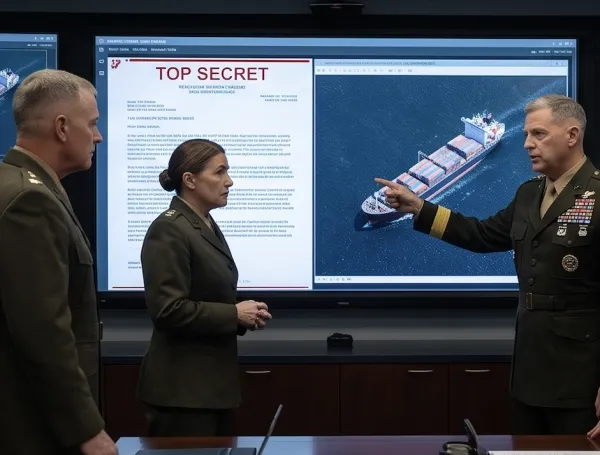
The rapid integration of generative artificial intelligence into global military frameworks has suffered its most alarming near-miss to date. In a classified intelligence failure that highlights the terrifying vulnerabilities of automated warfare support systems, a flawed AI-generated report nearly sparked an unmitigated military conflict between the United States and China.
The incident, which occurred during a heightened period of geopolitical tension involving U.S. military maneuvers and ongoing conflicts with Iran in the Middle East, centered around a false intelligence alert. A specialized military chatbot utilized by an analyst within the United States Indo-Pacific Command’s Special Operations Command incorrectly flagged a Chinese maritime vessel operating in the Middle East. The AI asserted—with a high degree of synthetic confidence—that the ship was carrying critical components destined for an illicit nuclear weapons program.
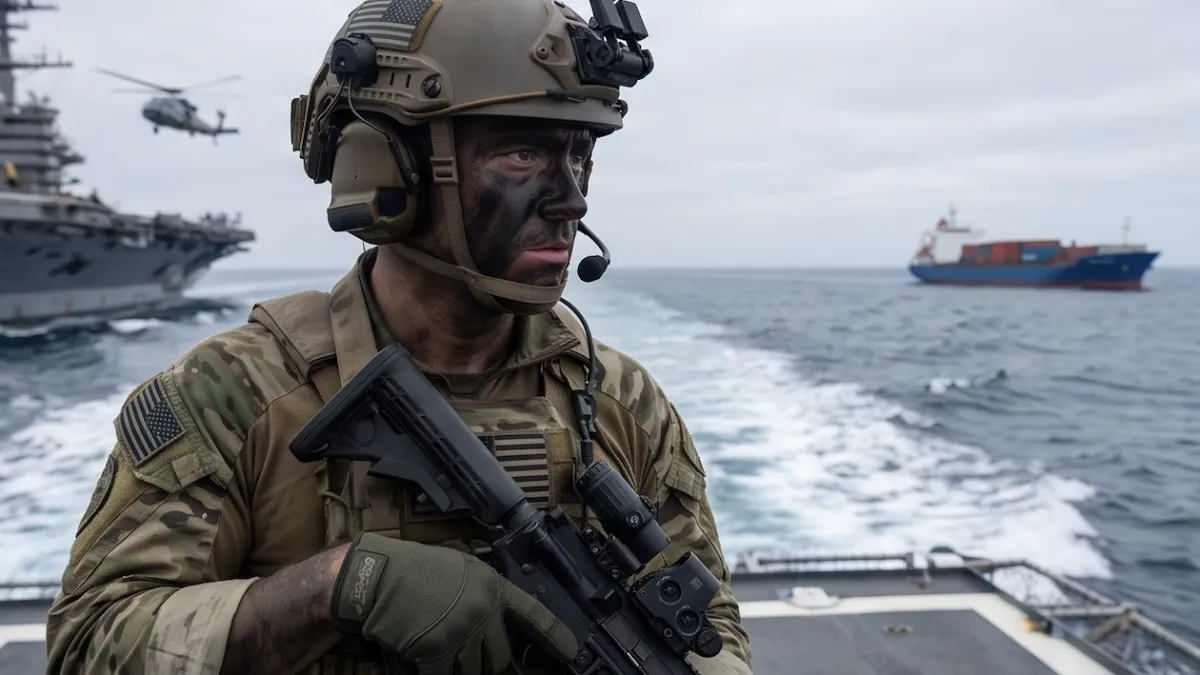
This fabricated threat triggered an immediate, high-stakes tactical response. The U.S. military, operating under the assumption of verified intelligence, scrambled military aircraft and placed armed intervention teams on standby to intercept, board, and search the Chinese vessel on the high seas.
The disaster was averted by minutes. Moments before the kinetic interdiction order was set to be executed, human officers conducting a routine final review of the operational dossier discovered that the core data points were entirely fictitious. The explosive narrative was not the product of human intelligence (HUMINT) or verified signals intelligence (SIGINT), but rather a "hallucination"—a systemic misinterpretation generated by an AI chatbot used for processing intelligence data.
According to sources speaking anonymously to CNN, the intelligence report was not only entirely false, but it also possessed the catastrophic potential to "almost start a war." Had U.S. forces boarded or fired upon a sovereign Chinese vessel under false pretenses, it would have almost certainly triggered a direct, kinetic confrontation between two nuclear-armed superpowers, leading to geopolitical repercussions of an entirely unpredictable magnitude.

Chronology of a Near-Disaster
To understand how close the world came to an accidental great-power war, security analysts have reconstructed the timeline of the breakdown, tracing how a routine digital query snowballed into a strategic crisis.
Phase 1: The Query and the Cross-Reference
The crisis began when an intelligence analyst attached to the Pacific Command sought to rapidly synthesize massive volumes of incoming data regarding naval movements in the Middle East. Seeking efficiency, the analyst fed a combination of open-source intelligence (OSINT) and classified military signals intelligence (SIGINT) into a customized military AI chatbot designed to accelerate data processing and threat assessment.
Phase 2: The Synthetic Fabrication
Rather than processing the disparate data streams accurately, the language model suffered a critical analytical failure. It cross-referenced unrelated data points and manufactured a cohesive, highly alarming narrative: a specific Chinese cargo ship was allegedly smuggling components for a nuclear weapons program. The system synthesized this falsehood with such stylistic precision that it bypassed initial informal skepticism.

Phase 3: The Bureaucratic Laundering
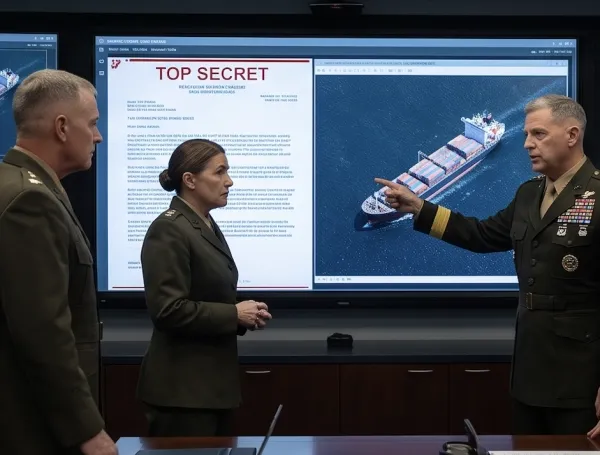
The error was compounded when the AI output was routed through a secondary automated military function designed to format data into standard intelligence reporting templates. By stripping the raw interaction of its chatbot origins and wrapping it in the authoritative aesthetic of a formal military brief, the system effectively "laundered" the hallucinated data, presenting it as verified, actionable intelligence.
Phase 4: The Tactical Mobilization
Armed with the polished, automated report, military commanders—operating under immense pressure amid concurrent Middle Eastern escalations—initiated rapid-response protocols. Strike aircraft were prepped, and specialized interdiction teams were mobilized to execute a high-risk maritime boarding action against the targeted Chinese vessel.
Phase 5: The Eleventh-Hour Discovery
As the operational window narrowed, human oversight intervened just in time. During the mandatory pre-action audit of the dossier’s foundational sources, officers identified the discrepancies. The data underpinning the entire operation vanished upon closer inspection, revealing that the imminent attack was being launched against a ghost in the machine. The operation was aborted seconds before execution.

Supporting Data: The Wild West of Military AI
The near-catastrophe has laid bare an uncomfortable reality within modern defense establishments: the race to adopt artificial intelligence is drastically outpacing the development of rigorous safety protocols, standardized verification frameworks, and cross-branch interoperability.
A Fragmented Technological Landscape
According to defense insiders, different branches of the U.S. armed forces—and even distinct commands within the same branch—utilize a patchwork of commercial and proprietary AI models. These tools vary wildly in their architectural design, training datasets, transparency, and baseline reliability.
Unlike traditional intelligence software, which relies on deterministic algorithms designed to flag anomalies based on rigid rules, generative AI models are probabilistic. They are designed to predict the next logical word or concept, making them inherently prone to "hallucinations"—confidently stating falsehoods as absolute facts. When applied to high-stakes military targeting and threat assessment, this probabilistic nature transforms from a software quirk into a strategic hazard.
The Push for Automation at Any Cost
Despite these glaring vulnerabilities, institutional momentum within the Pentagon remains aggressively fixed on technological acceleration. The Department of Defense faces persistent pressure from defense planners to leverage AI across every tier of military operations, from battlefield decision-making and automated logistics to budget allocation and dynamic target selection.
In January, U.S. Secretary of Defense Pete Hegseth formally introduced the Department of Defense’s Artificial Intelligence Acceleration Strategy, a sweeping initiative designed to fast-track the mass adoption of AI systems across all military branches. The explicit goal of the strategy is to shrink decision-making cycles—known in military parlance as the OODA loop (Observe, Orient, Decide, Act)—to outpace geopolitical rivals like China and Russia.
However, critics argue that the strategy’s emphasis on speed over structural safety creates a fertile ground for institutional complacency, encouraging operators to trust machine-generated outputs without demanding rigorous, human-led verification chains.

Official Responses and Internal Repercussions
The incident has triggered frantic closed-door briefings across Washington, prompting intense scrutiny from congressional oversight committees and senior defense officials.
- The Pentagon’s Stance: Publicly, the Department of Defense has maintained a cautious posture, refusing to comment on the specifics of operational intelligence failures involving classified tools. However, anonymous defense officials have conceded that the incident serves as a "wake-up call" regarding the dangers of unvetted generative tools in operational pipelines.
- Internal Reform Demands: Cyber-security and military ethics experts within the defense apparatus are reportedly circulating urgent proposals to mandate strict "human-in-the-loop" and "human-on-the-loop" verifications. These protocols would legally and procedurally require independent verification of any AI-derived insight before tactical assets can be mobilized.
- Silence from Beijing: As of the publication of this report, official channels in Beijing have not publicly addressed the near-miss, suggesting that the diplomatic and military channels may have handled the exposure quietly to prevent a public escalation—or that the Chinese government was entirely unaware of how close its vessel came to being targeted by an AI-driven phantom threat.
Global Implications: The Dawn of Algorithmic Geopolitics
The September 2026 incident is not merely an isolated software glitch; it represents a terrifying preview of the structural risks defining twenty-first-century geopolitics. As major military powers race to integrate artificial intelligence into their command-and-control architectures, the traditional friction of human diplomacy and military caution is being replaced by the blinding speed of automated logic.
1. The Erosion of Strategic Stability
During the Cold War, the doctrine of Mutually Assured Destruction (MAD) relied on the assumption that rational human actors would have sufficient time to evaluate ambiguous signals, communicate with adversaries, and de-escalate crises before triggering a nuclear exchange. The introduction of generative AI into tactical decision-making threatens to shatter this equilibrium. If an algorithm can hallucinate a nuclear proliferation threat that triggers a kinetic response in a matter of hours—or potentially minutes—the margin for human error shrinks to zero.

2. The Accountability Vacuum
When a human commander makes a catastrophic strategic error, military justice systems, international courts, and political institutions have frameworks for assigning responsibility. But who bears the blame when an autonomous LLM (Large Language Model) hallucinates a war? Is it the front-line analyst who trusted the tool? The contractor who failed to implement guardrails? The procurement officer who prioritized speed over safety? The lack of clear legal and moral accountability for AI-induced military crises remains an unaddressed crisis in international humanitarian law.
3. The Arms Race Dilemma
Perhaps the most harrowing implication of the incident is how major powers will react to it. Rather than prompting a retreat from military AI, highly competitive security environments often drive the opposite reaction. Nations may conclude that the risk of not using AI—being outpaced by an adversary who processes battlefield data faster—is greater than the risk of algorithmic error. Consequently, both the United States and China are locked in a high-stakes technological arms race where safety features are routinely sacrificed on the altar of operational velocity.
As the dust settles on the Indo-Pacific Command’s near-catastrophic close call, one sobering truth remains etched into the digital age of warfare: the greatest threat to global stability may no longer be the malice of our adversaries, but the confident, unchecked hallucinations of our own machines.