By Laura María Villarraga Ariza / Last News Desk
Updated: September 10, 2026
Introduction: A New Reality at the Border and Beyond
The immigration landscape across the United States has undergone a radical and rapid transformation. Driven by the implementation of hardline deportation policies initiated at the start of President Donald Trump’s second term in January 2025, U.S. Immigration and Customs Enforcement (ICE) has dramatically intensified its enforcement operations. The result is a historic and sustained surge in arrests of individuals residing in the country in an irregular legal status, fundamentally altering communities, straining detention facilities, and sparking intense legal and humanitarian debates.

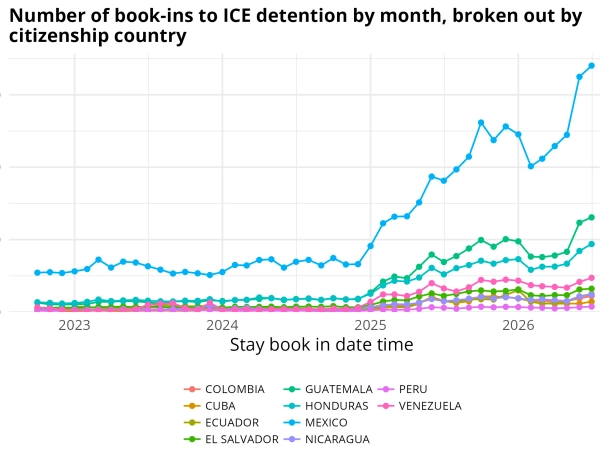
Data compiled by the Deportation Data Project—a joint research initiative between the University of California, Berkeley, and the University of California, Los Angeles (UCLA), which tracks public immigration enforcement records—illustrates a startling upward trajectory in detentions. While enforcement levels remained relatively stable throughout 2023 and 2024, the beginning of 2025 marked an inflection point. Since then, arrest curves have surged upward, touching nearly every demographic and nationality, with citizens from Mexico, Guatemala, and Honduras bearing the brunt of the crackdown.
1. Main Facts: The Scope and Scale of the 2025–2026 ICE Surge
The statistics emerging from the federal immigration enforcement apparatus reveal a historic scaling up of operations. According to the Deportation Data Project, monthly intake figures at ICE detention facilities have reached unprecedented highs.

- The Mexican Majority: Mexican nationals continue to represent the largest absolute volume of detentions. From a stable baseline of 2,500 to 4,000 monthly arrests between 2023 and late 2024, Mexican apprehensions climbed steeply after January 2025. By mid-2026, these numbers shattered previous records, surpassing 17,000 cases per month.
- Central American Nationals: Guatemala and Honduras follow closely behind as the second and third most impacted nations. Guatemala experienced a sharp escalation, climbing to over 6,000 monthly detentions by July 2026. Honduras similarly witnessed a dramatic surge, approaching 4,500 monthly facility intakes during the same period.
- South America and the Caribbean: While fewer in total volume compared to Mexico and the Northern Triangle, nations such as Venezuela, Colombia, Ecuador, Peru, Cuba, and Nicaragua have all seen parallel upward trends starting in 2025. Venezuela stands out within this group, recording between 1,500 and 2,500 arrests monthly during the height of the acceleration phase, while other regional nations maintained figures generally below 2,000 per month.
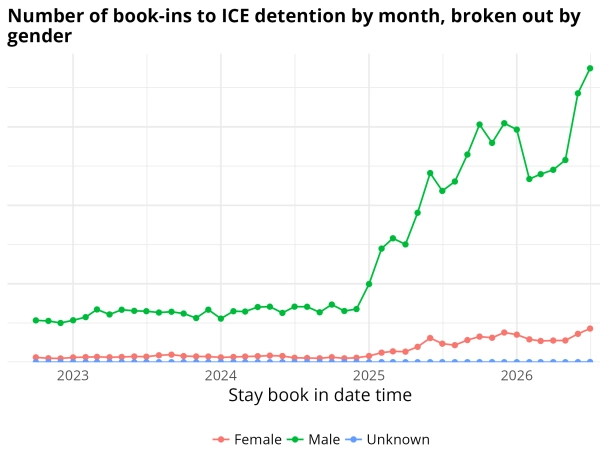
- Gender Disparities in Enforcement: Demographic breakdowns of the data indicate that men represent the overwhelming majority of ICE detainees. Male arrests hovered between 5,000 and 7,000 monthly through 2024, but skyrocketed following the policy shift in January 2025, peaking at an unprecedented high of over 35,000 arrests in July 2026. Conversely, female detentions, while also increasing after January 2025, remained significantly lower, transitioning from under 1,000 monthly to a peak of roughly 4,000 cases.
2. Chronology: How the Enforcement Strategy Evolved
To fully grasp the magnitude of the current immigration climate, observers must look back at the distinct operational phases that bridge the previous administration’s strategies with the current reality.
Phase I: Stability and Predictability (2023 – Late 2024)
Throughout 2023 and the majority of 2024, ICE operations operated within a framework characterized by prioritized targeting and moderate monthly fluctuations. While enforcement actions still occurred regularly, intake numbers across detention centers remained relatively predictable. Mexican nationals accounted for the bulk of the population—ranging steadily between 2,500 and 4,000 monthly entries—while citizens from other Latin American and Caribbean nations rarely breached the 1,000-monthly threshold. During this window, critics and advocates alike debated enforcement priorities, but the volume of overall detentions remained contained within established institutional capacities.

Phase II: The Turning Point (January 2025)
The inauguration of President Donald Trump for a second term in January 2025 marked an immediate pivot in federal policy. Promising large-scale, systematic deportations, the administration dismantled previous prosecutorial discretion guidelines that had previously focused ICE resources primarily on individuals with serious criminal records or recent border crossers. Within weeks of the transition, field offices nationwide received directives to ramp up workplace audits, community sweeps, and targeted operations.
Phase III: The Exponential Ascent (Mid-2025 – July 2026)
By the middle of 2025, the compounding effects of the new mandates were fully realized. The data reveals a steep, unbroken upward curve across all measured nationalities and demographics. Operational units expanded their reach from traditional border zones into the interior of the United States. By July 2026, monthly detentions reached historic milestones: overall male arrests surpassed 35,000, and Mexico-specific intakes exceeded 17,000. Facilities nationwide began grappling with capacity constraints as the systemic machinery of mass deportation operated at full throttle.
3. Supporting Data: What the Numbers Tell Us
The granular insights provided by academic institutions and independent trackers offer a clear picture of who is being targeted and how the enforcement priorities have shifted.
Criminal History vs. Non-Criminal Status
A focal point of contemporary debate involves the background of those swept up in the interior raids. Recent investigative reports and policy analyses underscore a notable trend: a significant proportion of individuals detained in mid-2026 possessed no criminal record. This reality has fueled intense public discourse, contrasting starkly with official narratives that often emphasize the targeting of dangerous transnational criminals and public safety threats.

For instance, high-profile community incidents—such as the detention of a 66-year-old Colombian national who was apprehended by ICE agents while simply stopping to buy a cup of coffee at a McDonald’s, or the case of 22-year-old Colombian digital creator Bryan Olivera, who detailed his harrowing months under ICE custody as a form of "mental torture"—have brought the human cost of indiscriminate sweeps into the public eye. Approximately 900 Colombian nationals alone have found themselves entangled in these operations during mid-2026, often expressing shock at the lack of administrative leniency.
The Macroeconomic and Facility Burden
With tens of thousands of individuals entering custody every month, the U.S. detention infrastructure faces unprecedented strain. Facilities originally designed for short-term processing are seeing extended stays as immigration courts struggle to keep pace with the sheer volume of docketed removal proceedings. Budgetary allocations for ICE have expanded significantly to accommodate the logistical requirements of charter flights, expanded bed space, and increased personnel.

4. Official Responses and Institutional Perspectives
The unprecedented surge in enforcement has elicited sharp, polarized responses from lawmakers, civil rights organizations, and federal agencies.
The Administration’s Stance
Proponents of the mass deportation strategy defend the actions of ICE as a necessary restoration of the rule of law and national security. Administration officials argue that existing federal statutes mandate the detention and removal of anyone residing in the United States without legal authorization, regardless of whether they have a criminal record. From this perspective, the aggressive operational tempo is viewed as fulfilling a clear electoral mandate to secure the nation’s borders and interior communities. Supporters contend that robust enforcement is the only effective deterrent against future irregular migration and a vital step toward safeguarding domestic labor markets.

Critiques from Advocacy Groups and Legal Experts
Conversely, immigrant advocacy organizations, legal defense networks, and human rights watchdogs have launched aggressive challenges against the enforcement wave. Critics argue that the widespread use of dragnet-style operations violates fundamental due process rights and tears apart mixed-status families who have lived peacefully in the U.S. for decades.
Legal scholars have raised concerns over the psychological and physical conditions inside overcrowded detention facilities, pointing to testimonies of detainees who describe prolonged confinement, inadequate access to legal representation, and severe psychological distress. Furthermore, civil rights groups argue that sweeping non-criminal populations into detention centers misallocates valuable law enforcement resources that should instead be directed toward genuine public safety threats.
5. Implications: Looking Ahead at the Future of U.S. Immigration Policy
As the data from mid-2026 demonstrates, the scale of U.S. immigration enforcement has crossed into a new historical epoch. The long-term implications of this strategy will likely reverberate across multiple dimensions of American society, international diplomacy, and the global economy.
- Impact on Diplomatic Relations: The heavy concentration of arrests among Mexican, Guatemalan, Honduran, and Venezuelan nationals places renewed pressure on bilateral and multilateral relations between Washington and Latin American governments. Issues surrounding repatriation flights, economic remittances, and regional migration management have become central topics of diplomatic negotiation.
- Economic and Social Ripple Effects: The removal of hundreds of thousands of workers from local economies—particularly in sectors such as agriculture, construction, hospitality, and food service—presents complex economic challenges. While proponents argue this opens opportunities for domestic workers, business associations and labor economists frequently warn of labor shortages, supply chain disruptions, and upward pressure on consumer prices.
- The Legal Horizon: As federal courts wade through a historic backlog of immigration appeals, habeas corpus petitions, and civil rights lawsuits challenging ICE tactics, the legal framework governing interior enforcement is poised for profound judicial scrutiny. Whether these policies face constitutional roadblocks or continue to accelerate will depend heavily on upcoming legislative battles and federal court rulings.
Ultimately, the aggressive enforcement campaign led by ICE through 2025 and 2026 has redefined the daily reality for millions of undocumented immigrants living in the United States. As the numbers continue to climb, the debate over how a modern nation balances border sovereignty, humanitarian obligations, and the rule of law remains one of the most defining and contentious issues of the decade.