
By: Editorial Desk
Date: July 16, 2026
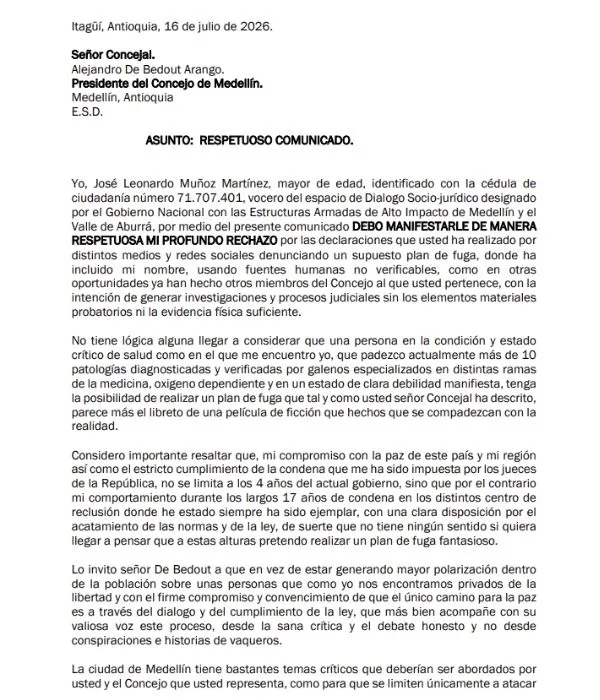
A storm of political and security-related controversy has descended upon the high-security prison in Itagüí, Antioquia, following urgent public warnings regarding a supposed mass breakout plot. The allegations, spearheaded by high-profile political figures, have cast a spotlight on the delicate intersection of the government’s peace-building efforts and the harsh realities of the Colombian carceral system.
The Genesis of the Allegation: A Clash of Narratives
The tension began when the designated Minister of Justice, Iván Cancino, and the President of the Medellín City Council, Alejandro De Bedout, sounded the alarm over a purported, highly coordinated escape plan. According to these officials, the target date for this operation was set for August 7, 2026—the day of President-elect Abelardo de la Espriella’s inauguration.
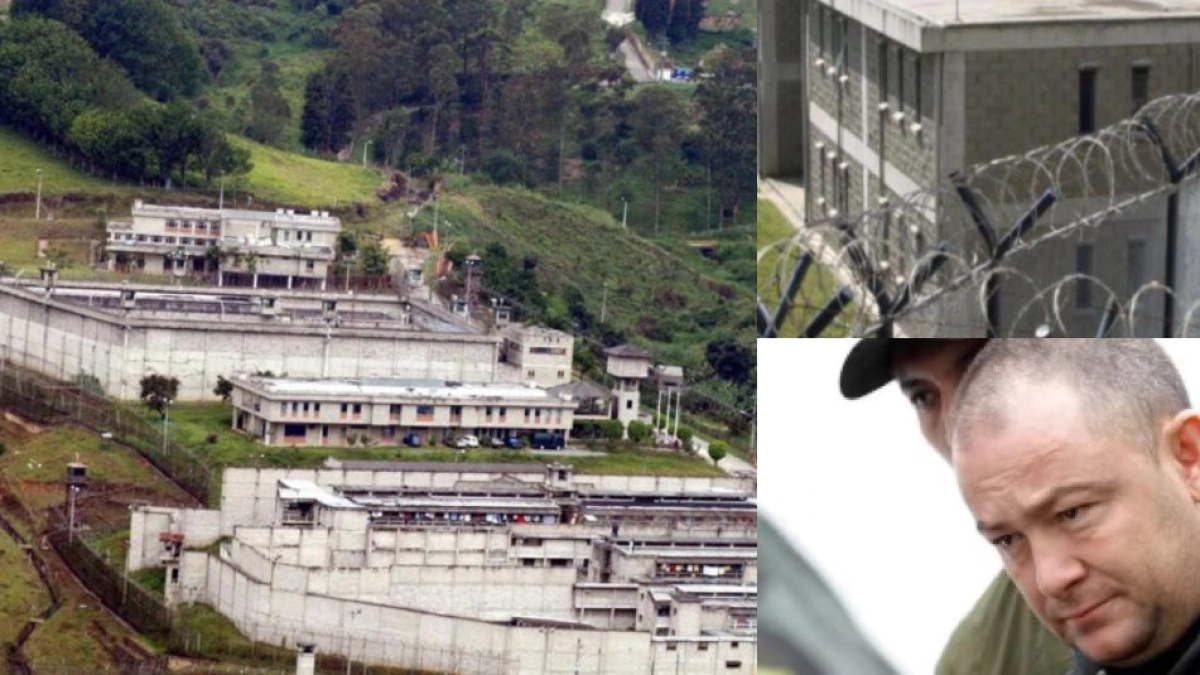
The Itagüí penitentiary is not a typical prison. It houses some of the most notorious leaders and high-ranking members of criminal organizations such as "La Oficina de Envigado," "La Agonía," and "Los Triana." Crucially, several of these individuals have been designated as authorized "peace spokespersons," participating in the government’s urban peace dialogue tables—an initiative aimed at dismantling organized crime through socio-juridical agreements.

The warning from De Bedout, in particular, claimed the existence of credible intelligence suggesting that the security of the facility was under threat, prompting immediate calls for a top-level government response.
Alias ‘Douglas’ Responds: "A Work of Fiction"
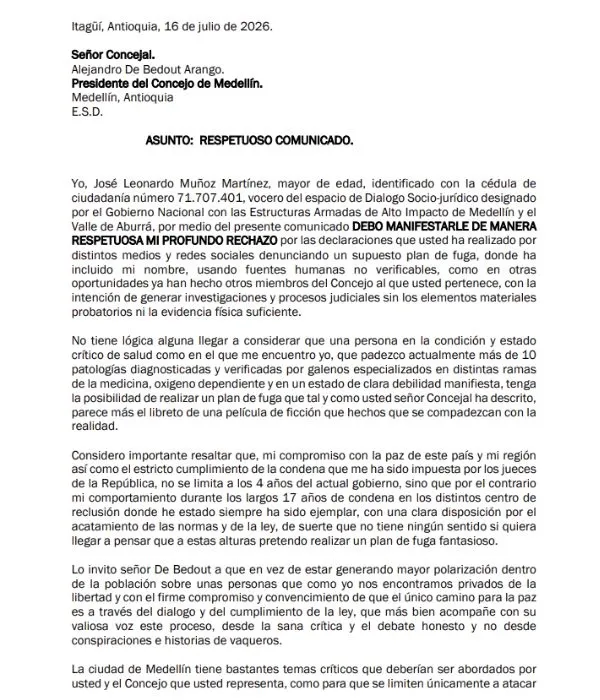
Among those at the center of the storm is José Leonardo Muñoz Martínez, known as "Alias Douglas," a prominent figure in the Valley of Aburrá peace dialogue process. In a sharp, formal rebuttal, Muñoz Martínez fired back at the accusations in a letter addressed to the Medellín City Council.
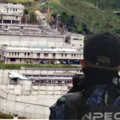
Muñoz Martínez categorically denied any involvement in or knowledge of a breakout plan. His response was as much a defense of his current condition as it was a challenge to the credibility of his accusers.
"It is entirely illogical to suggest that someone in my physical condition, suffering from a critical state of health, could even conceive, let alone execute, a plan of escape," Muñoz stated. He detailed a harrowing medical profile, asserting that he suffers from more than ten diagnosed pathologies, is dependent on supplemental oxygen, and remains in a state of "clear manifest weakness."

He went further, dismissing the claims made by Councilman De Bedout as a "fictional script" or a "cowboy story." Muñoz challenged the validity of the evidence presented, arguing that the councilman relied on "non-verifiable human sources" to push a narrative intended to incite judicial pressure without a shred of concrete evidence. He underscored his 17 years of incarceration, which he characterized as "exemplary" and in strict adherence to the law, emphasizing his ongoing commitment to the peace process.
Chronology of the Tension
- Mid-July 2026: Reports begin to circulate among political circles in Medellín regarding security vulnerabilities at the Itagüí high-security complex.
- July 16, 2026: Councilman Alejandro De Bedout and Minister-designate Iván Cancino publicly voice concerns about a potential breakout set for the August 7th presidential transition.
- July 16, 2026: The National Penitentiary and Prison Institute (INPEC) reacts by raising the alert level and ordering a formal inspection of the facility.
- July 16, 2026: José Leonardo Muñoz Martínez (Alias Douglas) issues a formal letter of rejection, demanding a retraction and calling for evidence to be presented to the judicial authorities rather than the media.
- July 16, 2026: Acting Minister of Justice, Cielo Rusinque, formally requests an exhaustive report and verification of the situation from the director of the INPEC.
Official Responses and Institutional Measures
The weight of the accusation forced a swift institutional response. Cielo Rusinque, the acting Minister of Justice, did not treat the warnings lightly. She formally instructed the director of the INPEC to conduct an immediate, high-level verification of the information circulating.

The INPEC’s response was robust. In addition to declaring a state of maximum alert at the Itagüí facility, the agency ordered the deployment of the Regional Director of the Northwest, accompanied by a specialized commission from the General Directorate. Their mission: to audit every security protocol, conduct a thorough cell-by-cell inspection, and review the integrity of the facility’s electronic surveillance systems.
The penitentiary is monitored by a network of 36 high-definition cameras, operational 24 hours a day. The INPEC has also bolstered this with the deployment of specialized tactical units, particularly during nighttime hours, to ensure that any potential breach is effectively neutralized before it can begin.

Implications for the Urban Peace Agenda
The incident highlights a fundamental friction point in the current administration’s approach to security. By utilizing high-ranking criminal figures as "peace spokespersons," the government has opened itself to criticism from those who argue that such individuals are inherently untrustworthy and that their status as peace negotiators is merely a facade to gain leniency or facilitate criminal operations from behind bars.
For the opposition, this alleged escape plot is proof that the "peace dialogue" is a security risk. For the government and the spokespersons involved, the accusations are seen as a political maneuver designed to sabotage the transition and delegitimize the peace process.

"If there is any real evidence, it should be delivered to the Attorney General’s Office or the judiciary," Muñoz wrote in his letter. "Using this for political polarization while ignoring the real needs of the city—like sanitation, public services, and infrastructure—is a disservice to the public."
The Path Forward: Evidence vs. Perception
As the August 7th deadline approaches, the pressure on the INPEC to prove the security of the Itagüí facility is immense. The incident has effectively paralyzed the discourse around the peace talks, shifting the focus from the negotiation table to the prison yard.
Legal experts note that for the government to maintain the credibility of its urban peace strategy, it must walk a narrow tightrope. It must ensure that the facilities holding these individuals are impregnable, while simultaneously managing the political fallout whenever an allegation of this magnitude surfaces.
The demand for a retraction from Alias Douglas places the burden of proof squarely on the shoulders of the politicians who made the initial claims. Should those claims prove baseless, the political capital of those who sounded the alarm could be significantly diminished. Conversely, should the investigation uncover even a minor vulnerability, the implications for the future of the peace-dialogue spokespersons could be permanent, potentially leading to the revocation of their status and a return to stricter, isolated confinement.

Conclusion: A Nation Watching
The situation at Itagüí is a microcosm of the broader challenges facing Colombia’s justice system. It is a place where health crises, criminal power, political ambition, and the fragile hope for peace collide. As the INPEC continues its "maximum alert" status, the nation waits to see whether the August 7th date will pass as a routine administrative transition or if the fears voiced by the political leadership will be vindicated by the discovery of a tangible threat.
For now, the walls of the Itagüí facility remain the focus of intense scrutiny, serving as a reminder that in the world of high-stakes criminal justice, perceptions often travel faster than the truth, and the cost of being wrong—on either side of the debate—could be the stability of the entire urban peace project.