
By Justice Desk Reporting
In a remote rural settlement in Barranco de Loba, Bolívar, a man who for months had been a ghost to the authorities was finally unmasked. Helmer Campo Jerez, known in the criminal underworld as "Cachaco," believed that by trading his tactical gear for the humble attire of a farm worker, he could vanish into the landscape of the Colombian countryside. However, the long arm of the law, directed by the specialized units of the Dijín (Directorate of Criminal Investigation and Interpol), proved that the anonymity of the field was no match for high-level intelligence operations.
Alias "Cachaco," a high-ranking regional commander of the "Édgar Madrid Benjumea" substructure of the Clan del Golfo, was apprehended in a high-stakes joint operation involving the National Army and the Navy. His capture marks a significant victory for the Colombian security forces, effectively decapitating a leadership cell that had orchestrated some of the most brutal attacks against state personnel in recent years.

The Weight of the Accusations
The legal case against Campo Jerez is extensive and grave. He faces formal charges of aggravated homicide and aggravated conspiracy to commit crimes. For the Colombian justice system, "Cachaco" is not merely a foot soldier; he is identified as the primary mastermind, coordinator, and material participant in the cold-blooded assassination of Patrolman Edwin Agustín Feria Mercado and Patrolwoman Belén Karina Durán Ortiz.
The double homicide, which shook the nation, occurred on April 25, 2025, in the municipality of Simití, Bolívar. The incident was part of a broader, orchestrated offensive known as the "plan pistola" (gun plan)—a calculated campaign of violence launched by the Clan del Golfo between April 15 and May 23, 2025. This campaign targeted law enforcement and military personnel across several departments, including Antioquia, Bolívar, Córdoba, Sucre, and Magdalena, in an attempt to destabilize regional security and assert territorial dominance.
Chronology of a Targeted Attack
The attack in Simití remains one of the most chilling examples of the brutality exerted during the 2025 offensive. According to investigators, the operation was executed with military precision.

- Pre-dawn, April 25, 2025: A group of heavily armed assassins arrived at the riverfront of Simití via boat, utilizing the waterways to circumvent traditional checkpoints.
- The Assault: The squad opened fire with long-range weapons against the local police station. Patrolwoman Belén Karina Durán Ortiz, who was performing her duties as a sentry, was caught in the initial volley, becoming the first casualty of the attack.
- Tactical Coordination: Intelligence reports indicate that "Cachaco" was not only aware of the operation but had personally directed the tactical approach. As the chief of hit squads for the substructure, he oversaw criminal operations in Simití, Arenal del Sur, and Gamarra (Cesar), using his influence to mobilize resources and personnel for the attack.
- The Aftermath: Following the killing, a massive manhunt was launched. Feeling the tightening grip of the military and police presence, Campo Jerez fled his stronghold, shifting his base of operations and adopting a "low profile" persona as a common farmer to evade detection.
The Intelligence Operation: Closing the Net
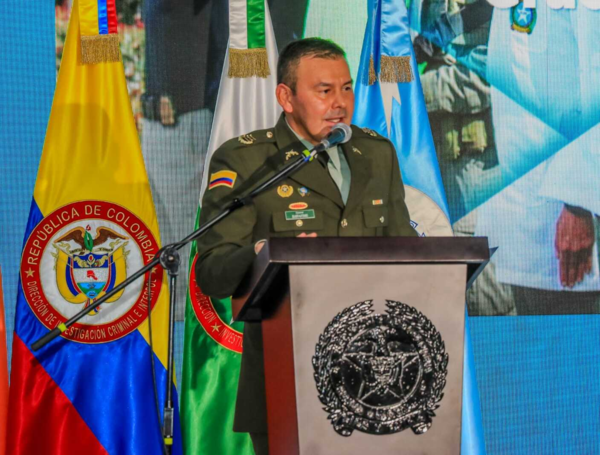
The capture of "Cachaco" was the culmination of an exhaustive and methodical investigation. Colonel Elver Vicente Alfonso Sanabria, Director of the Dijín, emphasized that the operation was not a stroke of luck, but the result of rigorous police science.
"The full identification and localization of alias ‘Cachaco’ was the result of exhaustive police work that integrated the management of human intelligence, including testimonies from former members and individuals cooperating with the justice system, alongside advanced technical forensic testing," Colonel Alfonso Sanabria stated during the post-capture briefing.
The investigators had to navigate a complex web of counter-intelligence. "Cachaco" had been careful to limit his electronic footprint, relying on traditional communication channels and his rural disguise to remain hidden. The breakthrough came when authorities successfully triangulated his location through a mix of signal intelligence and corroborated tips from local informants who had seen through his mask as a simple laborer.

Understanding the ‘Clan del Golfo’ Strategy
To understand the significance of this arrest, one must look at the structural nature of the Clan del Golfo. The organization, often referred to as the Gaitanist Self-Defense Forces of Colombia (AGC), operates through "substructures"—semi-autonomous units that control specific geographic corridors.
The "Édgar Madrid Benjumea" substructure, to which "Cachaco" belonged, is a critical piece of the organization’s logistics. By controlling areas in the south of Bolívar and neighboring Cesar, the group manages riverine drug trafficking routes and extortion rackets that fund their regional expansion. The "plan pistola" was a strategic move by the central command to force the state to withdraw from these lucrative corridors by creating a climate of fear and attrition.
By removing "Cachaco," the authorities have disrupted the chain of command, creating a power vacuum that complicates the substructure’s ability to coordinate large-scale attacks. It sends a message to the rank-and-file that even those who hide in the most remote corners of the country are within reach of the law.
Official Responses and Judicial Implications
The capture has been hailed by the Ministry of Defense as a "decisive strike" against criminal structures in the Caribbean region. Beyond the immediate justice served for the families of Patrolman Feria and Patrolwoman Durán, the prosecution is preparing to use the evidence gathered against "Cachaco" to dismantle the broader network supporting him.
Legal analysts point out that the charges of aggravated conspiracy are likely to lead to a significant prison sentence. Furthermore, the authorities are investigating whether "Cachaco" played a role in other violent acts during the 2025 period of unrest.
The defense of the accused has yet to make a formal statement, but the prosecution is confident that the convergence of human intelligence and physical evidence will ensure a conviction. The trial is expected to be a landmark case, potentially revealing deeper insights into how the Clan del Golfo manages its internal hierarchy and its methods for coordinating violent "plan pistola" actions.

Implications for Regional Security
The arrest of "Cachaco" in Barranco de Loba serves as a turning point for the local population. For months, residents in the area lived under the shadow of a high-value criminal target, often subjected to the indirect pressures of his presence. His removal restores a degree of normalcy to the region and provides the police with a unique opportunity to regain control of rural territories that were previously considered "red zones."
However, security experts warn that the arrest is only one battle in a long war. The Clan del Golfo is known for its ability to replace middle-management leaders quickly. The challenge for the Colombian state now lies in following up this arrest with a sustained institutional presence, providing social investment, and strengthening the rule of law so that the void left by "Cachaco" is not filled by another criminal successor.
As the legal proceedings continue, the case of Helmer Campo Jerez stands as a testament to the resilience of the Colombian security forces. It is a reminder that the strategy of "hiding in plain sight" is a temporary illusion, and that for those who commit heinous crimes against the state, the sanctuary of the shadows is increasingly difficult to maintain.

The nation looks on as the justice system prepares to hold him accountable, hopeful that this development marks a definitive step toward lasting peace in the southern Bolívar region.
For more information on justice-related news, follow our updates on social media or subscribe to our weekly newsletter to stay informed about the developments in this case.