Main Facts: The Sacred Geography of Lhasa and the Architectural Marvel of the Potala Palace
Perched on the towering plateaus of the Himalayas at an altitude of 3,700 meters above sea level, Lhasa—the capital of Tibet—stands as one of the most geographically isolated and spiritually magnetic urban centers on Earth. While global travelers may look toward Jerusalem for Abrahamic roots, Athens for classical antiquity, or Cairo for ancient monuments, those drawn to profound mysticism, esoteric beauty, and Buddhist philosophy inevitably find their way to this high-altitude sanctuary.
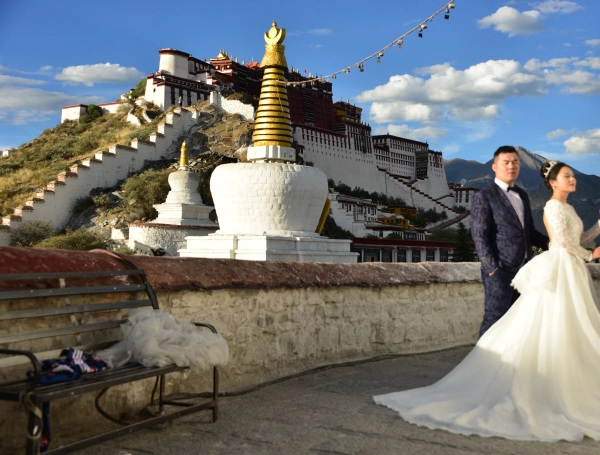
At the absolute center of Lhasa’s cultural and physical landscape rises the Potala Palace. Far more than a mere royal residence, the Potala is a monumental synthesis of fortress, monastery, and palace. It is widely considered one of the most breathtaking architectural achievements ever conceived by human ingenuity and religious devotion.
Constructed upon a dramatic red hill, the palace complex soars 115 meters high, spanning 13 distinct stories and covering an expansive footprint of 130,000 square meters. Within its colossal walls lie approximately 1,000 rooms, 35 grand capels, 15 massive pillars, and an astonishing collection of 200,000 sacred statues.
The structure is sharply divided into two primary sections:
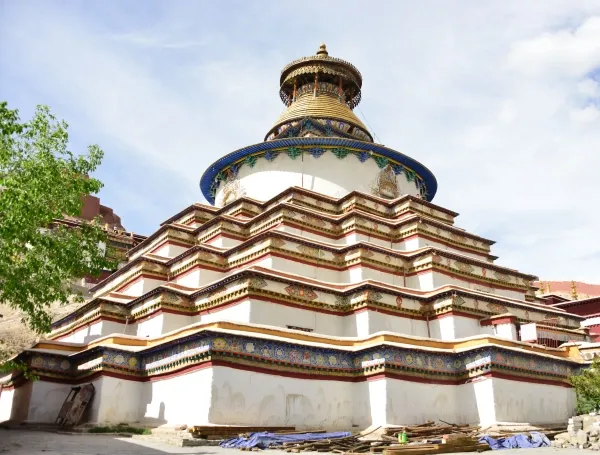
- The White Palace: Historically utilized as the living quarters and administrative suites of the Tibetan government.
- The Red Palace: Dedicated entirely to religious study, administrative prayer halls, and the elaborate gilded stupas (tombs) housing the remains of past Dalai Lamas, stretching sequentially from the fifth down to the thirteenth.
Known traditionally as the "Abode of Avalokiteshvara"—the Bodhisattva of Compassion—the Potala houses countless relics fashioned from solid gold, silver, precious gemstones, rare painted thangkas, and ancient manuscripts. Among its most revered artifacts is the tomb-statue of the Fifth Dalai Lama, which alone weighs 372 kilograms of solid gold and is encrusted with 15,000 precious gems. Nearby rests the venerated statue of Shakyamuni, lavishly adorned with priceless jewels.
Chronology: From Ancient Monarks to Modern Exiles
The historical timeline of Lhasa and its spiritual architecture spans more than a millennium, marked by dynastic foundations, religious evolution, and profound geopolitical shifts.
- 7th Century: Tibetan King Songtsen Gampo initiates the early construction of fortifications and spiritual centers on the site that would eventually anchor modern Lhasa.
- 15th Century: The expansion of Tibetan monasticism leads to the founding of major academic and spiritual institutions outside the city center, including the Drepung Monastery (1416) and the Sera Monastery (1419).
- 17th Century: The Fifth Dalai Lama significantly expands and completes the Potala Palace, establishing it as both the political capital of Tibet and the formal winter residence of successive spiritual leaders.
- Mid-20th Century (1959): Following political upheavals and the incorporation of Tibet into the People’s Republic of China, the Fourteenth Dalai Lama, Tenzin Gyatso, is forced into exile. He relocates his residence to Dharamshala, India, where he establishes the Tibetan government-in-exile.
- September 1973: The Fourteenth Dalai Lama undertakes a historic diplomatic and spiritual tour of Europe to engage with leaders of Western faiths, including the Pope in Rome, Protestant leaders in Geneva, and Anglicans in England—an event during which international observers and personal aides directly witnessed his bridge-building mission between East and West.
- Modern Era: Lhasa transitions into a bustling, colorful city where ancient spiritual traditions exist side-by-side with modern commerce, serving as a year-round destination for pilgrims and cultural travelers alike.
Supporting Data: Monastic Life, Sacred Rituals, and Architectural Scale
The religious infrastructure of Lhasa extends far beyond the imposing silhouette of the Potala Palace. Surrounding the urban core are monastic institutions that have preserved ancient Tibetan Buddhist traditions for centuries.
The Great Monasteries of Lhasa
- The Jokhang Temple: Located near the heart of Lhasa, the Jokhang is universally regarded as the single most sacred sanctuary in Tibetan Buddhism. Its inner sanctum shields an enormous, heavily venerated statue of Buddha completely cast in gold.
- Drepung Monastery: Founded in 1416, Drepung historically functioned as one of the largest monasteries in the world, housing thousands of monks and serving as the primary residence of the Dalai Lamas prior to the construction of the Potala. Today, it maintains an active community of approximately 500 monks.
- Sera Monastery: Established in 1419, Sera is globally renowned for its daily "monastic debates." In shaded courtyards, monks gather to test their mastery of sacred texts through rigorous philosophical arguments, punctuated by dramatic physical gestures, synchronized hand-claps, and assertive vocalizations.
- Norbulingka: Serving historically as the traditional summer palace of the Dalai Lamas, this sprawling estate encompasses 374 rooms surrounded by meticulously landscaped botanical gardens and tranquil ponds.
Pilgrimage Practices
The devotion observed in Lhasa is intensely physical. Pilgrims and monks routinely perform full kora (circumambulation) around the Potala Palace and the Jokhang Temple. Moving strictly clockwise in alignment with cosmic forces, devotees spin endless rows of cylindrical golden prayer wheels, which are inscribed with sacred mantras—spinning them is believed to dispatch prayers continuously into the spiritual ether.

More devoted pilgrims undertake the grueling practice of prostration over the entire circuit: throwing their bodies flat onto the unforgiving stone ground, rising, taking a step forward, and repeating the cycle continuously for miles around the holy perimeter.
Official Responses and Perspectives
The preservation and governance of Lhasa’s sacred sites remain a subject of deep international interest, cultural debate, and religious reverence.

- The Tibetan Government-in-Exile: Operating from Dharamshala, India, the administration under the Fourteenth Dalai Lama continues to advocate globally for the preservation of authentic Tibetan culture, language, and religious freedom. Representatives emphasize that monuments like the Potala and Jokhang are not merely dead historical museums, but the living, breathing heart of a persecuted spiritual lineage.
- Cultural and Heritage Organizations: UNESCO and international architectural historians view the historic ensemble of the Potala Palace—including the Jokhang Temple and Norbulingka—as World Heritage treasures of "outstanding universal value." Efforts focus heavily on balancing the structural integrity of ancient mud-brick, stone, and timber structures against the pressures of modern tourism and climate degradation.
- Pilgrims and Global Observers: For millions of Buddhists worldwide, Lhasa remains the earthly equivalent of Shangri-La—a mythical valley of absolute peace, harmony, and spiritual awakening. Visitors frequently report a transformative shift in perspective upon witnessing the devotion of monks in the debating courtyards of Sera or the serene silence of the Potala’s golden chapels.
Implications: The Cultural Crossroads of Ancient Mysticism and Modernity
As the modern world hurtles forward into an era of hyper-connectivity and secularization, Lhasa’s enduring presence presents profound implications for how humanity values heritage, faith, and spiritual geography.
On one hand, the city has evolved to incorporate many modern conveniences, seamlessly blending Western-style commercial amenities with ancient Tibetan traditions. Colorful storefronts lining the market streets now sell both high-tech goods and traditional religious artifacts, such as singing bowls, butter-lamp oils, and hand-carved prayer beads.

On the other hand, the deep spiritual undercurrents that course through the Brahmaputra River valley—which originates near the mythic Mount Kailash, the ultimate source of sacred rivers for both Buddhism and Hinduism—remind the global community of a worldview rooted in compassion, impermanence, and inner awakening.
Whether viewed through the lens of architectural preservation, geopolitical displacement, or personal spiritual transformation, a journey to Lhasa and the halls of the Potala Palace forces travelers to cross a profound threshold. It offers a rare glimpse into a realm where stone and gold are elevated to serve the intangible human quest for meaning, making it an irreplaceable cornerstone of global cultural history.