
By Editorial Staff, September 25, 2026
The integration of data-driven decision-making, the ethical deployment of Artificial Intelligence (AI) in public administration, and the complex challenge of financing large-scale technological overhauls took center stage during the “Public Leadership for the Development of Smart Cities” panel at the Claro Tech Summit 2026, held in Cartagena.

As urban centers across the globe grapple with the complexities of the digital age, local leaders from Bogotá and the department of Bolívar presented a roadmap for how sub-national governments can transition from traditional bureaucracy to agile, technology-integrated ecosystems.
Main Facts: A New Paradigm for Public Management
The core of the discussion revolved around the shift from "analog government" to "smart territory." For Bogotá, the focus is on hyper-personalized social intervention, while Bolívar is leveraging connectivity and physical infrastructure to bolster security and territorial accessibility.

Bogotá’s administration highlighted its progress in the "nominal tracking system" for early childhood development. By articulating more than 30 variables—ranging from health records to socioeconomic indicators—the city is monitoring approximately 462,000 children between the ages of zero and six. A pilot program in the Kennedy locality demonstrated the efficacy of this approach: by utilizing field data and AI-driven predictive modeling, officials identified that 62% of the children surveyed were at risk of malnutrition. This discovery enabled a seamless, data-backed collaboration between the Secretariats of Health, Social Integration, Education, and Planning, allowing for precise resource allocation.
Conversely, the department of Bolívar showcased the transformation of Mompox. Through the integration of high-definition surveillance cameras, acoustic sensors, and advanced drone technology, the municipality has created a real-time security command center. This system, which provides data directly to the National Police and the Dijín, has become a template for regional security, with plans to expand the model to cities like Magangué.

Chronology of Digital Transformation (2025–2026)
- Q1 2025: Initial deployment of Bogotá’s "Nominal Tracking" pilot programs in high-vulnerability localities.
- Q3 2025: Mompox begins the integration of its environmental sensor network and security drone fleet.
- Q1 2026: Launch of the "GeoBolívar" platform, mapping essential services across the department to bridge the rural-urban divide.
- Q3 2026 (Present): Announcement of the "SuperApp Bogotá" architecture, designed to unify all municipal services under a single digital identity.
- September 25, 2026: Formalization of the strategic alliance between the District of Bogotá and Claro Colombia to scale digital education and literacy.
Supporting Data: Efficiency Through Automation
The transition to smart cities is not merely a technological upgrade but an economic imperative. The panel highlighted several key metrics that demonstrate the potential impact of AI:
- Administrative Efficiency: The Secretariat of Environment in Bogotá manages an average of 300 petitions, complaints, and claims daily. By integrating AI to categorize and draft initial responses, the city aims to reduce processing times significantly. However, the administration emphasized a "human-in-the-loop" requirement: no AI-generated response is sent without final approval from a public official, ensuring accountability.
- Environmental Intelligence: Mompox’s deployment of environmental sensors has laid the groundwork for "Digital Twins"—virtual replicas of physical infrastructure that allow the government to simulate flooding or climate events, creating predictive models to save lives and mitigate property damage.
- Educational Outreach: The new partnership between Bogotá and Claro Colombia will provide free training across 180 digital paths, focusing on high-demand skills like cybersecurity, AI, and entrepreneurship, directly feeding into the city’s growing tech workforce.
Official Responses and Strategic Perspectives
The Regulatory Debate
One of the most contentious topics was the role of the national legislature in regulating AI. Diana Celis Mora, Bogotá’s TIC Counselor, expressed a cautious stance, revealing that the District had submitted negative concepts regarding two pending AI bills in Congress.
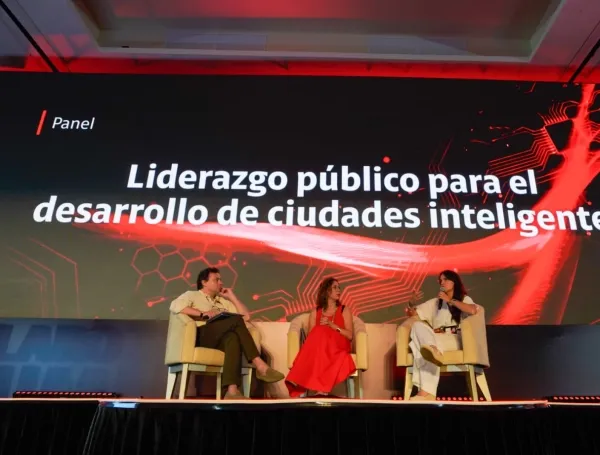
"We believe in a framework that empowers regulators rather than stifling innovation," Celis Mora stated. "Instead of rigid laws that become obsolete in months, we advocate for ethical guidelines and ‘regulatory sandboxes.’ These controlled environments allow us to test AI applications in real-world scenarios, identifying risks and ethical pitfalls before they affect the general population."
The Challenge of Funding
The transition to a smart city is expensive. Bogotá’s recent approval of $5.2 trillion COP in future appropriations for "smart public lighting"—which includes telegestión and infrastructure modernization—serves as a benchmark for local investment.

However, funding remains the primary hurdle for smaller municipalities. Nohora Mercado, Secretary of TIC for Bolívar, noted that the department has relied on a hybrid funding model. "We combine national grants, international cooperation from the IDB (Inter-American Development Bank), the World Bank, and CAF, and public-private partnerships (PPPs) to ensure these projects remain sustainable."
Implications: The Future of the "SuperApp" and Digital Rights
The vision for the "SuperApp Bogotá" is perhaps the most significant implication for the future of Colombian governance. The goal is to move away from a fragmented system of dozens of different user accounts and passwords. By centralizing services—from paying property taxes to scheduling medical appointments—the city intends to drastically reduce the "digital friction" that currently hampers citizens.

The critical ethical implication here is data sovereignty. As emphasized during the summit, the architecture of the SuperApp is being built on the principle that the citizen remains the owner of their data. This represents a paradigm shift from traditional government data-hoarding to a model of "data-as-a-service" for the citizen, where privacy and transparency are baked into the code.
A Call for Digital Equity
The partnership between Bogotá and Claro Colombia highlights the realization that a smart city is only as strong as its least-connected citizen. By offering 180 different training paths, the city is betting on human capital. If citizens cannot use the tools, the technology is useless.

As the Claro Tech Summit 2026 concluded, the consensus among participants was clear: the path forward involves balancing aggressive technological adoption with robust ethical safeguards. The successes seen in Mompox and the data-driven social policies in Bogotá are not just local triumphs; they are test cases for the entire Latin American region.
Moving forward, the challenge for both Bogotá and Bolívar will be to scale these pilots without losing the focus on the individual. The transition to a smart city is not defined by the speed of the fiber optics or the complexity of the algorithms, but by the tangible improvement in the quality of life for the child in Kennedy or the resident in Mompox.

As policymakers return to their respective offices, the mandate is clear: keep the data secure, keep the human in the loop, and ensure that the digital revolution leaves no one behind.