
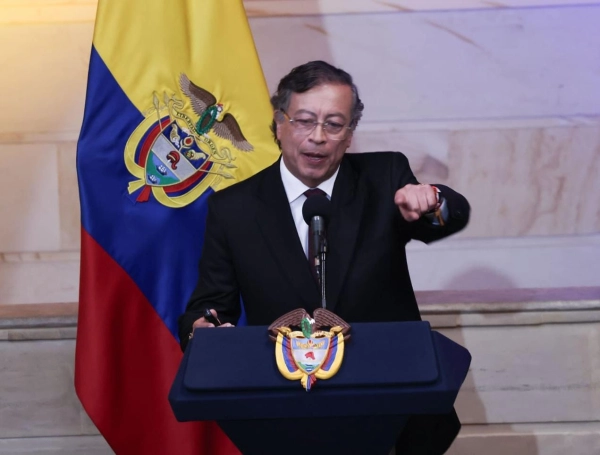
During his final address to the Congress of the Republic on July 20, 2026, President Gustavo Petro painted a picture of an educational revolution. Standing before the legislature, the President heralded a significant surge in access to higher education, specifically claiming the creation of 425,096 new enrollment slots by the end of 2025. He further asserted that his administration remained on track to meet the ambitious goal of 500,000 new openings by the end of his term.
However, an independent analysis of official data from the Ministry of Education reveals a significant disconnect between the administration’s narrative and the empirical reality of the higher education system. As the nation evaluates the legacy of the Petro administration, the gap between political rhetoric and statistical evidence has become a central point of debate, prompting experts to question the methodologies used to calculate these supposed "gains."
The Core Facts: A Statistical Discrepancy
President Petro’s central argument rested on the claim that his policy of gratuity in public education has outperformed previous initiatives, such as the widely debated "Ser Pilo Paga." According to the President, the cumulative growth in new enrollment slots by the close of 2025 reached 425,096.

However, when cross-referencing these assertions with the official records of the Ministry of Education—specifically the data maintained in the National System of Information for Higher Education (SNIES)—the narrative falters.
To understand the scope of the discrepancy, one must distinguish between two primary indicators: total enrollment (the number of students currently active in the system) and the "first-course" indicator (students entering their first semester). When looking at total enrollment, which includes undergraduate, technical, technological, and professional degrees, the data shows that at the start of the administration in 2022, the system recorded 2,466,228 students. By the end of 2025, that figure rose to 2,723,364. This represents a total increase of 256,136 students—a figure substantially lower than the 425,096 cited by the President.
Even when isolating undergraduate programs—the specific focus of the government’s 500,000-cup goal—the data shows an increase of 212,017 students between 2022 and 2025. In either metric, the government’s public claim exceeds the verifiable data by a margin of over 200,000 slots.

A Chronology of Disconnect
The tension regarding these figures did not emerge overnight; it has been a recurring theme throughout the Petro administration.
- 2022: The administration assumed office with a mandate to expand higher education access, prioritizing the elimination of financial barriers for low-income students.
- 2023-2024: As the government announced various expansion programs, independent analysts and academic observers began to notice that the Ministry’s reporting methods differed from historical norms. Observers pointed out that the government began "stacking" annual increases rather than measuring net growth in system capacity.
- Early 2026: Leading up to the final legislative session, the debate intensified. Experts, including former education officials and analysts like Francisco Cajiao, publicly warned that the government’s method of counting "new slots" was essentially double-counting students, leading to inflated projections.
- July 20, 2026: In his final speech to Congress, President Petro reiterated the 425,096 figure, effectively finalizing the administration’s position despite the growing body of evidence contradicting the claim.
Methodological Critique: How the Government Reaches its Numbers
The crux of the controversy lies in the methodology. Traditionally, the capacity of a higher education system is measured by the net increase in the number of students the system can simultaneously accommodate compared to a base year.
The government, however, appears to be utilizing a cumulative summation of annual increases. According to experts, this approach is fundamentally flawed. If a university opens 1,000 new spots in 2023, and those students remain in the system through 2024 and 2025, they are being counted as "new" in each subsequent year under the government’s current reporting logic.

"Total enrollment represents the actual capacity of the system," explains Francisco Cajiao, a prominent education analyst. "When we speak of ‘new slots,’ we are referring to the net capacity the system has gained to absorb more individuals simultaneously. Any other calculation method is, at best, misleading, and at worst, a deliberate attempt to manipulate public perception of the administration’s success."
By choosing to aggregate annual growth rather than measuring the change in total enrollment, the government has created a "phantom" growth that does not reflect the number of actual students currently occupying seats in classrooms or lecture halls.
The Coverage Gap
Beyond the raw number of slots, the President also claimed a 10-percentage-point increase in higher education coverage during his tenure. Once again, the data provided by the administration itself tells a more conservative story.
The figures show that coverage in 2022 stood at 54.92 percent. By 2025, that number had reached 61.75 percent. This represents a total increase of 6.83 percentage points—a significant achievement by any standard, but one that falls noticeably short of the 10-point claim made by the President.
While some within the government argue that this figure may reach the 10-point goal when 2026 data is finalized, this remains speculative. Official data for 2026 will not be released until 2027. Furthermore, with universities still in the midst of enrollment processes for the second semester of 2026, and many public institutions facing delays in their academic calendars, declaring this growth a "fait accompli" is premature.
Implications for Future Policy
The implications of this statistical inflation are profound. For the incoming administration and the broader public, the primary concern is not merely the inaccuracy of the figures, but the erosion of trust in institutional data.

1. Planning and Resource Allocation
If policymakers rely on inflated enrollment figures to allocate budgets, they risk overestimating the needs of the system or, conversely, failing to invest where actual growth is occurring. Misleading data can lead to inefficient use of public funds, particularly in a sector as sensitive as education.
2. The Credibility of Higher Education Reform
Colombia’s education sector is currently grappling with high dropout rates and concerns regarding the quality of instruction in the newly expanded system. When the government focuses on the quantity of "slots" rather than the quality of education or the sustainability of the institutions, the long-term impact on the workforce and the economy remains in question.
3. Institutional Transparency
The Ministry of Education is tasked with maintaining the SNIES as a reliable, transparent database for public use. By utilizing a non-standard methodology that contradicts the established norms of the SNIES, the administration has introduced a level of skepticism that may undermine the credibility of future reports.

Conclusion: A Legacy of Mixed Results
As the Petro administration draws to a close, the narrative regarding education will likely remain a centerpiece of its defense. There is no doubt that the administration made a concerted effort to broaden access to higher education, and the increase in enrollment—while not as high as claimed—is a measurable expansion of the system.
However, the insistence on presenting data that deviates from standard analytical metrics does a disservice to the complexity of the achievement. By inflating numbers, the administration has inadvertently shifted the focus from the genuine challenges of the education system—such as quality, retention, and the financial health of public universities—to a debate over arithmetic.
For the students, faculty, and institutions that make up Colombia’s higher education system, the path forward requires more than just political slogans. It requires a commitment to rigorous, transparent data and a focus on the structural realities of the classroom. Whether the next administration can reconcile these inflated promises with the hard data on the ground will be one of the most pressing tests for the country’s educational future.