By Laura Nathalia Quintero El Filtro – Breaking News Desk Updated: September 17, 2026
Executive Summary: The Anatomy of a Viral Hoax
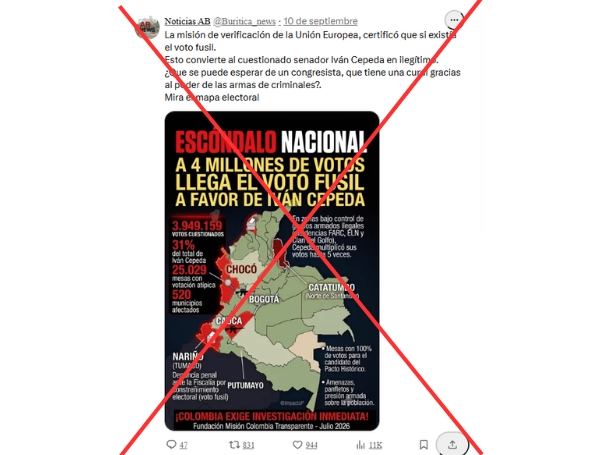
In the digital ecosystem surrounding Colombia’s highly contentious 2026 general elections, a sophisticated disinformation campaign took root in early September. Viral publications circulated across platforms like X (formerly Twitter), falsely asserting that the European Union Election Observation Mission (MOE UE) had officially verified and certified the existence of the so-called "voto fusil" (gunpoint vote) during the legislative and presidential contests.
According to these fraudulent posts, the international body allegedly confirmed that Senator Iván Cepeda—the presidential candidate representing the Pacto Histórico coalition—secured his legislative mandate and significant electoral support through armed coercion and the intimidation of rural voters by illegal armed groups.
However, an exhaustive verification process conducted by El Filtro, the dedicated fact-checking unit of El Tiempo, reveals that these claims are entirely false. Far from validating allegations of widespread armed interference that tipped the scales of the election, the official final report and public statements issued by the MOE UE explicitly state that the organization detected no systemic armed interference capable of altering the ultimate outcome of the polls. Furthermore, forensic digital analysis demonstrated that the viral images used to promote this narrative were digitally manipulated, with key words altered to subvert the original reporting of independent media outlets.
Chronology of Events: From the Campaign Trail to the Viral Disinformation Surge
To understand the context of the current disinformation wave, it is essential to trace the timeline of key events leading up to and following the 2026 Colombian electoral process:
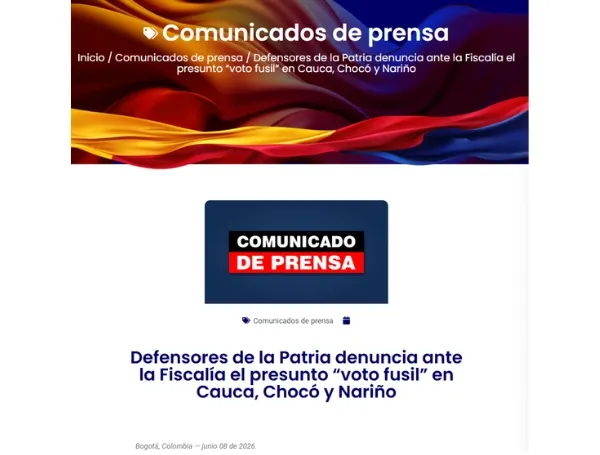
June 8, 2026: Prior to the presidential runoff, the political party Defensores de la Patria—then associated with conservative candidate Abelardo de la Espriella—announced a formal complaint before the Office of the Attorney General (Fiscalía General de la Nación). The party alleged widespread voter coercion (constreñimiento al sufragante) under Article 387 of the Penal Code, specifically pointing to potential anomalies in departments like Cauca, Chocó, and Nariño.
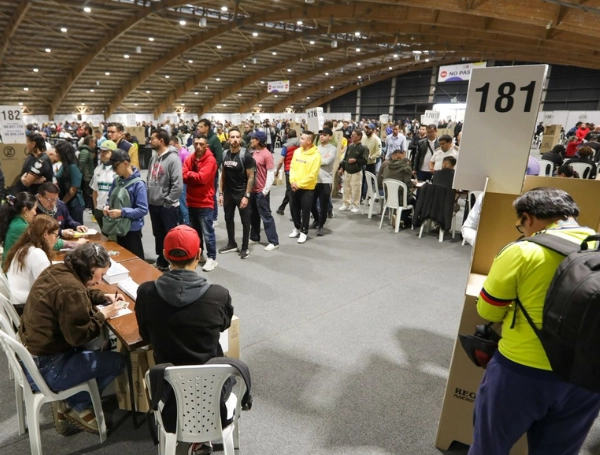
June 21, 2026: The second-round presidential runoff took place across the country amid tight security and heightened political polarization.
June 24, 2026: The National Electoral Council (Consejo Nacional Electoral – CNE) finalized the national scrutiny and released the definitive vote tallies. The official results confirmed that Abelardo de la Espriella secured 12,960,166 votes, defeating Iván Cepeda, who obtained 12,708,312 votes. The margin of victory stood at 251,854 votes.
September 3, 2026: The European Union Election Observation Mission officially released its comprehensive final report on the 2026 Colombian elections during a press conference in Bogotá, publishing 15 key recommendations to optimize future democratic processes.
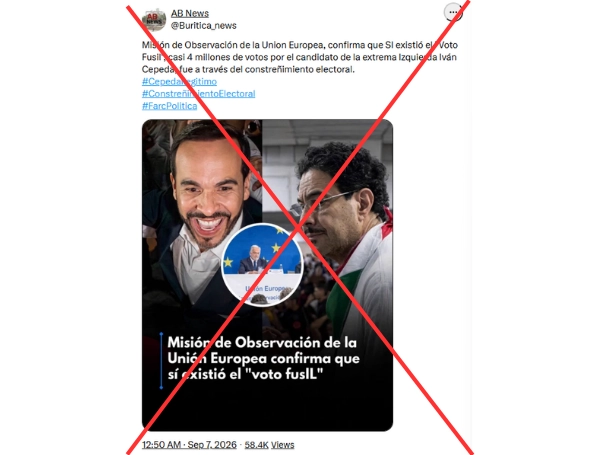
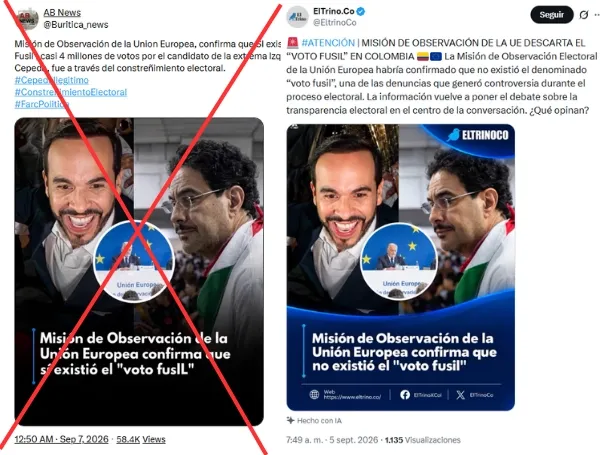
September 5, 2026: Digital portals such as ElTrino.CO published media graphics detailing the EU mission’s actual findings regarding security and armed groups. Shortly thereafter, these exact images were intercepted, digitally altered (swapping the negative term "no" for the affirmative "sí"), and recirculated by partisan accounts.
September 7, 2026: The fabricated narrative gained significant traction online. Accounts such as ‘AB News’ on X, boasting over 8,000 followers, disseminated graphics falsely claiming that the EU had certified the "voto fusil," rapidly accumulating thousands of views and interactions.
Main Facts and Official Responses: What the EU Observation Mission Actually Stated
The core of the viral falsehood rests on a deliberate distortion of statements made by European Union election officials during the presentation of their final evaluation.
During the September 3 press conference in Bogotá, Esteban González Pons, Chief of the MOE UE, directly addressed inquiries from journalists regarding the "voto fusil" and allegations of armed pressure. Pointing to the empirical data compiled in the report, González Pons yielded the floor to Deputy Chief Observer Antonio Gabriel, emphasizing:
"Regarding what the mission has seen, I refer you to the report. There you will find our perception. But I will give the floor to Antonio Gabriel: we have not detected an interference by armed groups that affected the outcome of the elections."
Expanding upon this assessment, José Antonio Gabriel detailed the technical findings of the mission’s territorial analysis. He explained that while the elections indisputably unfolded within a complex environment marked by traditional infractions—such as vote-buying—the areas subjected to intense, concentrated pressure from organized armed groups represented a minute fraction of the national demographic.
"What we have detected with our detailed analyses is that the zones affected by a sufficiently intense presence of armed groups represent a small percentage of the population, speaking of one and a half percent of the population," Gabriel stated.
Furthermore, the deputy chief noted that behavioral patterns in these specific regions were far from monolithic:
"When you analyze voting patterns in these areas especially affected by the presence of armed groups, what you see is very diverse electoral behavior patterns… We are talking about more than 100 denominations with different territorial presences, with different historical genealogies and with different behavioral models."
Supporting Data: Contextualizing the EU Final Report
The complete 2026 final report of the MOE UE, publicly accessible via the European External Action Service portal, provides a nuanced, multi-dimensional evaluation of Colombia’s democratic exercise.
Overall Conduct: Despite recognizing an atmosphere characterized by polarization, digital disinformation, and the persistent footprint of illegal armed actors, the international mission formally categorized the electoral process as "notably peaceful" and praised the high levels of civic participation.
The CITREP Context: The mission did note that the Special Transitional constituencies for Peace (Circunscripciones Especiales Transitorias de Paz – CITREP) remained structurally vulnerable to the influence of criminal factions and traditional political apparatuses. However, the report explicitly clarifies that this local vulnerability does not equate to a determination that these actors dictated the macro-level results of the presidential race.
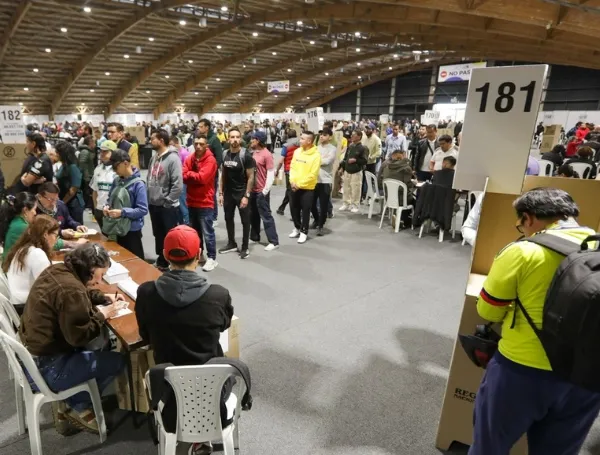
Logistical Transparency: The EU observers confirmed unhindered access to polling stations across the nation. They characterized the voting phases as "transparent," noted that party witnesses operated without systemic restrictions, and described the ultimate vote-counting phase as "precise and transparent," despite acknowledging isolated instances of minor irregularities and historical vote-buying practices.
Implications of the Disinformation Campaign
The propagation of fabricated claims surrounding international electoral certification carries profound systemic implications for democratic stability in Colombia:
Erosion of Institutional Legitimacy: By inventing endorsements from respected multilateral bodies like the European Union, bad actors attempt to retroactively invalidate legal electoral victories and undermine public trust in constitutional institutions such as the National Electoral Council (CNE) and the Registraduría.
Peril to Vulnerable Communities: Analysts and human rights organizations have repeatedly warned that branding entire rural regions or municipalities as hubs of coerced voting (voto fusil) without empirical verification stigmatizes local populations. It exposes inhabitants of historically marginalized zones—such as departments in the Pacific and southern regions—to generalized suspicion and potential reprisals from both state and non-state actors.
Polarization Amplification: Fabricated narratives weaponize the genuine security challenges facing rural Colombia, converting complex socio-political phenomena into polarizing digital ammunition designed for rapid virality rather than constructive civic dialogue.
The Digital Manipulation: Exposing the Evidence
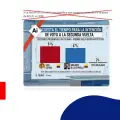
A critical component of El Filtro’s investigation involved digital forensics and reverse image searches. The investigation exposed how a legitimate media graphic published on September 5 by the X account ElTrino.CO—which accurately reported that the EU "did not" confirm the existence of the "voto fusil"—was subjected to digital tampering.
By utilizing basic image-editing tools, malicious actors excised the negative particle, transforming the headline to falsely claim that the EU "did" certify the phenomenon. This altered asset served as the visual cornerstone for subsequent posts questioning the legitimacy of elected officials and intensifying political animosity.
Conclusion
The assertion that the European Union Election Observation Mission certified the existence of the "voto fusil" to sway the outcome of Colombia’s 2026 elections is definitively false. Official documentation, direct statements from EU mission leadership, and thorough forensic analysis confirm that international observers found no evidence of systemic armed interference capable of altering the democratic mandate. El Filtro reiterates the importance of verifying digital content through primary official sources before sharing materials that seek to polarize public opinion through misinformation.
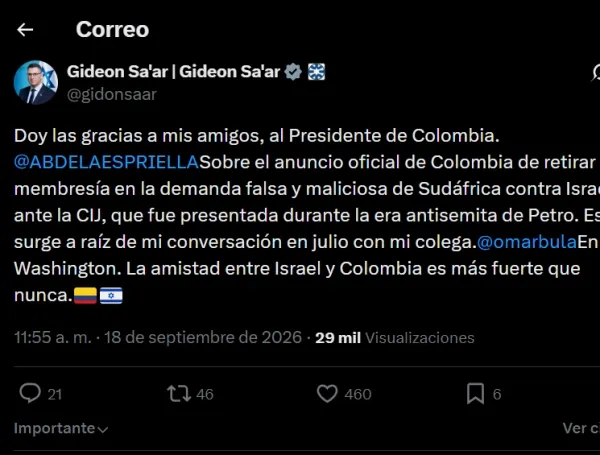
Bogotá / Jerusalem — In a development that signals a profound realignment of Colombia’s foreign policy, the Government of Israel officially confirmed that Colombia has formally withdrawn its intervention in the high-profile genocide case brought…
Main Facts: A Judicial Turnaround and the Reopening of Political Scrutiny The political landscape in Colombia has been profoundly rattled following a definitive legal and moral turning point in the case of Juliana Guerrero. Once…
Bogotá, Colombia — In a move that signals a significant departure from traditional military appointments, the administration of President Abelardo De La Espriella has officially published the nomination of Lucas Eduardo Ariza as the new…