
By Luisa Fernanda Gutiérrez Henao
Redacción Últimas Noticias
Updated: November 1, 2026, 5:22 P.M. EST
Main Facts
An aviation disaster struck the state of Florida on Sunday, November 1, 2026, when a private jet crashed directly into a roadway in the densely populated county of Palm Beach, triggering a massive explosion and leaving a scene of absolute devastation. According to official confirmations released by the United States Department of Transportation and the Federal Aviation Administration (FAA), the aircraft—identified as a twin-engine Learjet 60—was carrying at least nine people on board. Tragically, all occupants perished in the high-impact crash and subsequent fire.

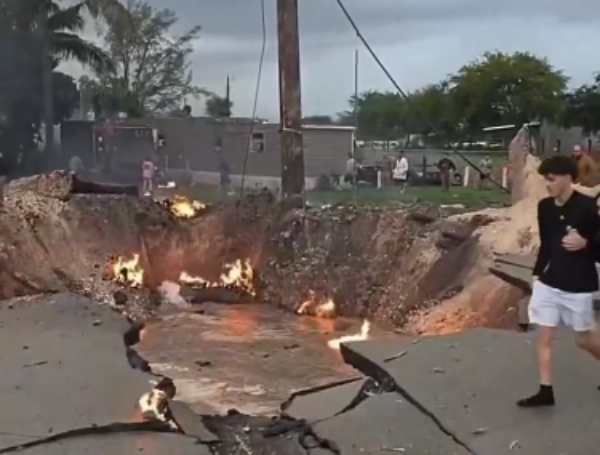
The incident unfolded shortly before 1:00 p.m. local time, converting a routine Sunday afternoon into a scene of utter horror for residents living near the crash site in the vicinity of Cresthaven and Military Trail. Video footage captured by astonished witnesses and subsequently broadcast across social media platforms documented the terrifying final moments of the flight. The aircraft plummeted rapidly toward the ground before colliding violently with the asphalt, erupting into a violent fireball that instantly consumed the surrounding area.
A towering plume of thick, black smoke billowed into the Florida sky, visible for miles around Palm Beach County. Emergency response units, including local fire rescue, hazardous materials teams, and law enforcement agencies, rushed to the scene. First responders immediately worked to suppress the intense flames and secure the perimeter, where an enormous crater now mars the highway. Authorities have confirmed that all northbound and southbound lanes of Military Trail remain completely closed to vehicular traffic as specialized teams manage the grim task of recovering victims and collecting forensic evidence.

Chronology of Events
Reconstructing the timeline of the fateful flight provides critical context into how the disaster materialized within a matter of minutes.
- Flight Departure (Austin, Texas): The Learjet 60 departed earlier in the day from Austin, Texas, under standard operational parameters. The flight plan indicated that the private jet was bound for the Bahamas, carrying a total of nine individuals, whose identities have been withheld pending full notification of next of kin and ongoing forensic verification.
- Rapid Descent and Loss of Control: As the aircraft approached South Florida, radar and telemetry data recorded by the Federal Aviation Administration noted an catastrophic anomaly. The private jet began an extraordinarily steep descent, registering a maximum vertical descent rate exceeding 32,000 feet per minute—an extreme indicator of an acute mid-air emergency or loss of aircraft control.
- The Crash (Approx. 12:50 P.M. EST): The aircraft descended rapidly over a residential sector near Cresthaven in Palm Beach County, ultimately striking a major thoroughfare. The impact generated an immediate, catastrophic explosion that scattered debris across a wide radius and formed a deep crater in the middle of the road.
- Immediate Emergency Response (1:00 P.M. onwards): Within minutes, dozens of Palm Beach County Fire Rescue units arrived at the scene. Firefighters deployed foam and water hoses to douse the blazing wreckage, while police established a wide security perimeter, diverting traffic and urging motorists to seek alternate routes to avoid severe congestion along the corridor.
- Official Statements (Afternoon): U.S. Transportation Secretary Sean Duffy took to official communication channels to confirm the casualty toll and outline the deployment of federal investigators to the accident site.
Supporting Data and Technical Profile
The involvement of a Learjet 60—a high-performance, mid-size business jet manufactured by Bombardier Aerospace—has placed a sharp focus on the technical aspects of the tragedy. Known for its powerful Pratt & Whitney Canada PW305A turbofan engines and swift climb and descent capabilities, the aircraft is widely utilized for private corporate and charter operations throughout North America and the Caribbean.

Data points released by the Federal Aviation Administration and analyzed by aviation safety experts underscore the severity of the final moments of the flight:
- Aircraft Type: Bombardier Learjet 60 (twin-engine private business jet).
- Occupants: 9 individuals (crew and passengers combined), with zero survivors.
- Origin and Destination: Departed from Austin, Texas (AUS); intended destination was the Bahamas.
- Telemetry Highlight: A recorded vertical descent rate peaking at approximately 32,000 feet per minute prior to impact.
- Impact Site Geometry: A severe structural crater formed on Military Trail near Cresthaven, Palm Beach County, Florida, alongside localized structural damage and thermal scorching.
- Road Closures: Complete shutdown of both northbound and southbound lanes of Military Trail, causing significant regional traffic disruptions.
Official Responses and Government Reactions
The magnitude of the Palm Beach County plane crash prompted immediate, high-level responses from federal, state, and local authorities.
U.S. Secretary of Transportation Sean Duffy formally addressed the nation via his official account on the social media platform X (formerly Twitter), describing the event as an unmitigated tragedy. "A Learjet 60 crashed in a neighborhood near Cresthaven, and the nine people on board sadly lost their lives," Duffy stated, extending profound condolences to the families and loved ones affected by the catastrophe.
Furthermore, Secretary Duffy confirmed that the Federal Aviation Administration acted swiftly upon receiving distress and radar loss signals, dispatching a specialized team of investigators and emergency support personnel to assist local authorities on the ground. "The FAA has deployed a specialized team to provide support and spearhead the technical investigation alongside the National Transportation Safety Board (NTSB)," Duffy noted, while urging the public and media outlets to rely exclusively on official government channels for verified updates.

Local emergency management officials in Palm Beach County echoed these sentiments, emphasizing that psychological support services are being mobilized to aid witnesses and first responders who confronted the harrowing scenes at the crash site. Local law enforcement agencies have asked the community to respect the active crime and aviation accident scene while forensic experts comb through the charred debris.
Implications and Next Steps
As the smoke clears over Palm Beach, the disaster carries profound implications for aviation safety protocols, private air charter oversight, and community infrastructure in Florida.

Aviation Safety and Investigation Protocols
The National Transportation Safety Board (NTSB), operating in conjunction with the FAA, has assumed primary jurisdiction over the investigation. Investigators are currently searching the wreckage for the aircraft’s cockpit voice recorder (CVR) and flight data recorder (FDR)—commonly referred to as the "black boxes"—which will be transported to a federal laboratory for in-depth analysis.
Key questions that investigators hope to answer include:

- Mechanical Failure vs. Human Factors: Did the extreme descent rate stem from a catastrophic mechanical malfunction, engine failure, flight control surface anomaly, or a sudden medical emergency in the cockpit?
- Weather and Environmental Conditions: Although initial reports do not point toward severe weather, meteorologists are analyzing local wind shears, visibility, and atmospheric pressure at the time of the approach.
- Air Traffic Control Communications: Investigators are reviewing all audio logs and radar transcripts between the flight crew and air traffic controllers to determine if any distress calls or warnings were issued prior to the steep plunge.
Infrastructure and Community Impact
The physical destruction of a section of Military Trail has temporarily severed a vital local transit artery, forcing commercial and civilian traffic into prolonged detours. Municipal engineers are assessing the structural integrity of the roadway surrounding the impact crater to determine the extent of repaving and utility repairs required before the thoroughfare can be safely reopened to the public.
For the residents of Palm Beach County, the sudden and violent nature of the crash has reignited debates regarding the safety of flight paths traversing heavily populated residential zones and suburban road networks. Community leaders have called for transparent reviews of low-altitude flight paths associated with private aviation moving to and from regional hubs toward international destinations like the Bahamas.

Anticipated Reports
The FAA and NTSB have announced that a preliminary investigative report containing factual findings and initial hypotheses regarding the cause of the Learjet 60 crash will be published in the coming days. As the investigation deepens, the focus remains on honoring the victims, supporting their grieving families, and uncovering the precise sequence of events that transformed a routine cross-country flight into an unforgettable tragedy.