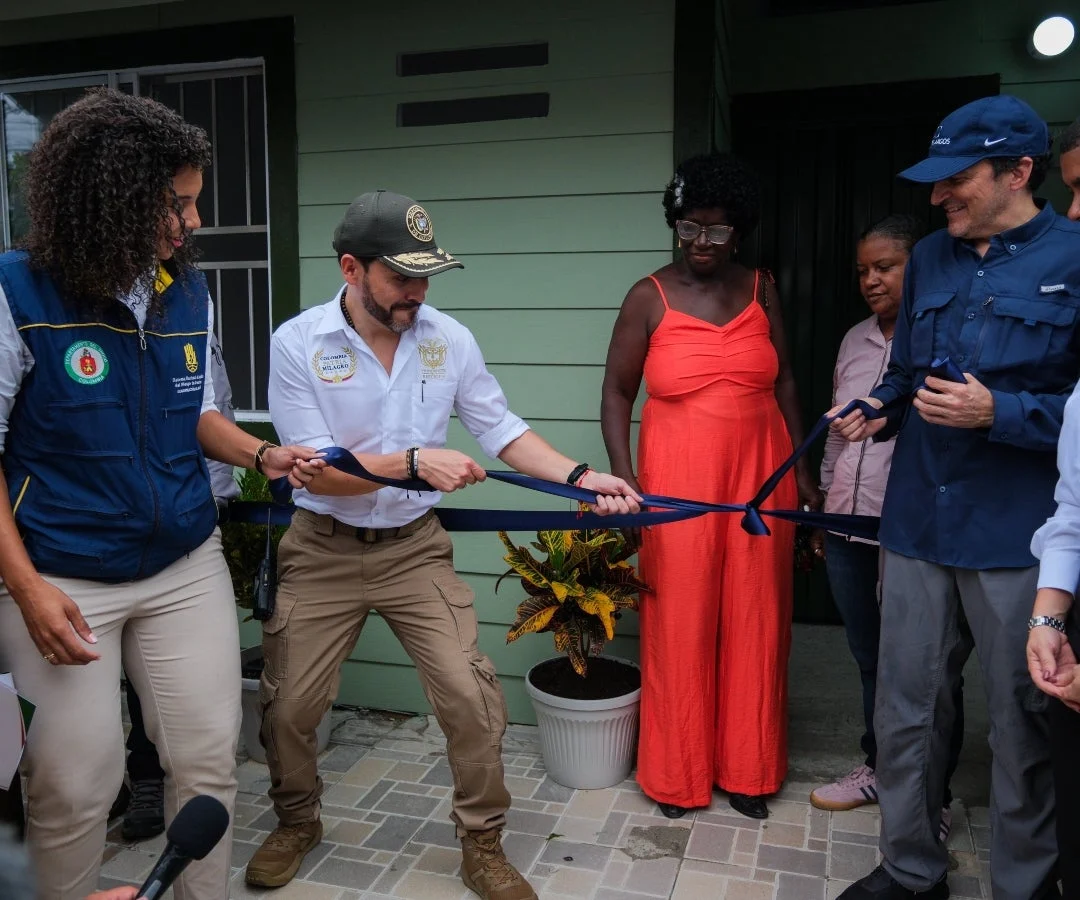
QUIBDÓ, COLOMBIA — In a major milestone for national recovery efforts following the devastating August 10 earthquake, the national government, in a strategic partnership with the private sector, has officially delivered the first wave of a 1,000-home reconstruction initiative. The announcement was marked by an emotional ceremony in Quibdó, capital of the Chocó department, where the first completed housing units were handed over to families who lost everything in the disaster.
The comprehensive relief effort goes beyond shelter. Alongside the housing distribution, authorities unveiled a state-of-the-art mobile medical unit designed to bridge the healthcare gap in remote and vulnerable neighborhoods. This dual-pronged approach highlights a coordinated strategy between public institutions and private conglomerates to restore not just physical infrastructure, but the fundamental social fabric and well-being of disaster-stricken populations across multiple departments.
Main Facts
The cornerstone of the current recovery phase is the construction and distribution of 1,000 new housing units earmarked specifically for households displaced or severely impacted by the August 10 earthquake. This initiative is the tangible result of a high-level public-private partnership forged between the national government and the prominent conglomerate Grupo Argos.
During the inaugural event in Quibdó, President Abelardo De la Espriella personally delivered the keys to the very first completed home of the project. The overarching plan involves a geographically diverse distribution strategy across six Colombian departments:
- Chocó (500 units): Concentrated in Quibdó, Unión Panamericana, and Opogodó.
- Valle del Cauca (235 units): Distributed across Argelia, El Águila, and El Cairo.
- Caldas (100 units): Located in the municipality of Chinchiná.
- Risaralda (100 units): Situated in Dosquebradas.
- Quindío (40 units): Addressing localized vulnerability in the department.
- Antioquia (25 units): Split between Ciudad Bolívar and Andes.
In tandem with the housing rollout, the government introduced a fully equipped mobile medical unit to Quibdó. Engineered to deliver primary healthcare directly to marginalized and affected communities, the vehicle features essential clinical infrastructure, including an examination table, a pediatric table, medical scales, a private restroom, a handwashing station, and a dedicated consultation desk. This mobile clinic is intended to serve as a vital lifeline for preventative care, routine check-ups, and maternal-child health services while permanent local health infrastructure undergoes restoration.
Chronology of Events
The road to recovery has been marked by rapid mobilization and structured milestones, transforming initial emergency response into sustained structural rehabilitation.
Phase 1: Immediate Emergency Response (August 10 – August 25)
Immediately following the severe earthquake on August 10, local and national emergency services were deployed to the epicentral zones. Search and rescue teams, civil defense units, and humanitarian aid workers rushed to Chocó and surrounding departments to secure structural integrity, clear debris, and provide temporary shelter, food, and clean water to thousands of newly displaced citizens.
Phase 2: Strategic Public-Private Alignment (Late August – September)
Recognizing the immense fiscal and logistical challenges of rebuilding thousands of homes across rugged terrain, the administration initiated high-level talks with private sector leaders. The formal alliance with Grupo Argos was established to leverage corporate engineering capacity, supply chains, and financial backing, transforming a protracted bureaucratic reconstruction timeline into an accelerated operational plan dubbed by officials as the "Patria Milagro" (Miracle Fatherland) initiative.
Phase 3: Groundbreaking and Logistics Mapping (October – November)
Engineering teams, urban planners, and local authorities mapped out the precise geographic distribution of the 1,000 homes. Priority was heavily weighted toward Chocó, which suffered the most severe structural devastation. Concurrently, procurement for specialized medical transport and mobile clinics began, ensuring that health services would parallel the housing development timeline.
Phase 4: Delivery of the First Units and Medical Launch (Current Phase)
The formal inauguration in Quibdó marks the transition from planning to execution. By officially handing over the first residence and deploying the mobile medical unit, the administration has set a precedent for the remaining 999 homes. Construction and outfitting are scheduled to scale up rapidly across the remaining five departments over the coming months.
Supporting Data and Geographic Distribution
The allocation of the 1,000 housing units reflects a meticulous vulnerability assessment conducted by disaster relief agencies and the Ministry of Housing. The data highlights a targeted approach prioritizing regions with pre-existing infrastructural deficits that were exacerbated by the seismic event.
| Department | Municipality / Region | Number of Units Allocated | Primary Focus |
|---|---|---|---|
| Chocó | Quibdó, Unión Panamericana, Opogodó | 500 | Epicentral recovery, rural-urban transition |
| Valle del Cauca | Argelia, El Águila, El Cairo | 235 | Mountainous zone stabilization, infrastructural repair |
| Caldas | Chinchiná | 100 | Urban-suburban resettlement |
| Risaralda | Dosquebradas | 100 | Peri-urban housing density management |
| Quindío | Department-wide allocation | 40 | Seismic retrofitting and replacement |
| Antioquia | Ciudad Bolívar, Andes | 25 | Suroeste sub-regional support |
Beyond housing metrics, the deployment of the mobile medical unit in Quibdó addresses a critical statistical gap in regional healthcare access. Prior to the earthquake, many remote sectors of Chocó relied on distant municipal hospitals. The newly introduced mobile clinic is equipped to handle dozens of primary consultations daily, drastically reducing travel burdens for families struggling with post-disaster trauma, sanitation-related illnesses, and chronic health conditions.
Official Responses and Statements
The human element of the recovery effort was central to the addresses given by national leaders during the Quibdó ceremony, emphasizing dignity, psychological restoration, and governmental accountability.
President Abelardo De la Espriella delivered a passionate address to the gathered families, reaffirming the state’s commitment to leaving no citizen behind in the wake of the tragedy:
"From the very first moment, I told those affected that they were not alone, that they had a president standing with them, and I told everyone that we were going to build the ‘Patria Milagro’ with speed and resolve. Here in Quibdó, we are handing over the very first of 1,000 homes, and I wanted to come personally to deliver this key to you," stated President De la Espriella.
Echoing the sentiment of holistic rehabilitation, Deputy Minister of Housing José D’Silva Uribe emphasized that the initiative transcends the mere construction of physical structures. He noted that the true objective is the emotional and social restoration of the household unit:
"Today we do not simply come to hand over a house. Today we come to give you back your home: that space where a family can once again feel safe, gather together, share moments, and recover those everyday experiences that turn four simple walls into a true home," remarked Deputy Minister D’Silva Uribe.
Local community leaders and regional representatives also voiced cautious optimism, praising the speed of the public-private partnership while emphasizing the long-term need for continuous state presence in historically marginalized departments like Chocó.
Implications and Future Outlook
The successful delivery of the first phase of this housing and healthcare initiative carries profound implications for Colombia’s disaster management framework and socio-economic development.
1. A New Paradigm for Public-Private Collaboration
The synergy between the national government and Grupo Argos serves as a potential blueprint for future crisis response in Latin America. By combining the regulatory power, social mandate, and territorial reach of the state with the logistical efficiency, capital flexibility, and technical expertise of private conglomerates, large-scale infrastructural deficits can be tackled at an unprecedented pace. Observers note that if this model proves successful across all 1,000 units, it could redefine how Colombia approaches post-disaster reconstruction and social infrastructure projects moving forward.
2. Decentralized Healthcare and Social Resilience
The inclusion of the mobile medical unit points to a growing recognition that physical housing alone cannot guarantee community recovery. Public health experts have long argued that trauma, displacement-induced stress, and disruptions in sanitation create secondary health crises following natural disasters. By bringing primary care directly to the doorsteps of vulnerable neighborhoods in Quibdó, the government is mitigating long-term public health risks and reinforcing community resilience against future shocks.
3. Addressing Historical Disparities
While the August 10 earthquake was an acute natural disaster, its impact laid bare the deep-seated structural vulnerabilities inherent in departments like Chocó and parts of Valle del Cauca and Antioquia. The concentration of 50% of the new housing stock in Chocó represents a vital step toward addressing historical regional inequalities. However, economists and regional analysts stress that continuous investment in roads, education, formal employment, and permanent healthcare facilities will be necessary to ensure sustainable, long-term development in these previously underserved areas.
As construction crews push forward to complete the remaining 999 homes across the six designated departments, the eyes of the nation remain fixed on Quibdó. For the families who have received their keys, the doors represent not just protection from the elements, but a hard-won return to normalcy, dignity, and hope for the future.