Executive Summary: The Rise of a Global Outlier
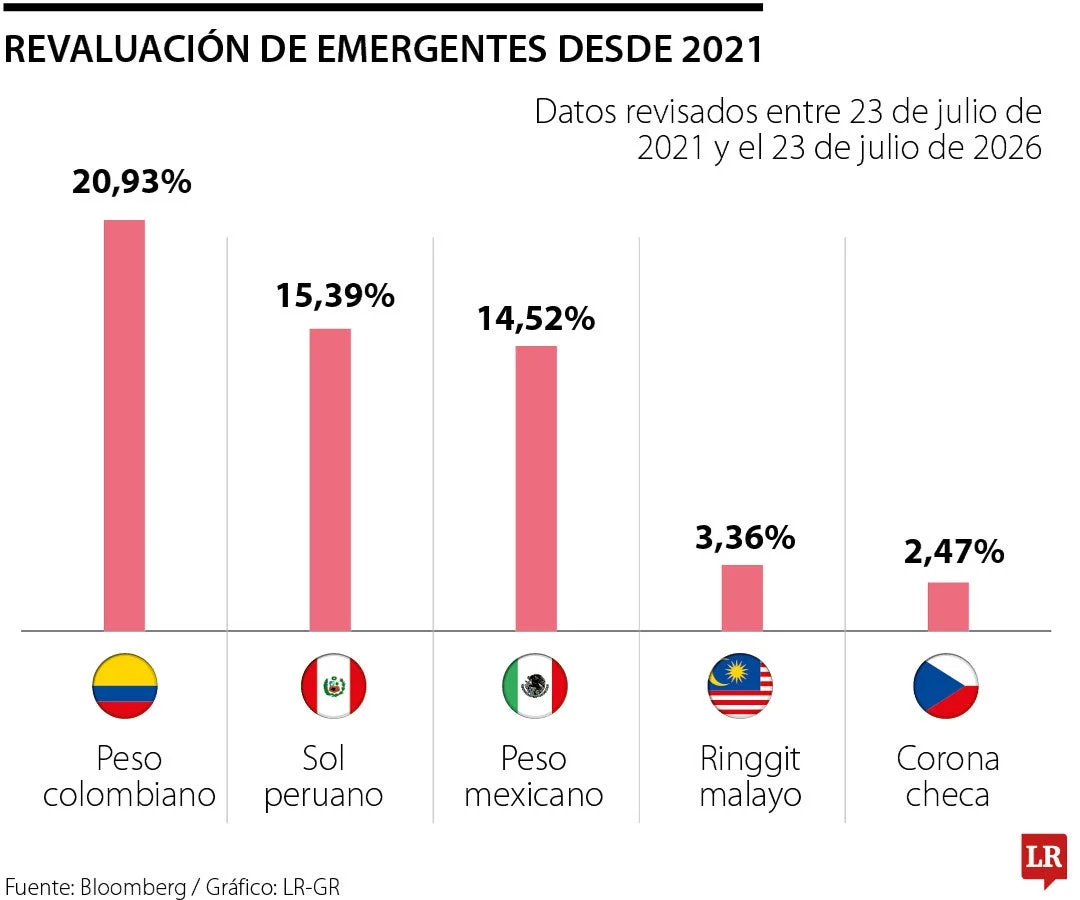
In the volatile landscape of emerging market finance, the Colombian peso (COP) has emerged as an unexpected titan. Over the past five years, specifically since the waning days of the global pandemic in mid-2021, the currency has undergone a staggering 20.93% revaluation against the U.S. dollar. This performance has not only defied regional trends in Latin America but has also positioned Colombia as a global leader in currency appreciation, outstripping traditional powerhouses and regional peers like Mexico and Peru.
However, this "monetary miracle" is increasingly viewed as a double-edged sword. While a strong currency lowers the cost of imports and helps temper inflation for a nation that sources 30% of its basic food basket from abroad, it has simultaneously placed a strangulating grip on the country’s export engines. As the administration of Abelardo De La Espriella prepares for a pivotal transition on August 7th, the nation faces a fundamental question: Is the "Super Peso" a sign of genuine economic resilience, or is it a "fictitious" rate driven by high interest rates and "dark remittances" that threatens to hollow out Colombia’s industrial and agricultural core?
Main Facts: A Regional and Global Comparison
The Colombian peso’s trajectory over the last five years represents a radical departure from the traditional narrative of emerging market vulnerability. According to data tracking currency performance from July 2021 to the present (July 2026), the COP has secured its place as one of the three most revalued emerging market currencies in the world.
The Revaluation Leaderboard
While the Colombian peso surged by nearly 21%, its closest regional competitors also saw significant gains, though they remained in Colombia’s shadow:
- Peruvian Sol (PEN): 15.39% appreciation.
- Mexican Peso (MXN): 14.52% appreciation.
- Malaysian Ringgit (MYR): 3.36% appreciation.
- Czech Koruna (CZK): 2.46% appreciation.
- Brazilian Real (BRL): 2.29% appreciation.
The Contrast: The Devaluation Corner
The strength of the Colombian peso is even more pronounced when contrasted with currencies that have collapsed during the same period. The Argentine Peso (ARS) leads this unfortunate list with a 93.52% devaluation, followed by the Turkish Lira (TRY) at 81.91%. Other major economies have also seen their currencies weaken significantly against the dollar, including the Indian Rupee (-22.95%), the South Korean Won (-22.10%), and the Chilean Peso (-19.48%).
The fact that Colombia sits at the opposite end of this spectrum suggests that unique domestic factors—ranging from monetary policy to capital flow dynamics—are overriding the general "risk-off" sentiment that often plagues emerging markets.
Chronology: From Pandemic Recovery to Monetary Tightness (2021–2026)
The journey of the Colombian peso over the last half-decade can be divided into three distinct phases:
Phase I: The Post-Pandemic Pivot (July 2021 – Late 2022)
In the immediate aftermath of the COVID-19 lockdowns, Colombia, like much of the world, faced surging inflation. The Central Bank (Banco de la República) began an aggressive cycle of interest rate hikes to prevent the economy from overheating. During this period, the peso began to stabilize after years of volatility, attracting the attention of yield-seeking investors.
Phase II: The Carry Trade Boom (2023 – 2025)
As interest rates in developed economies like the U.S. and the Eurozone remained relatively lower compared to the aggressive tightening in Bogotá, Colombia became a "darling" for carry trade investors. This strategy involves borrowing money in low-interest currencies to invest in high-yield assets elsewhere. With Colombia offering some of the highest real interest rates in the world, the influx of foreign capital became a flood, driving the peso’s value upward despite political transitions and social unrest.
Phase III: The "Super Peso" Consolidation (2025 – July 2026)
By 2025, the peso and the Brazilian real were accumulating year-to-date returns exceeding 16% against the dollar. Low market volatility further incentivized investors to double down on Colombian assets. However, by early 2026, the narrative began to shift from "economic strength" to "export crisis," as the prolonged appreciation started to erode the profit margins of the nation’s primary industries.
Supporting Data: The Mechanics of Appreciation
The current exchange rate environment is not merely a product of market sentiment; it is driven by hard economic data and specific financial mechanisms.
The Carry Trade and Interest Rate Differentials
According to Bloomberg, the Colombian peso has led the global carry trade surge primarily because of the "real interest rate" (the nominal rate minus inflation). While other nations began cutting rates in 2025, Colombia maintained a hawkish stance to combat persistent service-sector inflation. This created a massive yield gap that made the peso nearly irresistible to institutional investors.
The Commodity Buffer
Historically, the Colombian peso is closely tied to the price of oil. The recovery of oil prices—both Brent and WTI—has provided a quantitative cushion for the economy. While the strong peso reduces the number of pesos received for every dollar of oil sold, the high price per barrel has partially offset the "exchange rate hit" for the state-owned oil giant, Ecopetrol, and the national treasury.
The Shadow Economy and Remittances
A more controversial data point mentioned by analysts is the role of remittances. Colombia has seen a record-breaking influx of foreign exchange through family transfers. However, critics and some economic reports suggest that a portion of these flows may be "dark remittances"—unconventional or illicit capital entering the country under the guise of legal transfers. This artificial demand for pesos further inflates the currency’s value beyond what the productive economy can support.
Official Responses and Sectoral Perspectives
The appreciation of the peso has created a deep schism between different sectors of the Colombian economy, leading to conflicting demands on the Abelardo De La Espriella administration.
The Exporters’ Outcry: Agriculture and Oil
The agro-industrial sector, particularly fruit exporters, has raised the loudest alarms. Unlike the oil sector, which benefits from high global prices, fruit exporters face a "pincer movement":
- High Input Costs: Fertilizers and specialized machinery are often priced in global markets, and while a low dollar helps, the domestic inflation in labor and logistics has wiped out those gains.
- Reduced Revenue: When they bring their dollars back to Colombia, they receive 20% fewer pesos than they did five years ago, making it impossible to cover rising local salaries.
The Importers’ Defense: Technology and the Consumer
On the other side of the debate are the importers and proponents of a strong peso. They argue that:
- Modernization: A strong peso allows Colombian industries to import high-tech machinery and industrial equipment at a discount, which should, in theory, increase long-term productivity.
- Inflation Control: Since 30% of the Colombian food basket is imported, a strong peso is the only thing preventing a cost-of-living catastrophe for the working class.
The Government’s Dilemma
The De La Espriella administration is under immense pressure to intervene. However, the Central Bank remains independent, and its primary mandate is price stability (inflation control), not protecting the exchange rate for exporters. The incoming economic directives, set to be unveiled on August 7th at the Casa de Nariño, will have to address whether the government will push for a more "competitive" (weaker) peso or continue to embrace the "Super Peso" as a tool for modernization.
Implications: The 2027 Prospect and the Risk of "Dutch Disease"
As Colombia looks toward the end of 2026 and the start of 2027, the long-term implications of this 20% revaluation are becoming clear.
The Threat of Deindustrialization
The most significant risk is a variation of "Dutch Disease," where a surge in one sector (in this case, financial inflows and commodities) causes the currency to appreciate so much that the manufacturing and agricultural sectors become uncompetitive. If the peso remains at these levels through 2027, Colombia risks a permanent loss of its export diversity. Once a farm or a factory closes because it is no longer profitable to sell abroad, it does not easily reopen when the exchange rate eventually corrects.
The Productivity Fallacy
Defenders of the strong peso point to machinery imports as a silver lining. However, economic critics argue this is a fallacy. Industrial machinery is typically a capital investment made once every five to ten years. In contrast, the costs of labor, electricity, and local raw materials are daily pressures. A cheap dollar for a one-time tractor purchase does not compensate a farmer for a 20% loss in revenue every single day of the harvest.
The 2027 Forecast: Uncertainty Reigns
No major financial institution or analyst currently dares to predict whether this trend will sustain through 2027. The global economy is shifting; if the U.S. Federal Reserve begins a significant easing cycle, the carry trade could accelerate even further, pushing the peso to even more "fictitious" heights. Conversely, if commodity prices drop or if the "dark remittances" are curtailed by stricter international regulations, the peso could face a violent and painful devaluation.
Conclusion: A Championship No One Wanted to Win
Colombia finds itself in the strange position of being a "world champion" in currency appreciation—a title that brings more anxiety than pride. While the "Super Peso" has shielded consumers from the worst of global inflation, it has placed the country’s productive future in jeopardy.
As the new economic guidelines are established this August, the focus must shift from celebrating a strong currency to ensuring a sustainable one. A "fictitious" exchange rate, built on the shifting sands of high interest rates and opaque capital flows, is not a sign of wealth; it is a structural imbalance that, if left unaddressed, could turn the 2027 economic outlook into a cautionary tale for the rest of the emerging world.