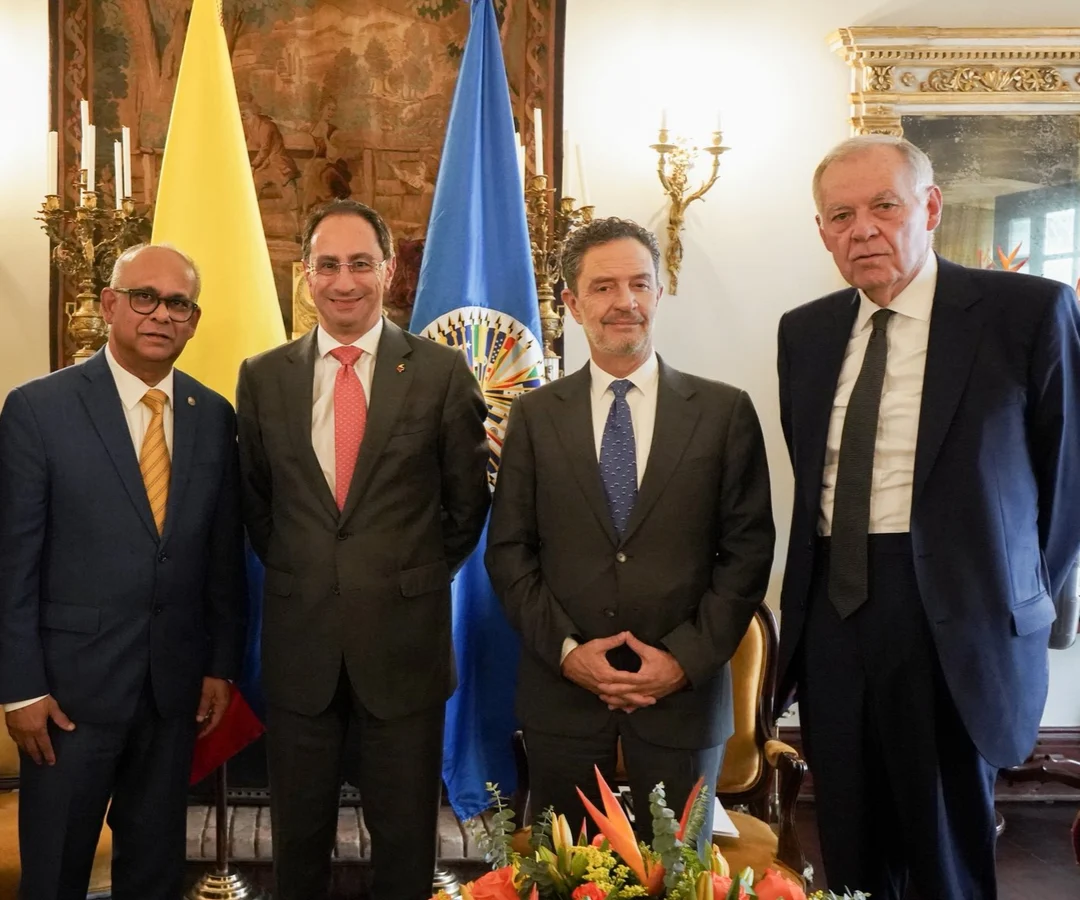
WASHINGTON, D.C. — In a crucial series of diplomatic engagements in the United States capital, high-ranking representatives of the Colombian government met with the leadership of the Organization of American States (OAS). The strategic meetings come at a pivotal juncture marked by an impending transition within Colombia’s permanent mission to the continental body. As Alejandro Ordóñez prepares to transition from his diplomatic post to assume leadership at the Ministry of the Interior, Vice President José Manuel Restrepo led a high-level delegation to confer directly with OAS Secretary General Albert Ramdin.
The high-stakes dialogue focused heavily on bridging the historical gap between multinational bureaucratic institutions and the everyday realities of citizens across the Americas. By emphasizing security, institutional stability, and regional cooperation, the Colombian administration seeks to position itself as a central pillar in fostering democratic resilience and prosperity throughout the hemisphere.
Main Facts
The diplomatic mission to the headquarters of the Organization of American States brought together key figures from both the Colombian executive branch and the continental organization to chart a collaborative path forward.
- The Core Delegation: Vice President José Manuel Restrepo spearheaded the Colombian delegation, accompanied by outgoing Permanent Representative to the OAS (and incoming Minister of the Interior) Alejandro Ordóñez, and Foreign Minister Omar Bula.
- The OAS Leadership: The delegation met with OAS Secretary General Albert Ramdin to discuss shared regional challenges, bilateral cooperation, and the modernization of multilateral governance.
- Key Strategic Objectives: The discussions centered on translating high-level diplomatic efforts into tangible outcomes for citizens, specifically targeting enhanced regional security, economic stability, family welfare, and the safeguarding of democratic freedoms.
- Presidential Vision: Vice President Restrepo reiterated the commitment of President Abelardo De La Espriella’s administration to project values of security, public trust, and economic opportunity beyond Colombia’s borders, fostering a cooperative network across the Americas.
- Future Milestones: The dialogue builds upon a series of diplomatic outreaches initiated earlier this year, including discussions regarding potential Colombian cities hosting the 80th-anniversary celebration of the OAS in 2028.
Chronology of Diplomatic Engagement
The recent meeting between Vice President Restrepo, Secretary General Ramdin, and the broader Colombian delegation is not an isolated event, but rather the culmination of a carefully coordinated diplomatic strategy that has evolved over several months.
June: The Foundation of Direct Communication
The groundwork for the current administration’s alignment with the OAS was established even before the official inauguration. In June, following the national elections, OAS Secretary General Albert Ramdin placed a direct telephone call to President-elect Abelardo De La Espriella. During this initial conversation, Ramdin extended formal congratulations on the electoral victory. More importantly, the two leaders laid the foundation for a revitalized partnership, explicitly agreeing to prioritize bilateral cooperation centered on hemispheric security, democratic institution-building, and sustainable development.
September: Barranquilla Visit and the 2028 Vision
Momentum accelerated in September when Secretary General Ramdin traveled to Colombia, making a high-profile stop in the coastal city of Barranquilla. During this visit, Ramdin publicly evaluated the state of affairs between the Andean nation and the continental body, describing the diplomatic relationship as "excellent."
Crucially, Ramdin used the platform to look toward the long-term horizon, announcing that either Barranquilla or the capital city of Bogotá were under consideration to serve as the host nation for the monumental 80th-anniversary celebrations of the OAS, scheduled for 2028. However, this optimistic outlook was tempered by candid warnings from the Secretary General regarding the current geopolitical climate. Ramdin noted a profound and marked ideological division among the nations of the Western Hemisphere, establishing that the overriding priority for the OAS moving forward must be the active pursuit of regional consensus and unity.
Current Transition and Washington Meetings
The diplomatic timeline culminated in the recent Washington, D.C., meetings. As Alejandro Ordóñez prepares to relinquish his post at the OAS mission to assume heavy responsibilities domestically at the Ministry of the Interior, the timing of the summit allowed for a seamless handoff of strategic priorities. Foreign Minister Omar Bula and Vice President Restrepo ensured that Colombia’s foreign policy objectives remained uninterrupted, utilizing the encounter to reaffirm long-term commitments while managing immediate institutional shifts.
Supporting Data and Geopolitical Context
To fully understand the weight of the recent meetings at the OAS, one must examine the broader socio-political and economic framework of the Americas. The Organization of American States, founded in 1948 with the signing of the Charter of the OAS in Bogotá, represents the world’s oldest regional mutual organization. Yet, in the contemporary era, the institution faces unprecedented stress tests.
- The Polarization Challenge: As highlighted by Secretary General Ramdin during his autumn visit to Colombia, the modern Americas suffer from severe ideological fragmentation. Left-leaning and right-leaning governments often find themselves at loggerheads over migration crises, economic policies, and democratic governance standards in trouble spots like Venezuela, Nicaragua, and Haiti.
- Colombia’s Strategic Weight: With a population exceeding 50 million and a strategic geographic position bridging South and Central America, Colombia acts as a geopolitical linchpin. Under the administration of President Abelardo De La Espriella, the nation has sought to anchor its foreign policy in traditional security alliances while aggressively courting foreign investment and economic integration.
- The Multilateral Mandate: Data from regional security indices indicate that public anxiety regarding organized crime, transnational drug trafficking, and economic uncertainty remains the primary driver of political discontent across Latin America. By pushing the OAS to focus on "tangible family welfare," the Colombian delegation is responding directly to regional polling data that suggests citizens are losing faith in abstract diplomatic declarations that fail to improve local safety metrics.
Official Responses and Statements
The high-level discussions in Washington generated significant commentary from both Colombian officials and international diplomats, underscoring the gravity with which both parties view the partnership.
Speaking on behalf of the Colombian government, Vice President José Manuel Restrepo emphasized the necessity of a pragmatic, citizen-centric multilateralism:
"We must ensure that the foundational work of the organization translates directly into enhanced stability, heightened security, and tangible well-being for families across the continent. Our vision of democracy is one that aggressively protects individual liberties while remaining ruthlessly responsive to the basic, everyday needs of our people."
Restrepo further elaborated on the internationalist posture of President Abelardo De La Espriella’s administration, noting:
"From the very beginning of President De La Espriella’s mandate, we have been vigorously constructing a domestic reality defined by security, public trust, and expanded opportunities. We do not view this as an isolated project; we are eager to collaborate proactively with our sister nations across the Americas so that this same wave of hope and security can permeate the entire region."
While Secretary General Ramdin has consistently praised Colombia’s constructive posture within the General Assembly and its permanent councils, his recent statements have consistently underscored the urgent necessity of institutional cohesion. In his prior addresses in Colombia, Ramdin stressed that international organizations like the OAS can only effectively combat transnational threats—such as illicit financial flows, environmental degradation, and irregular migration—if member states are willing to transcend domestic partisan squabbles and invest genuinely in hemispheric solidarity.
Implications of the Diplomatic Shift
The convergence of domestic administrative changes in Bogotá and ongoing regional challenges at the OAS carries profound implications for Colombia’s foreign policy and its standing in the international community.
1. Continuity in Foreign Policy Amid Domestic Shifts
The transition of Alejandro Ordóñez from the OAS mission to the Ministry of the Interior creates a natural pivot point. Ordóñez has long been recognized as a formidable conservative voice within Colombian politics; his transition into a domestic security and governance portfolio means that the ideological tenets he championed internationally—such as strict institutional order, traditional family values, and robust state authority—will now find a direct operational outlet within Colombia’s domestic governance. Concurrently, the smooth involvement of Foreign Minister Omar Bula ensures that Colombia’s permanent mission will maintain its aggressive advocacy for security cooperation without missing a beat.
2. Positioning Colombia as a Regional Leader
By actively aligning its national doctrine of "security, confidence, and opportunity" with the multilateral mandates of the OAS, the De La Espriella administration is positioning Colombia not merely as a participant, but as a conceptual leader within the hemisphere. In an era where several traditional regional powers are turning inward due to domestic economic pressures, Colombia’s willingness to champion continental unity fills a critical vacuum.
3. The 2028 Horizon and Institutional Renewal
The prospect of hosting the 80th-anniversary celebrations of the OAS in either Bogotá or Barranquilla in 2028 serves as a long-term strategic beacon. For Colombia, securing such a historic summit would provide an unparalleled platform to showcase its economic modernization, security transformations, and cultural vibrancy to the global community. However, realizing this ambition will require sustained diplomatic heavy lifting, cementing coalitions within the OAS Permanent Council, and proving that Colombia can serve as a neutral, trusted broker in a deeply divided continent.
Ultimately, the dialogue between Vice President Restrepo and Secretary General Ramdin signals a renewed commitment to pragmatic diplomacy. As the Americas navigate a volatile geopolitical landscape, Colombia’s active engagement with the OAS demonstrates a clear recognition that domestic prosperity and regional security are inextricably linked.