GLOBAL FINANCE & TECHNOLOGY REPORT
By the Financial Desk
Published: November 2026
Main Facts
Nu Holdings, the parent company of Latin America’s digital banking titan Nubank, has once again rewritten the playbook for modern financial institutions. In its financial results for the period ending September 30, 2026, the company reported a staggering net income of US$1.1 billion for the third quarter, representing a robust 31% year-over-year growth. This milestone underscores not only the viability of digital-first banking models at massive scale but also the sheer execution prowess of a firm that continues to expand its footprint across the Americas and beyond.
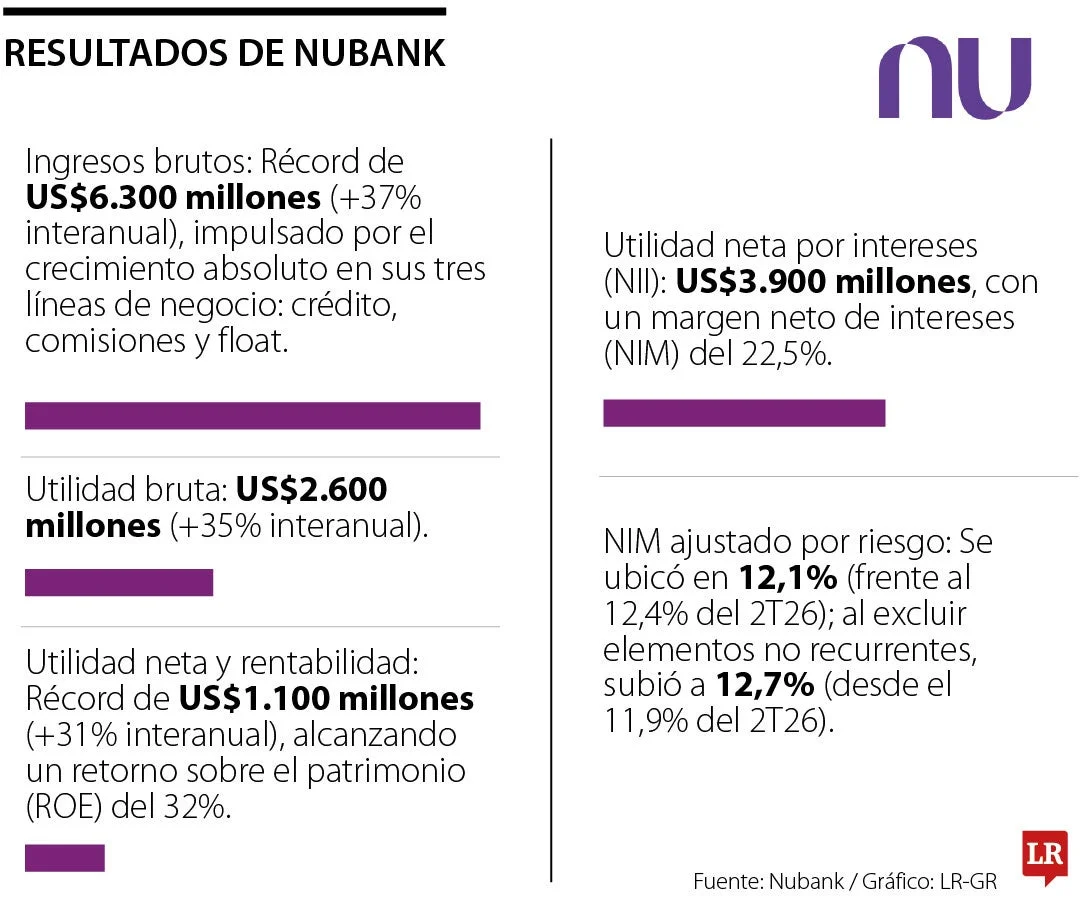
The financial metrics released by Nu Holdings point to a quarter of unprecedented acceleration across almost every key performance indicator:
- Record Net Income: US$1.1 billion (up 31% YoY).
- Historic Gross Revenues: US$6.3 billion, marking a phenomenal 37% year-over-year increase.
- Gross Profit: US$2.6 billion, expanding by 35% compared to the third quarter of 2025.
- Return on Equity (ROE): A stellar 32%, demonstrating elite capital efficiency.
- Net Interest Income (NII): Reached US$3.9 billion, with a Net Interest Margin (NIM) sitting comfortably at 22.5%.
Driving this growth is a diversified revenue model that successfully captures value across three primary pillars: credit, fee income, and liquidity yields (float). Each of these streams registered absolute year-over-year increases, proving that Nubank’s ecosystem approach—transitioning from a simple credit card issuer to a comprehensive financial supermarket—is generating compounding returns.
Market expansion remains equally formidable. In Brazil, Nubank has solidified its status as an inescapable utility, capturing 65% of the adult population while achieving a record activity rate of 86.3%. Meanwhile, strategic international bets are paying off handsomely: Mexico added nearly 870,000 new clients in a single quarter during its inaugural operational phase as a fully licensed bank, and Colombia cemented its position as the country’s leading credit card issuer by number of cardholders.
Chronology of Nu Holdings’ Q3 2026 Performance
To understand how Nubank achieved these historic figures, it is essential to trace the operational timeline and strategic milestones that defined the lead-up to and execution of the third quarter of 2026.
Early 2026: Laying the Groundwork for Internationalization
The groundwork for Q3’s record-breaking performance was laid earlier in the year. Following regulatory approvals in Mexico to transition into a full banking institution, Nu Holdings aligned its capital allocation strategy toward aggressive customer acquisition north of its Brazilian stronghold. Concurrently, the Colombian market underwent intensive product localization, pushing the rollout of its high-yield savings accounts and credit portfolios to capture market share from legacy incumbents.
July–August 2026: Mid-Year Momentum and Margin Optimization
As the third quarter commenced, Nubank focused intensely on portfolio quality and risk-adjusted margins. Despite macroeconomic headwinds and fluctuating interest rate environments across Latin America, the firm maintained strict credit underwriting standards. The risk-adjusted Net Interest Margin (NIM) began a strategic stabilization process; while standard metrics showed minor fluctuations due to seasonal adjustments, the exclusion of non-recurring elements revealed an underlying expansion of risk-adjusted NIM to 12.7% (up from 11.9% in Q2 2026), proving that portfolio quality was actually improving underneath the surface.
September 30, 2026: Closing the Quarter with Historic Milestones
The final weeks of September saw a massive surge in platform engagement, particularly in Brazil, where the 86.3% activity rate marked the seventh consecutive quarter of expansion in user engagement. In Mexico, marketing and product integration campaigns successfully converted hundreds of thousands of waitlist applicants into active bank accounts. By the time the books closed on September 30, Nu Holdings had cemented a historic balance sheet, positioning itself not just as a regional champion, but as a global benchmark for digital banking profitability.
Supporting Data: Deep Dive into the Financial Architecture
A granular look at Nu Holdings’ Q3 2026 financial statements reveals a robust operational structure capable of generating high margins while absorbing macroeconomic friction.
Revenue Diversification and Profitability
Nubank’s ability to generate US$6.3 billion in gross revenues—a 37% jump year-over-year—is rooted in its three-pillar revenue architecture:
- Credit: As the lending portfolio matures, interest income scales naturally. The Net Interest Income (NII) touching US$3.9 billion reflects a healthy demand for personal loans, credit cards, and working capital solutions across its operating geographies.
- Fees and Commissions: Beyond lending, transactional volume via debit cards, PIX (in Brazil), merchant services, and cross-border transactions contributed significantly to the US$2.6 billion gross profit.
- Liquidity Yields (Float): The massive influx of deposits across its digital savings accounts allows Nubank to generate substantial yield on liquid assets, turning everyday consumer savings into a powerful margin enhancer.
Credit Quality and Risk-Adjusted Margins
Skeptics of digital neo-banks often point to credit risk as an Achilles’ heel. However, Nubank’s Q3 data systematically dismantles this narrative. The Net Interest Margin (NIM) of 22.5% demonstrates exceptional pricing power. More importantly, the risk-adjusted NIM—when stripping away non-recurring items—rose to 12.7% in Q3 2026, up from 11.9% in the previous quarter. This indicates that the credit models, heavily reliant on proprietary machine learning algorithms and alternative data scoring, are successfully pricing risk and keeping delinquency cohorts under tight control.
Capital Efficiency and ROE
An ROE of 32% is extraordinary by any global banking standard. Traditional brick-and-mortar banks often struggle to break a 15% to 20% ROE due to bloated cost structures, legacy IT debt, and heavy physical branch footprints. Nubank’s purely digital architecture enables a remarkably low cost-to-serve, ensuring that incremental revenue scales at a much faster rate than operational expenses. This operating leverage is precisely what enabled the firm to post US$1.1 billion in pure net income this quarter.
Official Responses and Executive Insights
The leadership team at Nu Holdings emphasized that these record-breaking results are merely a waypoint on a much larger strategic journey.
"We delivered a record quarterly net income of US$1.1 billion, while continuing to grow in our core markets and taking our first steps beyond Latin America," stated David Vélez, founder and CEO of Nubank.
Vélez’s commentary points to a dual focus: deepening penetration in established territories while quietly planting seeds for global expansion. The phrase "beyond Latin America" carries significant weight for institutional investors, hinting that the technological infrastructure and operational playbook perfected in Brazil, Mexico, and Colombia may soon find a home in international markets outside the region.
Industry analysts have noted that Vélez’s leadership has consistently prioritized long-term platform value over short-term earnings management. By reinvesting efficiency gains into customer acquisition—such as the aggressive push in Mexico—Nubank continues to build an economic moat that legacy financial institutions find increasingly difficult to breach.
Implications: What Q3 2026 Means for the Future of Banking
The financial results posted by Nu Holdings in the third quarter of 2026 carry profound implications for the global financial ecosystem, Latin American macroeconomics, and the competitive landscape of retail banking.
1. The Death of the Legacy Banking Monopoly
For decades, Latin American banking was characterized by oligopolies that charged exorbitant fees and maintained high interest rates while offering subpar digital experiences. Nubank’s success—evidenced by capturing 65% of the adult population in Brazil—proves that consumer demand for transparent, low-cost, digital-first financial services is virtually limitless. Traditional banks are no longer competing on brand heritage; they are engaged in a desperate race to modernize their core technology before digital natives make their traditional branches obsolete.
2. Validation of the Neo-Bank Business Model
Globally, many fintech startups have struggled to transition from high-growth customer acquisition machines to sustainably profitable enterprises. Nubank has decisively crossed that chasm. Generating US$1.1 billion in net income with a 32% ROE sets a new gold standard. It proves that at scale, digital banks can achieve unit economics that far surpass those of legacy institutions.
3. Geopolitical and Regional Economic Shifts
Nubank’s localized triumphs are reshaping regional economies. In Mexico, signing up 870,000 new clients in a single quarter as a newly minted bank demonstrates that financial inclusion can be accelerated dramatically through digital channels in unbanked or underbanked populations. In Colombia, becoming the top credit card issuer reshapes consumer credit dynamics, driving down costs for everyday borrowers and forcing competitors to innovate or retreat.
4. The Horizon: Moving Beyond Latin America
As David Vélez hinted, Nu Holdings is looking outward. Having conquered the most complex financial markets in Latin America, the company possesses the capital, the technology stack, and the operational maturity to test its model in other developing regions—or even mature markets seeking modern fintech infrastructure.
Conclusion
Nu Holdings’ Q3 2026 performance is more than just a stellar earnings report; it is a structural turning point. By combining massive scale, hyper-efficient unit economics, disciplined risk management, and relentless product innovation, Nubank has proven that the future of global banking belongs not to those with the most brick-and-mortar branches, but to those with the smartest digital ecosystem. As the company looks toward its next phase of global expansion, the rest of the banking world is left playing catch-up.