By Global Science Desk
Published: November 9, 2026
Main Facts
For millions of years, the narrative of human evolution has been dominated by terrestrial threats. Paleontological textbooks and popular media alike have long framed the dawn of our lineage through the lens of ground-based danger: the stealthy ambushes of saber-toothed cats, the crushing jaws of prehistoric crocodiles, and the relentless packs of hyena-like carnivores that prowled the ancient landscapes of Africa and Eurasia.
However, a growing body of paleoanthropological and ecological research reveals a terrifying missing chapter in the story of human survival. The most lethal hazard to early hominins did not always come from the bushes or the shadows of the savannah—it descended silently from the open skies.
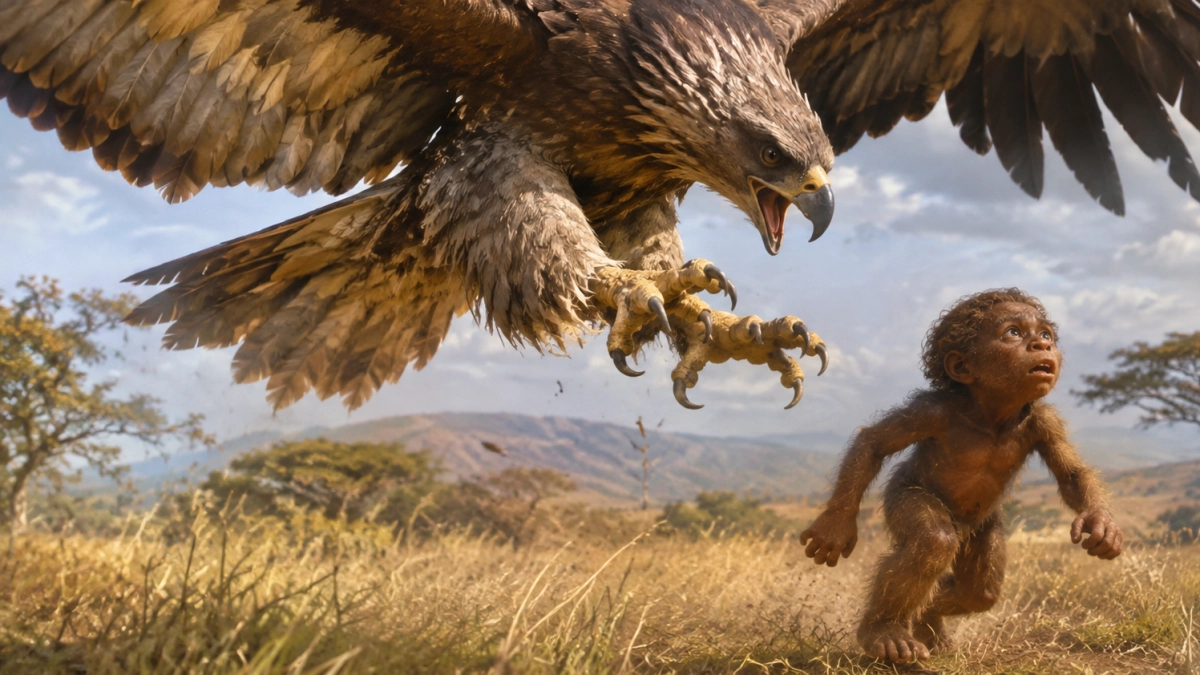
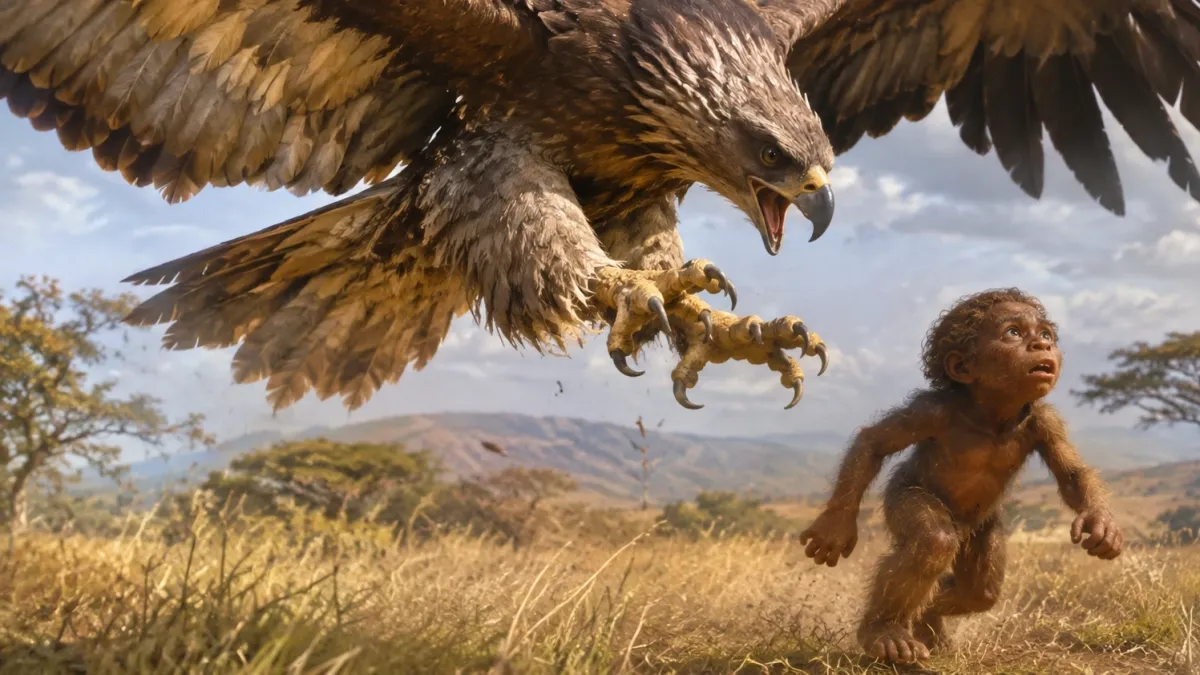
Recent investigations into fossil records, comparative primatology, and avian biology indicate that colossal birds of prey exerted immense evolutionary pressure on early hominins. These aerial predators were powerful enough to snatch infants and juveniles, fundamentally shaping early human behaviors, driving the adoption of cooperative social structures, refining mechanisms of group vigilance, and potentially laying the neurological groundwork for complex communication and early language.
The primary physical evidence anchoring this hypothesis remains one of the most famous fossils in paleoanthropology: the Taung Child. Discovered in South Africa, this specimen of Australopithecus africanus lived approximately 2.8 million years ago. For decades, anthropologists debated the exact cause of death for the roughly three-year-old hominin.
However, modern forensic analyses have identified distinct puncture marks beneath the eye sockets—injuries that bear an unmistakable resemblance to the damage inflicted by modern predatory raptors when they dispatch and consume primate prey.

While researchers continue to debate the exact species responsible, the Taung Child stands as a poignant testament to a primordial reality: long before humans stood at the apex of the global food chain, they were frequently the hunted, vulnerable to silent, winged executioners sweeping down from the canopy.
Chronology
To understand how avian predators influenced the trajectory of human evolution, scientists have reconstructed a timeline stretching from the early days of primate vulnerability to the mythological echoes of giant birds in human history.
- 2.8 Million Years Ago (The Taung Incident): An Australopithecus africanus toddler, now known globally as the Taung Child, is killed in what forensic paleoanthropologists argue was a textbook aerial ambush in the territory of modern-day South Africa. The microscopic and macroscopic trauma to its skull matches the unique hunting signatures left by modern crowned eagles.
- The Neogene and Quaternary Periods (Rise of the Megafauna Birds): Following the extinction of the non-avian dinosaurs, expansive ecological niches opened. Avian species exploded in size and ecological specialization. In North America, South America, New Zealand, and Australia, monstrous flying birds evolved, boasting wingspans of up to seven meters and specialized predatory behaviors.
- Late Pleistocene / Holocene Transition (The Extinction of Apex Avian Predators): Massive avian predators, such as the legendary Haast’s eagle of New Zealand, dominate island ecosystems, hunting giant flightless moas. As human populations expand and megafauna collapses, these hyper-specialized giant raptors drift into extinction, leaving behind only fossilized bones and powerful oral traditions among indigenous peoples, such as the Māori myth of Te Hokioi.
- Late 20th to Early 21st Century (The Primate-Raptor Analogue Studies): Primatologists such as Scott McGraw conduct exhaustive necropsies on hundreds of contemporary African primates killed by crowned eagles in the Taï Forest of Ivory Coast. The resulting anatomical data provides the definitive comparative baseline needed to re-evaluate hominin fossils.
- November 2026 (Synthesizing the Evolutionary Hypothesis): Modern researchers, including archaeologists James Cole and primatologist Scott McGraw, consolidate decades of interdisciplinary data. They formally link aerial predation pressure to the evolution of human group living, cooperative vigilance, and the dawn of sophisticated vocal communication.
Supporting Data and Comparative Analysis
The hypothesis connecting raptors to hominin evolution is not built on speculation alone; it rests on rigorous comparative anatomy and field observation.

The Taï Forest Clue
Dr. Scott McGraw, a prominent primatologist from Ohio State University, spent years examining the skeletal remains of more than 600 modern primates that had fallen victim to aerial predators in the dense canopies of the Taï Forest in Côte d’Ivoire. His primary focus was the African crowned eagle (Stephanoaetus coronatus), a formidable apex predator known to target modern monkeys and smaller apes.
When McGraw and his team analyzed the skulls of these contemporary primates, they discovered a startling anatomical signature: deep, repeated damage to the floor of the orbital floor—the delicate bone structure situated deep within the eye sockets.
Upon comparing these modern samples directly with the cranium of the Taung Child, researchers found that the pattern of trauma was virtually identical. The crushing force and puncture angles matched the biomechanics of an eagle driving its talons downward into the face of its prey to puncture the brain or skull base. This empirical match provided the smoking gun needed to validate the theory of prehistoric aerial predation on hominins.

Avian Titans of the Prehistoric World
The threat posed by birds was amplified by the staggering scale that avian predators achieved throughout the Cenozoic era. Without mammalian competitors in certain aerial and terrestrial niches, birds evolved into terrifying proportions:
- Pelagornis sandersi: Unearthed in South Carolina, this is widely recognized as the largest flying bird ever discovered. With an estimated wingspan reaching an astonishing seven meters (23 feet), it dominated ancient coastlines.
- The Teratorns of the Americas: Soaring predators closely related to New World vultures, these giants reached wingspans of up to six meters. Utilizing powerful thermal updrafts, they could patrol vast territories with minimal energy expenditure.
- The Haast’s Eagle (Hieraaetus moorei): Endemic to New Zealand, this apex predator possessed roughly double the body weight of a modern harpy eagle. Armed with ten-centimeter talons capable of crushing bone, it specialized in hunting four-meter-tall flightless moas. According to senior avian anatomical conservator Joanne Cooper of London’s Natural History Museum, the Haast’s eagle possessed the physical capacity to effortlessly target and dispatch human children. Researchers believe this very animal inspired the Māori legend of Te Hokioi—a mythical, monstrous bird said to carry off humans.
Official Responses and Expert Perspectives
The academic community views the intersection of avian biology and paleoanthropology as a paradigm-shifting lens through which to examine early human development.
Dr. James Cole, an archaeologist and dean of Applied Sciences at the University of Brighton in the United Kingdom, emphasizes that early hominins were far from the masters of their environment.

"For the vast majority of our evolutionary history, hominins occupied a precarious middle tier of the food chain," Cole notes. "They were viable prey for an extraordinary array of carnivores. Surviving meant constantly processing the multi-directional threats of a hostile ecosystem—watching the grass for ground predators while scanning the treetops for shadows."
According to Cole and his colleagues, the constant, invisible threat of raptors fundamentally altered daily routines. Unlike leopards or hyenas, which leave physical tracks, scat, and distinct warning scents, eagles and other large raptors are silent stalkers. They perch motionlessly in the upper canopy, utilizing surprise and overwhelming velocity.
"An eagle doesn’t chase you across the savannah for miles," McGraw explains. "It strikes in a fraction of a second from above. If you survived in that world, you couldn’t afford to be complacent. You had to anticipate the invisible."
Implications for Human Evolution: Society, Vigilance, and Language
The pressures exerted by aerial predators ripple far beyond mere survival statistics; researchers argue they catalyzed some of the most defining traits of the human lineage.
1. The Imperative of Group Living and the "Many-Eyes Effect"
To counteract the threat of ambush predators that attack from the sky, early hominins had to abandon solitary or small-family wandering in favor of larger, tightly bonded social groups.
This behavioral adaptation gave rise to what behavioral ecologists term the "many-eyes effect." In an expanded community, while members engaged in foraging, tool-making, or child-rearing, designated individuals could scan the canopy and the horizon. The collective vigilance of the group exponentially decreased the likelihood of a successful raptor ambush.

Furthermore, some scientists suggest that the adoption of bipedalism—walking upright on two legs—may have offered secondary advantages in horizon scanning and environmental surveillance, though experts caution against viewing upright posture as a direct result of avian pressure alone.
2. The Dawn of Complex Communication and Language
Perhaps the most intriguing implication of the raptor-threat hypothesis lies in the evolution of human communication.
In small groups, simple gestures and visual cues are often sufficient to warn others of danger. However, when a threat originates from the sky—hidden behind foliage or approaching at high speed from outside the immediate visual field—gestures fail. A hominin must be able to communicate the nature, direction, and urgency of an airborne threat verbally.

Primatologists point to modern vervet monkeys and other primates as living models for this evolutionary step. These animals utilize distinct, specific vocalizations—acoustic alarms that vary entirely depending on whether a predator approaches from the ground (requiring climbing a tree) or from the air (requiring dropping into cover under bushes).
As early hominins faced increasingly persistent aerial predation, the need to differentiate alarms, coordinate group defensive maneuvers, and maintain social cohesion outside of direct line-of-sight likely drove the neurological expansion required for more complex vocal communication. While researchers are careful to state that giant eagles did not directly "invent" human language, the evolutionary pressure to communicate precise, abstract danger undoubtedly helped pave the way for syntax and symbolic speech.
Conclusion
The narrative of human origins is slowly shedding its terrestrial bias. As fossil analysis grows more sophisticated and cross-disciplinary studies bridge the gaps between ornithology, primatology, and archaeology, we are reminded that our ancestors were forged in a crucible of total environmental peril. The ghosts of giant raptors, once rulers of the prehistoric skies, live on not only in our deepest cultural phobias and ancient mythologies, but quite possibly in the very social structures, vigilance systems, and linguistic capabilities that allowed humanity to conquer the earth below.