By Global Technology & Automotive Desk Published: October 23, 2026
1. Main Facts: The Unveiling That Defied Conventional Automotive Standards
In a world increasingly saturated with predictable vehicle rollouts and fierce competition from the rapidly expanding Chinese automotive sector, Elon Musk has once again upended expectations. The much-anticipated presentation of the new Tesla "flying car"—the long-awaited evolution of the Tesla Roadster—turned out to be far more than a standard commercial automobile preview. Instead, it was an unprecedented, high-octane technical exhibition born from the combined engineering prowess of two industry titans: Tesla and SpaceX.
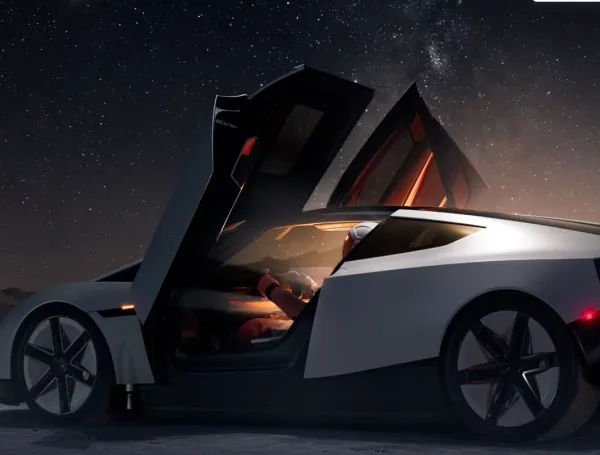
Rather than debuting a traditional convertible ready for mass-market dealerships, Musk showcased a hardtop vehicle concealing a dense array of compressed-air thrusters. Fired from a platform reminiscent of a giant-scale toy launcher, the vehicle blurred the line between automotive engineering and aerospace propulsion.
While the presentation captivated global audiences and sent shockwaves through digital platforms, industry analysts and automotive experts quickly pointed out a stark reality: the vehicle demonstrated on stage is less of a viable street-legal car and more of an engineering fantasy on wheels. Far from the functional, point-A-to-point-B flying cars of science fiction, the event was a masterclass in marketing, physics manipulation, and high-performance cross-pollination between electric mobility and rocket science.
2. Chronology of Events: Inside the McGregor Demonstrations
To separate marketing hype from physical reality, Musk and his team of aerospace and automotive engineers conducted three rigorous, live real-world tests before a select group of journalists and industry insiders. The venue chosen for these closely guarded trials was the SpaceX Rocket Test and Development Center in McGregor, Texas, effectively preempting any skepticism regarding computer-generated imagery or artificial intelligence illusions.
Test One: The Inverted Aerodynamic Sweep
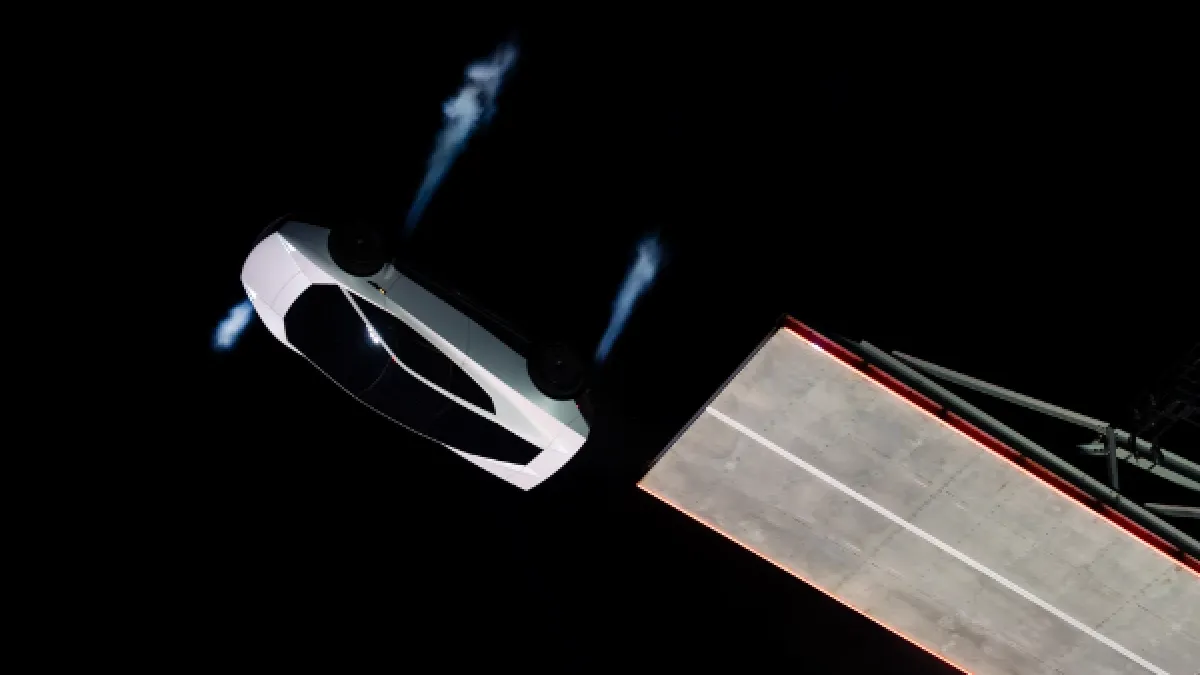
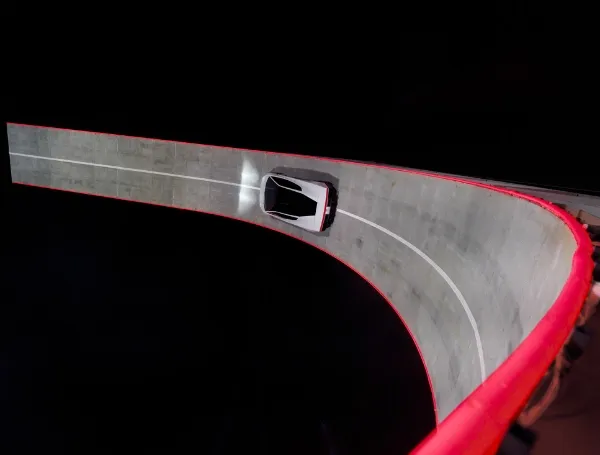
The first demonstration focused on extreme under-car airflow. Engineers pushed aerodynamic principles to the absolute limit, designing a system where high-speed airflow beneath the chassis generated an immense pressure differential. This effectively reversed standard aerodynamic lift, pressing the vehicle firmly against the testing surface even under inverted conditions. The test forced tire deformation resistance well beyond standard operational tolerances.
Test Two: Compressed Gas Acceleration
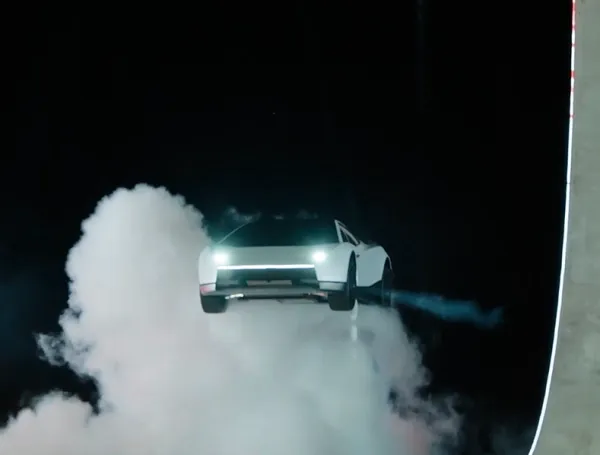
The second trial demonstrated the raw, immediate thrust capabilities of the vehicle’s gas-propulsion system. Functioning similarly to an aircraft turbine but with instantaneous response times, the cold-gas thrusters propelled the vehicle forward with ferocious energy, bridging the gap between stationary ground friction and airborne trajectory.
Test Three: The Controlled Vertical Hop and Descent
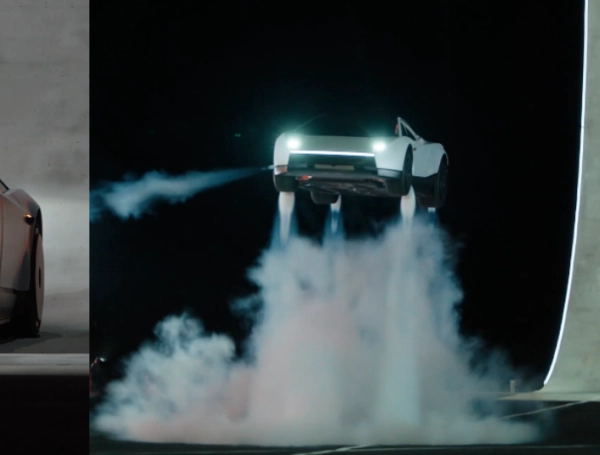
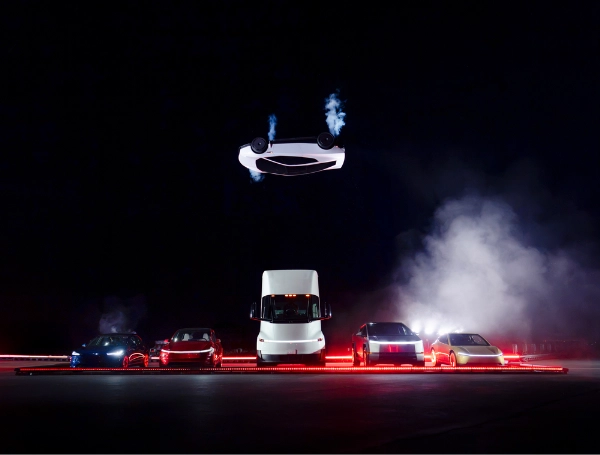
The definitive test of the exhibition occurred when the vehicle’s floor-mounted thrusters elevated the chassis, allowing rear thrusters to propel it across a distance of roughly 40 meters—clearing a line of five parked Tesla vehicles. The machine then executed a controlled vertical descent, enveloped in a dramatic cloud of condensed, ultra-cold gas generated by the pressure drop.
3. Supporting Data & Engineering Mechanics: How the System Operates
Underneath its sleek, minimalist exterior, the new Roadster relies on an unorthodox propulsion architecture that merges battery-electric automotive platforms with rocket telemetry.
The Cryogenic Propulsion System
The core of the vehicle’s "flight" and hyper-acceleration capabilities lies in a specialized tank containing 600 liters of cold gas compressed at extreme pressures within a cryogenic storage unit. This gas is intelligently routed through a network of distribution lines to various tactical nozzles strategically placed around the vehicle’s perimeter.
Linear Movement: Forward and reverse thrust vectors.
Vertical Control: Ascent and controlled cushioning during descent.
Rotational Dynamics: Alternating lateral nozzles allow the vehicle to pivot and rotate on its own axis.
By-Wire Command and Computing
Given that human reaction times are far too slow to manage simultaneous aerodynamic surfaces and high-pressure thrusters, the vehicle operates entirely on a by-wire architecture. Every command—whether managing ground traction or mid-air stabilization—is processed and executed computationally within milliseconds through redundant electronic wiring, eliminating mechanical linkages entirely.
Performance Tiering
Musk announced that the vehicle will be released in three distinct configurations:
Performance: A two-seat baseline electric model featuring active aerodynamics and a multi-mode suction system designed for maximum track downforce and everyday driving.
Thrust: A limited-edition variant equipped with the rear cold-gas thrusters, capable of achieving a 0 to 100 km/h acceleration time in less than a single second.
Rocket (Invitation-Only): An extreme, single-occupant variant integrating the full suite of perimeter cold-gas thrusters and multi-mode suction systems, capable of executing the gravity-defying aerial maneuvers witnessed during the Texas demonstration.
4. Official Responses and Expert Analysis
Despite the dazzling visual spectacle, leading automotive authorities have raised serious questions regarding the vehicle’s classification and practical utility.
José Clopatofsky, Director of Motor magazine, offered a sobering technical critique of the vehicle’s flight capabilities:
"Without fixed or rotary wings, sustaining horizontal or vertical flight depends entirely on the brute force of compressed gas, much like a rocket. Given the finite capacity of the gas storage, it is highly improbable that the vehicle can achieve sustained horizontal distance. It functions more like a bullet fired from a cannon, bound to a progressive decline. In its current configuration, this is not a flying car that transports you from one municipal point to another."
Clopatofsky further noted that true flying vehicles traditionally rely on hovering rotors (like helicopters) or evolving passenger-drone architectures to navigate urban airspace. The Roadster lacks these mechanisms entirely. Without airfoils to generate lift via differential air pressure, the vehicle remains fundamentally bound to the laws of traditional ground-based dynamics, augmented by temporary rocket-assisted propulsion bursts.
5. Implications: Viability, Real-World Challenges, and the Future
The unveiling of this radical Roadster forces both the automotive and aerospace industries to confront profound questions regarding engineering feasibility, regulatory hurdles, and consumer practicality.
Regulatory and Infrastructural Roadblocks
Installing a vehicle powered by high-pressure cryogenic tanks and thrusters into contemporary urban traffic is an administrative and safety nightmare. Regulatory bodies such as the NHTSA (National Highway Traffic Safety Administration) and the FAA (Federal Aviation Administration) would face unprecedented jurisdictional conflicts over a machine that blurs the boundary between car and aircraft. Consequently, the high-performance Thrust and Rocket variants will likely remain restricted to closed testing tracks and specialized proving grounds.
Battery Longevity and Daily Usability
For the everyday consumer, the Performance model will serve as the primary accessible option. However, integrating a cryogenic air tank, compressors, and high-pressure distribution systems into a consumer electric vehicle introduces severe engineering compromises. Most notably, the onboard energy required to compress and maintain gas pressures without external infrastructure will place an immense parasitic load on the vehicle’s battery pack, drastically reducing its everyday driving range.
Conclusion: Science Fiction Meets Financial Capital
Ultimately, the presentation of the Tesla Roadster was never designed to signal an immediate shift in mass-market commuting. Instead, it served as a calculated convergence of engineering brilliance, brand spectacle, and Elon Musk’s relentless ambition to push past conventional physical limits.
By fusing the immense market capital of Tesla with the aerospace audacity of SpaceX, Musk has once again shifted global attention toward the horizon of technological possibility. Whether the vehicle serves as a harbinger of a new genre of hyper-performance machines or remains a brilliant, highly expensive novelty, it has successfully forced the world to reimagine the boundaries of what is possible on—and slightly above—four wheels.
By Digital Reach Desk Updated: September 22, 2026 In an aggressive push to curb the relentless tide of unsolicited messages, automated spam, and digital harassment, WhatsApp has officially begun rolling out a landmark feature that…
Tech Desk / Digital Reach Published: September 13, 2026 Updated: September 13, 2026 Apple has officially set a new benchmark for mobile operating systems with the announcement and rollout schedule of iOS 27. Unveiled alongside…
WhatsApp, the world’s most popular messaging platform under the Meta umbrella, is rolling out a significant visual update to its interface. Users across the globe are beginning to notice a new, intuitive feature: a vibrant…