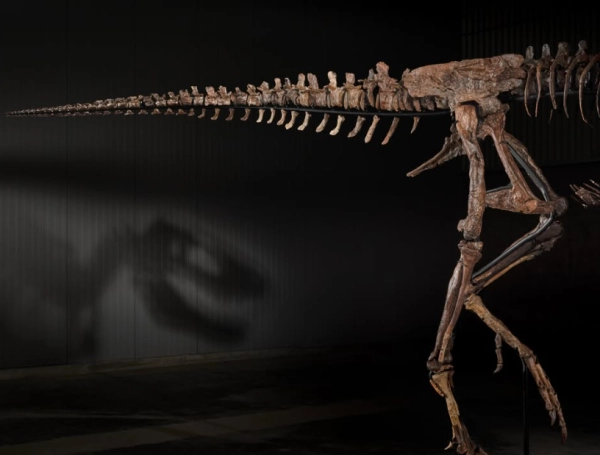
NEW YORK — In a milestone event that sent shockwaves through both the international art market and the global paleontological community, an exceptionally complete skeleton of a Nanotyrannus—affectionately and scientifically nicknamed "Jodi"—was sold at a Sotheby’s auction in New York City for a breathtaking $47.3 million.
The sale concluded after a tense, 12-minute bidding war contested by six deeply invested potential buyers. The final hammer price utterly shattered the auction house’s pre-sale estimated valuation of US$6 million to $9 million, multiplying expectations by more than fivefold. This monumental transaction places Jodi just shy of the all-time world record for a fossil at auction, a title currently held by "Gus," another prehistoric specimen that commanded $50.1 million in a July auction earlier this year.
The soaring financial valuations of prehistoric fossils continue to ignite intense debate among scientists, ethicists, and commercial collectors. While private auction houses celebrate the democratization and monetization of natural history, academic researchers frequently voice deep concern over the commercialization of invaluable scientific artifacts, warning that critical specimens disappearing into private hands could hinder public access and peer-reviewed research.
Main Facts: Anatomy, Discovery, and the Historic Sale
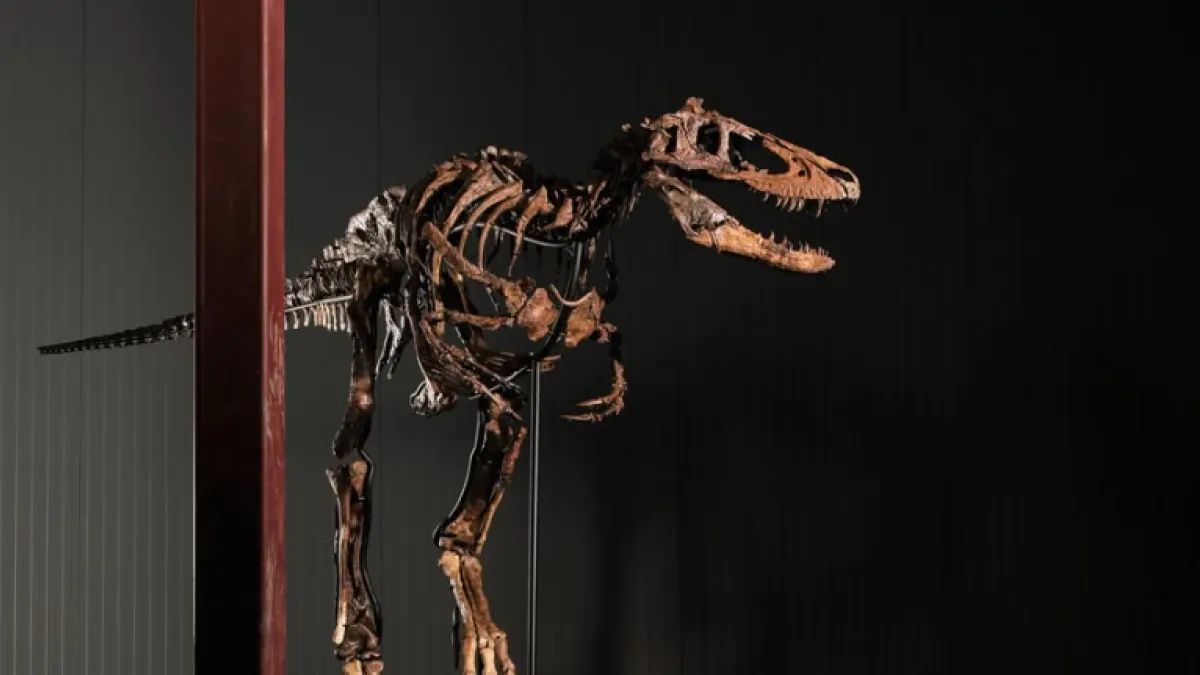
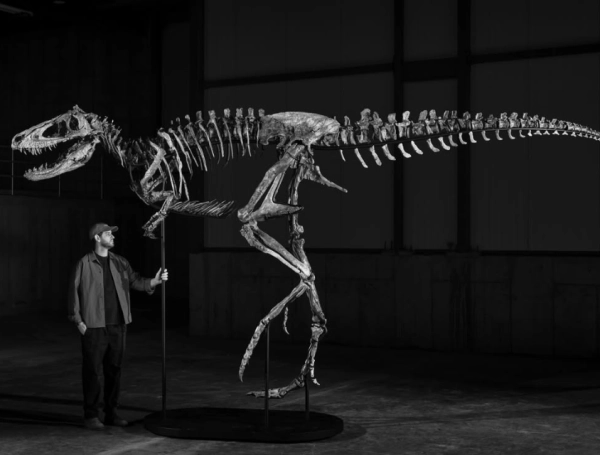
Sotheby’s catalogs describe Jodi as an archaeological and paleontological marvel. The specimen preserves an astonishing 191 distinct skeletal elements, anchored by a "practically complete" skull—a rare preservation milestone for predatory theropod dinosaurs. Physically, Jodi is formidable: the creature stands approximately 2.9 meters (9.6 feet) tall and stretches roughly 6 meters (19.6 feet) in length.
According to auction house disclosures, Jodi is classified as an adult specimen. To present the dinosaur in a complete, lifelike posture for exhibition, missing or fragmented bones were carefully reconstructed using advanced 3D-printing technology. Furthermore, the fossil was offered with "full rights," meaning the anonymous buyer has secured the legal latitude to produce and distribute commercial replicas, casting a wide net of potential future displays.
The journey of Jodi from the ancient muds of North America to the high-stakes financial district of Manhattan began six years prior to the sale. The specimen was originally discovered in 2019 by Montana rancher Jodi Pierson on private land. The delicate and meticulous excavation work was subsequently carried out by Clayton Phipps, a prominent commercial paleontologist widely known in the industry by his moniker, the "Dinosaur Cowboy."

Geologically, Jodi originates from the legendary Hell Creek Formation, a fossil-rich stratigraphic unit that spans across parts of Montana, Wyoming, and the Dakotas. Hell Creek is globally famous among paleontologists for yielding some of the world’s most pristine Late Cretaceous dinosaur specimens, serving as a window into the final ecosystem of the dinosaurs before the Cretaceous-Paleogene extinction event.
Chronology: From the Hell Creek Badlands to the New York Block
To understand the trajectory of Jodi from a buried secret in the American West to a multi-million-dollar commodity in New York, it is essential to trace its timeline:
- Summer 2019: Montana rancher Jodi Pierson discovers unusual fossilized bone fragments protruding from the earth on private property within the Hell Creek Formation.
- Late 2019 – 2020: Commercial paleontologist Clayton Phipps ("The Dinosaur Cowboy") leads the painstaking excavation, unearthing the bulk of what would become known as Jodi, preserving an impressive 191 bone elements and an intact skull.
- 2021 – 2025: The skeleton undergoes extensive preparation, stabilization, and study. Missing skeletal components are modeled and filled using state-of-the-art 3D-printing technology to ensure structural integrity and aesthetic completeness for display.
- Late 2026: Sotheby’s announces the upcoming auction of Jodi, setting an initial conservative pre-sale estimate between US$6 million and $9 million, framing it as a rare adult Nanotyrannus specimen.
- October 2026: The live auction commences in New York. Over a high-intensity 12-minute window, six competitive bidders drive the price upward in increments, culminating in a historic winning bid of $47.3 million.
Supporting Data: The Rare World of Nanotyrannus
To contextualize the financial and scientific weight of Jodi, one must examine the extreme rarity of the taxon itself. Jodi is officially recognized as one of only three relatively complete skeletons of Nanotyrannus known to science.
The benchmark for comparison is "Jane," the famous Nanotyrannus specimen discovered earlier, which is permanently housed and curated for public education and research at the Burpee Museum of Natural History in Rockford, Illinois. Having only three specimens of comparable completeness severely restricts the global scientific community’s ability to conduct comprehensive comparative analyses.
The Great Taxonomic Debate: Nanotyrannus vs. Juvenile T. rex
At the heart of the scientific intrigue surrounding Jodi is a decades-long, fiercely contested debate within vertebrate paleontology: Is Nanotyrannus a distinct, valid genus of small-to-medium-sized tyrannosaurid predator, or is it simply a juvenile stage of the iconic Tyrannosaurus rex?
For many years, mainstream consensus leaned heavily toward the juvenile T. rex hypothesis. Skepticism reigned, with many textbooks and researchers classifying morphological differences as mere developmental changes that occurred as a young T. rex matured into an apex adult.

However, recent anatomical studies, advanced bone-growth (histological) analyses, and the discovery of new specimens have shifted the pendulum. A growing contingent of researchers now argues that Nanotyrannus possesses distinct cranial features, limb proportions, and tooth counts that cannot be reconciled with standard T. rex ontogeny (growth patterns). This camp maintains that Nanotyrannus stood apart as a slender, lightning-fast predator sharing the Cretaceous landscape alongside its gargantuan cousin.
Official Responses and Expert Perspectives
The auction and its staggering final price tag drew swift, polarized reactions from top-tier academic paleontologists and commercial stakeholders alike.
Steve Brusatte, a renowned professor of paleontology and evolution at the University of Edinburgh and a prominent voice in modern dinosaur research, expressed a mix of profound scientific excitement and deep academic frustration regarding the sale.
"Apanas acabamos de confirmar la existencia real del Nanotyrannus, y ahora uno de sus mejores esqueletos está a punto de venderse al mejor postor," Brusatte noted, highlighting the precarious timing of the commercialization just as academic validation of the genus was gaining momentum.
Brusatte and his peers frequently argue that when specimens of immense taxonomic importance are sold to private collectors, they run the risk of vanishing from public view. Without guaranteed access for university researchers and museum scientists, key evolutionary questions may remain locked away in private vaults.
Conversely, commercial advocates and auction representatives defend the process. Sotheby’s emphasized that Jodi was offered with "full rights," granting the buyer complete freedom to manufacture and distribute replicas to institutions worldwide, thereby theoretically supporting educational outreach. Furthermore, commercial excavators argue that private funding is often the only mechanism capable of bearing the immense financial risk and labor required to unearth, prepare, and preserve fragile fossils that might otherwise erode away in the badlands.

Weighing in on the scientific uncertainties surrounding the specimen, David Hone, a respected paleontologist at Queen Mary University of London, expressed surprise at the market valuation. Hone pointed out the fundamental challenge facing the scientific community: without thorough, peer-reviewed access and independent study of Jodi’s specific skeletal markers prior to the sale, it is exceedingly difficult to accurately gauge its true scientific potential and contribution to the Nanotyrannus debate.
Implications for Science, Museums, and the Fossil Market
The sale of Jodi for $47.3 million carries profound, far-reaching implications for multiple sectors:
1. The Escalation of Commercial Paleontology
With fossils like Gus ($50.1 million) and now Jodi ($47.3 million) commanding figures typically associated with fine art masterpieces by Picasso or Monet, the commercial market for dinosaur fossils has entered a hyper-inflated era. This trend incentivizes commercial prospectors ("dinosaur cowboys") to scour public and private lands in the American West with unprecedented intensity. While this leads to new discoveries, it also raises concerns about potential trespassing, illegal extraction on federal lands, and the alienation of specimens from public stewardship.

2. The Widening Gap Between Museums and Private Collectors
Major public museums, operating on strict non-profit budgets and state grants, are increasingly priced out of the market. Institutions that once relied on purchasing or acquiring major fossil finds can no longer compete with billionaire private collectors, hedge fund managers, and international investors who view prehistoric skeletons as rare, prestige asset classes. This financial reality threatens to shift the balance of dinosaur research away from traditional academic hubs toward private collections.
3. Accelerated Research vs. Information Gatekeeping
While private owners occasionally loan high-profile fossils to museums for temporary exhibitions or grant scientists limited access, the lack of permanent, open-access curation poses severe risks to the scientific method. Science relies on reproducibility and permanent verification—principles fundamentally challenged when primary data (the physical fossil specimen) is held in a private residence and can be sold, moved, or hidden at a moment’s notice.
As the dust settles on the New York salesroom floor, Jodi the Nanotyrannus stands as a dual symbol of our enduring, childlike wonder for the prehistoric world and the complex, contentious intersection where modern capital meets ancient history. Whether Jodi’s new owner will grant scientists unfettered access to unlock the final secrets of this controversial predator remains one of the most pressing questions in modern paleontology.