
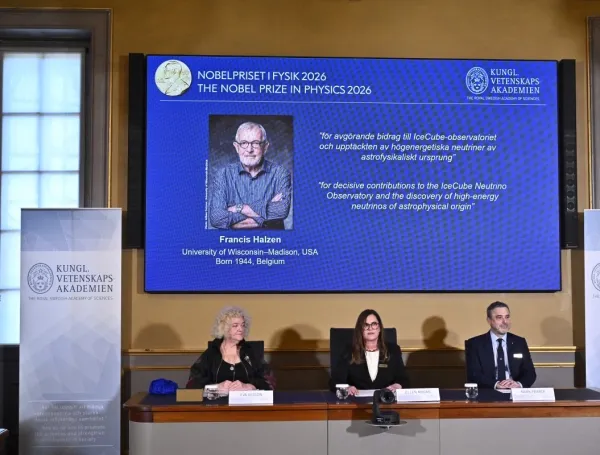
STOCKHOLM — In a landmark decision that bridges the gap between deep glacial exploration and the furthest corners of the cosmos, the Royal Swedish Academy of Sciences announced on Tuesday, October 6, 2026, that the Nobel Prize in Physics has been awarded to Belgian particle physicist Francis Halzen.
The prestigious honor was granted to Halzen "for his decisive contributions to the IceCube Neutrino Observatory and the discovery of high-energy neutrinos of astrophysical origin." His visionary insight—first proposed in 1988—suggested that the pristine, ancient ice of the South Pole could be transformed into a giant detector to capture elusive subatomic particles traveling across the universe.

The announcement marks a monumental triumph for neutrino astronomy, turning what was once considered a wild theoretical gamble into one of the most transformative observational windows of the 21st century.
Main Facts: Capturing the Ghosts of the Universe
At the heart of this year’s Nobel Prize is the culmination of decades of perseverance, engineering marvels, and groundbreaking physics. Francis Halzen’s realization that the South Pole could serve as a cosmic laboratory changed the trajectory of modern astrophysics.

Neutrinos are subatomic particles with virtually no mass and no electrical charge. Often referred to as "ghost particles," they interact so rarely with ordinary matter that billions of them pass through the human body every second without leaving a trace. Because they do not carry an electric charge and are rarely deflected by magnetic fields, neutrinos travel across the universe in straight lines directly from their points of origin, unfettered by dust, gas, or dark matter.
However, capturing them poses an extraordinary technological hurdle. Because they rarely collide with anything, observing them requires a vast volume of material to maximize the statistical probability of a rare interaction.

Halzen’s solution was elegantly simple yet logistically monumental: use a cubic kilometer of transparent, ultra-pure glacial ice at the South Pole as a particle detector. When a high-energy cosmic neutrino occasionally collides with an atomic nucleus within the ice, it produces a faint, characteristic blue flash of light known as Cherenkov radiation. By embedding thousands of highly sensitive optical sensors deep into the ice sheet, the IceCube Neutrino Observatory can detect these flashes, allowing scientists to reconstruct the trajectory and energy of the incoming particle.
Completed in 2011, the IceCube facility spans an entire cubic kilometer of ice, operating in near-total darkness deep beneath the surface. It acts as an unblinking eye looking out into the cosmos, tracking particles originating from environments far more violent and energetic than anything reproducible in terrestrial laboratories.

Chronology of a Vision: From a 1988 Proposal to a Nobel Triumph
The journey to the 2026 Nobel Prize spans nearly four decades, characterized by skepticism, incremental technological breakthroughs, and eventual global collaboration.
1988: The South Pole Hypothesis
Francis Halzen first formally introduced the audacious idea of utilizing deep Antarctic ice as a neutrino telescope. At a time when particle physics was largely dominated by accelerator-based experiments like those at CERN, the notion of turning a polar ice cap into a scientific instrument was met with considerable skepticism. The logistics alone—deploying sensitive electronics into shifting, sub-zero glacial environments—seemed insurmountable to many.
The 1990s: Early Prototyping and AMANDA
Undeterred, Halzen and a growing cohort of pioneering researchers pushed forward. Preliminary tests began with the deployment of the Antarctic Muon and Neutrino Detector Array (AMANDA), a smaller predecessor buried shallower in the ice. AMANDA proved that the South Pole ice was optically clear enough—and stable enough—to transmit Cherenkov light effectively. This vital proof-of-concept secured broader academic backing and funding.
2004–2011: Construction of IceCube
Bolstered by the success of AMANDA, construction of the full-scale IceCube Neutrino Observatory commenced. Using hot-water drills to melt holes up to 2,500 meters deep into the ice, engineers dropped strings of digital optical modules (DOMs) into the abyss before the water refroze. The final string was put in place in December 2011, completing the cubic-kilometer detector.

2013–2020s: Unlocking the Cosmos
Shortly after full operations began, IceCube scientists detected the first high-energy neutrinos originating from outside our solar system. Subsequent breakthroughs included tracing high-energy neutrinos back to active galactic nuclei and blazars—supermassive black holes feeding on matter millions of light-years away. By the mid-2020s, IceCube had firmly established neutrino astronomy as a primary pillar of multi-messenger astrophysics.
Supporting Data: The Physics of the Extreme Cosmos
To understand the magnitude of IceCube’s discoveries, one must look at the scale of energy involved in astrophysical phenomena.

- Particle Energies: The cosmos acts as a natural particle accelerator, flinging particles with energies up to a million times higher than those achievable by the Large Hadron Collider (LHC) on Earth.
- Volume and Scale: IceCube encompasses one cubic kilometer of ice. This immense volume is necessary because high-energy cosmic neutrinos are exceptionally rare; without a massive target area, researchers would rarely observe a collision.
- Environmental Stability: The South Pole offers unique advantages: the ice is exceptionally free of radioactive contaminants, and the geographic location is geologically stable, virtually eliminating seismic interference that could disrupt sensitive optical sensors.
- Directional Integrity: Unlike cosmic rays (which are charged particles deflected by galactic magnetic fields), neutrinos arrive at Earth pointing directly back to their cosmic engines, offering an uncorrupted map of the high-energy universe.
Official Responses and Academic Acclaim
The announcement from the Royal Swedish Academy of Sciences was met with widespread celebration across the global scientific community. Colleagues, institutional leaders, and international research bodies praised not only Halzen’s scientific acumen but also his leadership and tenacity.
"Francis Halzen’s vision redefined what is possible in observational astronomy," noted members of the Nobel Committee during the presentation. "He looked at a block of ice at the edge of the world and saw a window to the edge of the universe."

Universities and research consortia associated with the IceCube collaboration—which now includes hundreds of scientists from dozens of institutions worldwide—emphasized that the Nobel Prize is a testament to collaborative "big science." While Halzen is recognized for his decisive contributions and foundational concepts, the observatory’s ongoing success relies on a vast network of engineers, data analysts, and theoretical physicists working in tandem across extreme environments.
Implications: A New Era for Multi-Messenger Astronomy
The awarding of the 2026 Nobel Prize in Physics to Francis Halzen underscores a profound transformation in how humanity studies the cosmos. For millennia, astronomy relied entirely on visible light. The 20th century expanded this vision to include the entire electromagnetic spectrum—radio waves, X-rays, gamma rays, and infrared radiation.

Today, we have entered the era of multi-messenger astronomy, where light is combined with gravitational waves and neutrinos to provide a holistic view of violent cosmic events.
The continuous stream of neutrino interactions recorded by IceCube is poised to yield unprecedented insights into:

- Cosmic Accelerators: Revealing the exact mechanisms by which active galactic nuclei, gamma-ray bursts, and supernova remnants accelerate particles to near-light speeds.
- Dark Matter Searches: Providing indirect avenues to search for the elusive nature of dark matter through high-energy neutrino signatures.
- Unknown Cosmic Phenomena: Opening the door to discovering entirely new, high-energy phenomena that emit no light or gravitational waves, remaining hidden until intercepted by neutrino detectors.
As Francis Halzen’s 1988 vision reaches its highest form of validation in Stockholm, the sensors deep beneath the Antarctic ice continue their silent vigil, waiting for the next ghost particle to whisper secrets from the dawn of time.