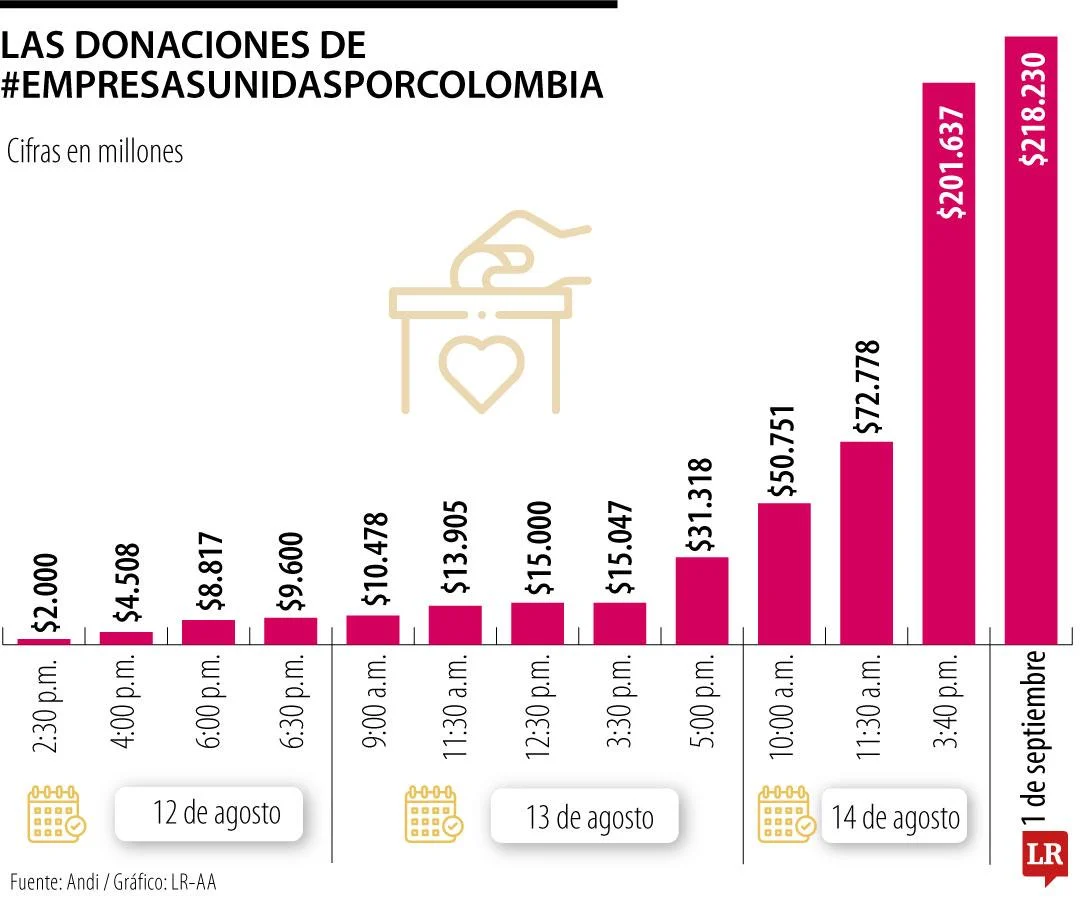
BOGOTÁ, COLOMBIA — In the wake of one of the most devastating natural disasters to strike the Andean nation in recent history, the Colombian private sector has demonstrated an unprecedented level of corporate social responsibility and rapid crisis response. Exactly one month following the catastrophic 7.4-magnitude earthquake that shook Colombia on August 10, the National Business Association of Colombia (ANDI) released a comprehensive balance revealing that the initiative "Empresas Unidas por Colombia" (Companies United for Colombia) successfully mobilized a staggering $218,230 million COP in monetary and in-kind donations.
The nationwide mobilization, born out of solidarity during a time of national emergency, bridged the gap between corporate philanthropy, government relief efforts, and vulnerable communities struggling to recover from widespread devastation. By pooling resources, logistical networks, and industrial capabilities, the Colombian business community has set a new benchmark for disaster relief management in Latin America.
1. Main Facts: The Scope of the Crisis and the Response
The sequence of events began on August 10, when a powerful 7.4-magnitude earthquake struck Colombia, leaving widespread infrastructural damage, displacing thousands of families, and straining local health and emergency services across multiple departments.
Just two days after the catastrophe, the annual Colombian Business Congress (Congreso Empresarial Colombiano) commenced in Cartagena. What was originally scheduled as a traditional convention on economic policy and commercial growth swiftly pivoted into a historic forum for collective action. Relief coordination became the central axis of the gathering, instantly sparking pledges that would eventually culminate in the $218.230 billion COP milestone recorded by September 1.
The primary vectors of this massive financial and material mobilization include:
- Fundación ANDI Channels: $18,950 million COP received directly through the association’s philanthropic arm.
- Corporate Ally Networks: $130,680 million COP donated by allied companies through various enabled financial channels.
- In-Kind Contributions: $68,600 million COP worth of essential goods, medical supplies, and non-perishable resources.
The initiative bypassed bureaucratic red tape by leveraging existing corporate supply chains, transforming factories, transport fleets, and retail networks into a finely tuned humanitarian apparatus.
2. Chronology of the Emergency and Relief Mobilization
Understanding the speed and scale of the "Empresas Unidas por Colombia" campaign requires examining the timeline of response over its first critical month:
Phase I: Immediate Impact and Pivot (August 10 – August 12)
- August 10: A 7.4-magnitude earthquake strikes Colombia, severely impacting infrastructure, homes, and public services, predominantly across five central and regional departments.
- August 12: The Colombian Business Congress opens in Cartagena. Recognizing the national emergency, ANDI leadership and attending executives suspend routine panels to establish the framework for Empresas Unidas por Colombia. Initial corporate pledges are registered on-site.
Phase II: Rapid Mobilization and Channel Activation (Mid-August)
- August 15 – 20: Financial channels via Fundación ANDI and corporate partners go live. Logistics hubs are established to handle the influx of monetary aid and massive quantities of physical goods. Strategic alliances are forged with organizations like ABACO (Association of Food Banks of Colombia).
- August 25: Distribution reaches critical mass. Initial humanitarian cargo begins arriving in the hardest-hit municipalities, prioritizing isolated regions lacking basic services.
Phase III: Assessment and First-Month Milestone (September 1)
- September 1: ANDI establishes the formal cutoff for the first comprehensive relief report, registering 524 distinct donors (over 449 companies and 75 individuals) and more than 5 million total kilograms of managed aid. Over 29,000 families receive direct assistance across 35 municipalities.
3. Supporting Data: Breakdown of Donors, Logistics, and Aid Distribution
The sheer volume of resources managed by Empresas Unidas por Colombia highlights the meticulous planning executed by ANDI and its partners. According to the official September 1 balance, the campaign achieved remarkable participation across the country’s economic ecosystem.
The Donor Profile
- Total Donors: 524 contributors.
- Corporate Participation: More than 449 companies stepped forward, with businesses officially linked to ANDI accounting for approximately 69% of all corporate donors.
- Individual Philanthropy: 75 private citizens made monetary or in-kind contributions, reflecting a broader societal buy-in beyond the corporate sphere.
Logistics and Humanitarian Distribution
The logistical feat accomplished by the private sector in coordination with humanitarian networks is perhaps the campaign’s most notable operational achievement:
- Total Aid Managed: More than 5 million kilograms (5,000 metric tons) of humanitarian aid.
- Delivered Relief: Approximately 4.3 million kilograms have already reached final destinations.
- Target Reach: Direct assistance successfully reached 29,682 families spread across 35 municipalities within the five most affected departments.
- Operational Partners: The distribution was executed in seamless coordination with ABACO, 26 regional food banks, and three specialized allied non-profit organizations.
Medical and Healthcare Support
Recognizing the acute strain placed on local medical infrastructure, the campaign integrated a specialized healthcare response:
- Medical Donations: Over $3,135 million COP in medicines, clinical inputs, and specialized medical devices were mobilized.
- Institutional Coordination: ANDI collaborated directly with national and territorial health authorities to optimize the distribution and clinical application of these medical donations, ensuring they arrived precisely where hospital networks were overwhelmed or facing critical shortages.
4. Official Responses and Leadership Perspectives
The success of Empresas Unidas por Colombia has drawn praise from government officials, civil society leaders, and international observers alike. However, the overarching sentiment from the private sector remains rooted in duty and national solidarity.
Bruce Mac Master, President of ANDI, encapsulated the philosophy driving the initiative during the one-month progress briefing:
"This response demonstrates that when Colombia faces an emergency, the business sector is fully prepared to place its capacities, resources, and knowledge at the service of communities. ‘Empresas Unidas por Colombia’ shows how solidarity can be transformed into concrete action and how, through donations, we can also deeply contribute to the recovery and reconstruction of affected territories."
Mac Master emphasized that modern corporate leadership extends far beyond financial metrics and quarterly earnings. In times of existential crisis, companies possess the operational agility, distribution networks, and financial liquidity required to act far faster than traditional state apparatuses operating under standard administrative constraints.
Local municipal leaders and regional governors in the five affected departments also voiced profound gratitude, noting that without private sector intervention, the timeline for basic recovery and the stabilization of food security would have been significantly delayed.
5. Implications for the Future: Corporate Social Responsibility and National Resilience
As Colombia transitions from the acute emergency response phase into long-term reconstruction and recovery, the legacy of Empresas Unidas por Colombia offers several vital takeaways for the nation’s socio-economic landscape and future crisis management:
1. Redefining the Role of the Private Sector in Crisis
Historically, disaster response in developing nations has fallen almost exclusively on state institutions and international aid agencies. The success of ANDI’s campaign signals a structural shift: the modern Colombian private sector is an indispensable pillar of civil protection and national security. By integrating corporate supply chains into disaster relief logistics, Colombia has established a working model for public-private humanitarian cooperation.
2. Strengthening Institutional Trust
The transparent channeling of over $218 billion COP through audited foundations, recognized food banks (ABACO), and verified medical channels reinforces public trust in corporate institutions. Donors—ranging from multinational corporations to small-to-medium enterprises and private citizens—were provided with clear metrics regarding the destination and impact of their contributions.
3. Building Long-Term Resilience
While immediate relief focused on food security, shelter, and medical supplies, the overarching mandate of Empresas Unidas por Colombia includes territorial reconstruction. The capital and resources still being deployed will play a crucial role in rebuilding schools, local commerce infrastructure, and housing in the 35 hardest-hit municipalities.
Conclusion
One month after the earth shook beneath Colombia on August 10, the country continues to heal. While the scars of the 7.4-magnitude earthquake remain visible across the affected landscape, the overwhelming response spearheaded by ANDI and supported by hundreds of businesses and individuals stands as a testament to national resilience. Through Empresas Unidas por Colombia, the private sector proved that economic strength, when guided by empathy and organized solidarity, is one of the most powerful tools a nation has in overcoming adversity.