In an ambitious effort to formalize the economy and dismantle predatory lending practices, the Colombian government, in partnership with major financial cooperatives and microfinance institutions, has launched a strategic initiative aimed at bringing millions of unbanked citizens into the formal financial system. The move comes as a direct response to a staggering economic reality: the prevalence of the "gota a gota"—an informal, often coercive lending practice that charges average annual effective interest rates as high as 666.5%.
The Crisis: A Cycle of Predatory Debt
The "gota a gota" (literally "drop by drop") is a ubiquitous feature of the informal economy in Colombia. It functions as a rapid-fire, high-interest loan system that requires virtually no documentation, collateral, or credit history. For millions of street vendors, small shopkeepers, and independent contractors, it is often the only available source of capital.
According to a pivotal 2025 study conducted by the National Association of Financial Institutions (ANIF) and Colombia Fintech, the cost of this informal credit is astronomical. While formal credit markets operate under regulated caps, the informal sector functions with total impunity, trapping borrowers in a cycle of debt from which many find it impossible to escape. The same study revealed that for households, the situation is marginally less dire but still unsustainable, with average interest rates hovering around 382.2% annually.
This systemic reliance on informal credit is a symptom of a larger exclusion crisis. As of 2025, more than 65% of the adult population in Colombia remained outside the formal financial system, lacking the credentials or banking history required by traditional commercial banks to secure a loan.

Chronology of a Strategic Shift
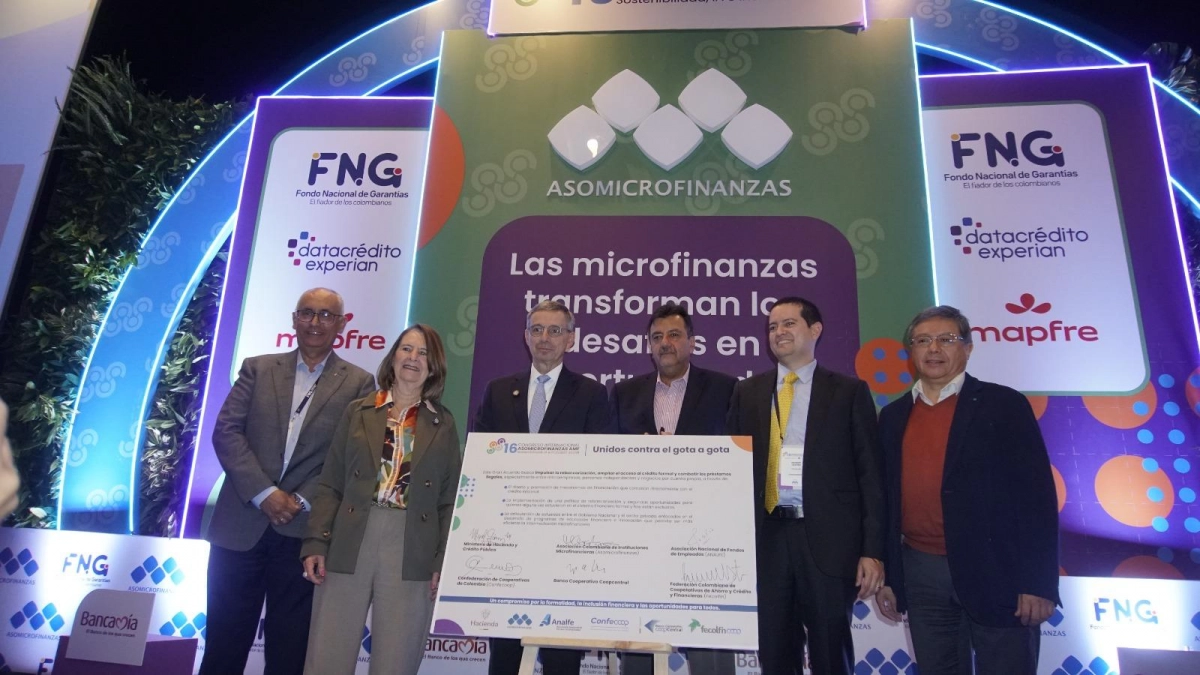
The government’s decision to confront this issue reached a milestone on October 23, 2026, when the Ministry of Finance signed a landmark agreement to bridge the gap between the informal and formal financial worlds.
- Pre-2025: High levels of financial exclusion persist, with over 60% of the population relying on non-traditional, high-cost lending.
- Early 2025: ANIF and Colombia Fintech release a joint report documenting the 666.5% interest rate for businesses, sparking a national debate on financial inclusion.
- July 2026: Asomicrofinanzas presents a formal proposal to the government to increase the penetration of formal microcredit from 14.8% to 35% by 2030.
- October 23, 2026: The Ministry of Finance signs a pact with Asomicrofinanzas, Confecoop, Fecolfin, Analfe, and Coopcentral to standardize access to formal credit.
- November 2026: Implementation phases begin, focusing on digital integration and data-driven credit assessment to replace traditional, exclusionary paperwork.
The Financial Landscape: Supporting Data
The scale of the sector is significant. Data from Asomicrofinanzas indicates that the microfinance sector currently serves approximately 2.6 million micro-entrepreneurs, with a total loan portfolio reaching $28.40 trillion pesos as of September 2026.

However, the geographical distribution of this credit remains uneven. Recent reports show that the Andean and Pacific regions concentrate roughly $19.53 trillion of the total microcredit distributed by formal institutions—representing nearly 69% of the national total. This concentration leaves other regions of the country particularly vulnerable to the predatory "gota a gota" operators, who fill the vacuum where institutional banking fails to reach.
Why the "Gota a Gota" Persists: The Speed Factor
The resilience of the "gota a gota" is not due to a lack of awareness regarding its cost, but rather to its unparalleled efficiency. Federico Gómez, CEO and co-founder of the fintech company Plurall, highlights a fundamental disconnect: the formal financial system is often too slow for the needs of a small business.

"The gota a gota solved what the formal system has not been able to solve for many micro-businesses: speed, proximity, and few requirements," Gómez explains. "A shopkeeper who needs to restock on a Friday cannot wait two weeks for a bank’s response."
The formal system requires collateral, credit history, and a bureaucratic vetting process that can take days or weeks. In contrast, informal lenders operate in real-time, handing over cash instantly. For the marginalized entrepreneur, this "ease of access" is a lifeline that, while ruinous in the long term, provides immediate survival in the short term.

The Fintech Revolution: Data as a Solution
To combat the informal market, the government and its partners are betting on technology. The integration of "alternative data" is the cornerstone of the new strategy. Fintech companies like Plurall are moving away from traditional credit scores, which are often tainted by past failures or simple non-existence, and are instead using real-time transaction data.
By analyzing electronic sales, payments to suppliers, and daily cash flows, lenders can build a dynamic profile of a business’s actual capacity to pay. This is where proprietary AI tools, such as Plurall’s "Bodhi Tree," come into play. These systems evaluate the health of a business based on its operational reality rather than a static, historical report.

According to Plurall’s internal data, 40% of their clients are approved for credit despite having a negative credit report in traditional databases. This approach treats a past financial "red flag" as a single variable rather than a life sentence, allowing entrepreneurs who have recovered from a "bad season" to rejoin the formal economy.
Official Responses and Strategic Goals
The government’s alliance with microfinance institutions and cooperatives is designed to provide what Maria Clara Hoyos, President of Asomicrofinanzas, calls a "second chance."

"This pact is a commitment to offer a formal alternative, with clear rules and guidance, both for those who have never had credit and for those who deserve a fresh start," says Hoyos.
The government’s ambitious target is to more than double the percentage of micro-enterprises with access to formal credit within the next four years. By fostering competition and providing digital alternatives, officials hope to lower the cost of capital for the most vulnerable sectors of the economy.

Implications for the Future of Colombian Finance
The implications of this initiative are twofold. First, there is the potential for significant wealth retention. By moving small business owners from 666.5% interest rates to the regulated rates of cooperatives and microfinance institutions, the government effectively injects liquidity back into the local economy, as these businesses will no longer be funneling their entire profit margins into interest payments.
Second, the initiative represents a fundamental shift in how the state views "creditworthiness." By recognizing that the informal economy is not inherently "risky" but merely "unrecorded," the state is signaling a move toward inclusive capitalism.

However, the success of this program will depend on the speed of implementation. If the formal financial system cannot match the "speed and simplicity" of the informal sector, the "gota a gota" will remain a stubborn competitor. The challenge, therefore, is not just one of financial policy, but of digital transformation—ensuring that the formal system becomes as accessible to the corner grocer as it is to the corporate executive.
As Colombia moves into 2027, the success of this initiative will be measured not just by the volume of loans approved, but by the tangible reduction in the influence of predatory lending in the daily lives of the nation’s most vital, yet often overlooked, economic actors: the micro-entrepreneurs.