By International News Desk
July 23, 2026
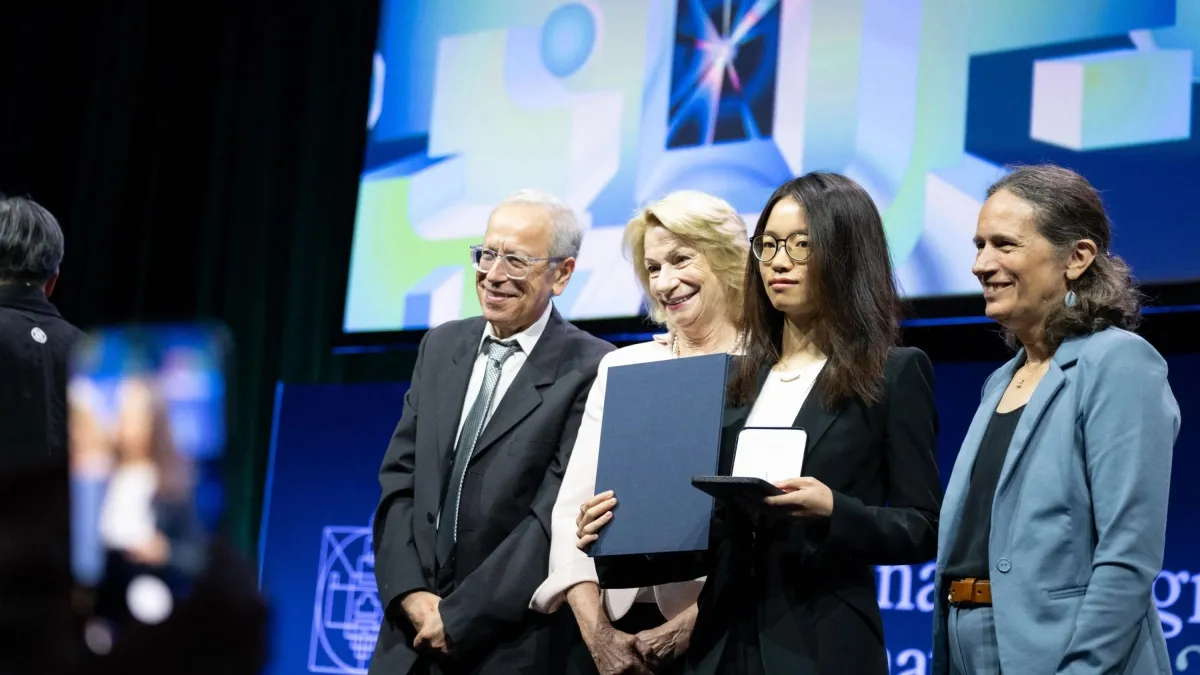
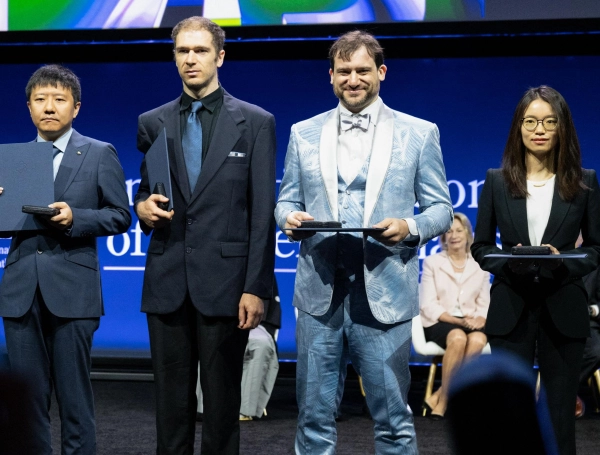
In a historic ceremony held during the International Congress of Mathematicians in Philadelphia, the global scientific community turned its eyes toward the four newest recipients of the Fields Medal—the most prestigious honor in the field of mathematics. Often described as the "Nobel Prize of Mathematics," this year’s selections represent a significant shift in the demographic landscape of elite research, while pushing the boundaries of human understanding in geometry, analysis, and physics.
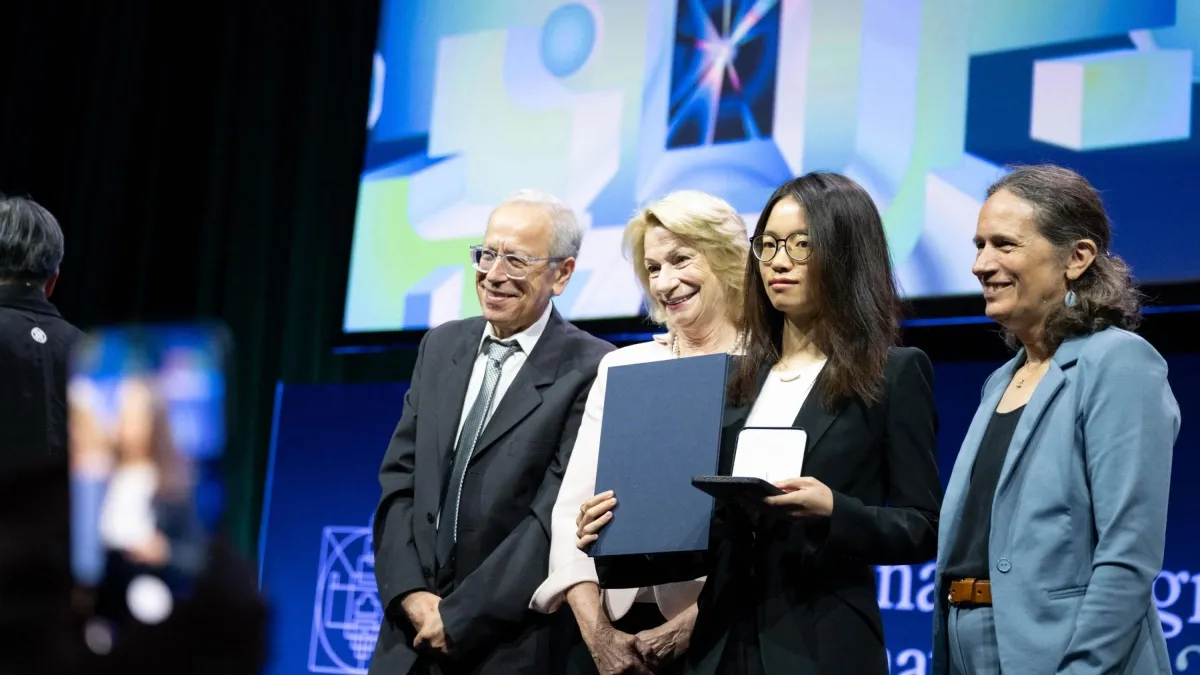
Among the honorees, the spotlight fell on Hong Wang, a professor at New York University, who made history as the third woman to ever receive this distinction. Alongside her, the Union Mathematical International recognized the groundbreaking work of Chinese mathematician Yu Deng and American researchers Jacob Tsimerman and John Pardon.
The Significance of the Fields Medal
The Fields Medal is not merely a prize; it is a global benchmark for potential. Established in 1936 following the vision of Canadian mathematician John Charles Fields, the award seeks to recognize and support young mathematicians who have made exceptional contributions. The criteria are stringent: recipients must be under the age of 40, a rule designed to incentivize the next generation of intellectual pioneers.

The prize consists of a solid gold medal and a cash endowment of 15,000 Canadian dollars. While the monetary value is modest compared to other international awards, the prestige associated with the Fields Medal is unparalleled. It was conceived as an alternative to the Nobel Prize—which famously excludes mathematics—and has since become the definitive yardstick for academic brilliance.
Profiles of the 2026 Laureates
Hong Wang: Breaking Barriers in Analysis
Hong Wang, 35, stands as a symbol of progress in an field historically dominated by men. Her work in harmonic analysis and the geometric measure theory has been described by peers as "transformative." The committee specifically lauded her for her sophisticated advancements regarding the Fourier restriction problem, the Falconer distance set problem, and the complex Kakeya problem in three dimensions. Her ability to synthesize disparate branches of analysis has opened new doors for researchers studying the underlying structures of geometric spaces.

Yu Deng: Decoding the Complexity of Physics
Joining Wang as a representative of Chinese mathematical excellence is Yu Deng, 37, a professor at the University of Chicago. Deng’s research focuses on the intricate world of partial differential equations. He gained international acclaim for his rigorous derivation of the Boltzmann equation—a cornerstone of statistical mechanics. By modeling how physical systems evolve through complex equations, Deng has bridged the gap between abstract mathematical theory and the physical reality of the universe.
Jacob Tsimerman: A Master of Algebraic Arithmetic
Jacob Tsimerman, 38, of the University of Toronto, has been recognized for his profound contributions to arithmetic and complex algebraic geometry. Tsimerman has solidified his reputation by tackling some of the most daunting challenges in the field, including the successful demonstration of the Griffiths conjecture and the André-Oort conjecture. His work has provided a framework for understanding the intersection of algebraic structures, essentially creating a "map" for future research in number theory.

John Pardon: Geometry and the Language of Topology
John Pardon, 37, a professor at Stony Brook University, rounds out the cohort of 2026. His work in symplectic geometry has been widely hailed for its elegance and technical depth. Pardon has made significant contributions to the understanding of group actions on 3-dimensional manifolds and has expanded the horizons of knot theory. His ability to apply topological insights to geometric problems has made him one of the most cited researchers in his age bracket.
Chronology: A History of Excellence
The history of the Fields Medal is one of evolving inclusivity and global expansion. Since its inception, the prize has traveled across borders, reflecting the shift in research hubs from Europe to North America and, more recently, toward East Asia.
- 1936: The first Fields Medals are awarded in Oslo, Norway.
- 1982: Shing-Tung Yau becomes the first Chinese mathematician to receive the honor, signaling the rise of Asian mathematical research.
- 2014: Maryam Mirzakhani, an Iranian mathematician, shatters the gender barrier by becoming the first woman to win the medal.
- 2022: Maryna Viazovska, a Ukrainian mathematician, becomes the second woman to receive the award for her work in sphere packing.
- 2026: Hong Wang becomes the third woman to be honored, marking the first time in history that two mathematicians of Chinese origin (Wang and Deng) share the stage as laureates in the same year.
Official Responses and Peer Commentary
The announcement in Philadelphia was met with a standing ovation from the international delegates. The President of the International Mathematical Union (IMU) remarked during the opening ceremony: "The diversity of this year’s winners is a testament to the global nature of mathematics. These four individuals have not only solved long-standing conjectures but have also fundamentally changed the way we approach complexity in our physical and logical worlds."
Colleagues and mentors of the winners have taken to academic journals and social platforms to celebrate the recognition. "Wang’s work is not just about the solution; it is about the methodology," noted a peer from the Institute for Advanced Study. "She approaches problems with a clarity that simplifies the seemingly impossible."

The Global Implications of the 2026 Awards
The 2026 selections carry profound implications for the future of science. By highlighting the work of researchers from both the United States and China, the IMU underscores the importance of international cooperation in a time of geopolitical tension. Mathematics, often called the "universal language," remains one of the few fields where collaboration persists regardless of national borders.
Furthermore, the recognition of Hong Wang serves as a powerful message to institutions worldwide. The continued increase in female representation among Fields Medalists—from zero for over 75 years to three in the last decade—suggests that structural changes in academic recruitment and support are beginning to yield results.

Looking Ahead: The Future of the Discipline
As the 2026 Congress concludes, the mathematical community looks toward the future. The problems solved by Wang, Deng, Tsimerman, and Pardon are not merely academic exercises; they are the foundations upon which future technologies, from cryptography to quantum physics, will be built.
The work on the Boltzmann equation by Deng, for instance, has implications for how we understand turbulence and fluid dynamics. Similarly, Tsimerman’s insights into algebraic geometry are vital for advancements in theoretical physics.

The 2026 Fields Medalists have set a high bar for the next four years. Their success proves that even after centuries of study, mathematics remains a frontier territory, waiting to be mapped by those with the curiosity and the courage to look beyond the known. As these four brilliant minds return to their respective universities, they carry with them the weight of the gold medal, but more importantly, the responsibility of leading the next great intellectual revolution.
For more information on the International Congress of Mathematicians and the work of the 2026 laureates, readers are encouraged to consult the official publications of the International Mathematical Union or subscribe to our science newsletter for deep-dive technical summaries.