By Natalia Tamayo Gaviria (Adapted and Expanded)
Published: October 31, 2026
Main Facts
In 2008, a scientific breakthrough fundamentally changed how humanity views biological processes at the microscopic level. Osamu Shimomura, Martin Chalfie, and Roger Y. Tsien were awarded the Nobel Prize in Chemistry for their pioneering research on the Green Fluorescent Protein (GFP). Derived originally from jellyfish, GFP acts as a luminous biomarker capable of tracking cellular processes inside living organisms in real time.
By introducing GFP into cells—or prompting cells to produce it naturally in a laboratory environment—scientists can visualize dynamic cellular changes, track proteins, and locate bacteria and viruses with unprecedented precision.
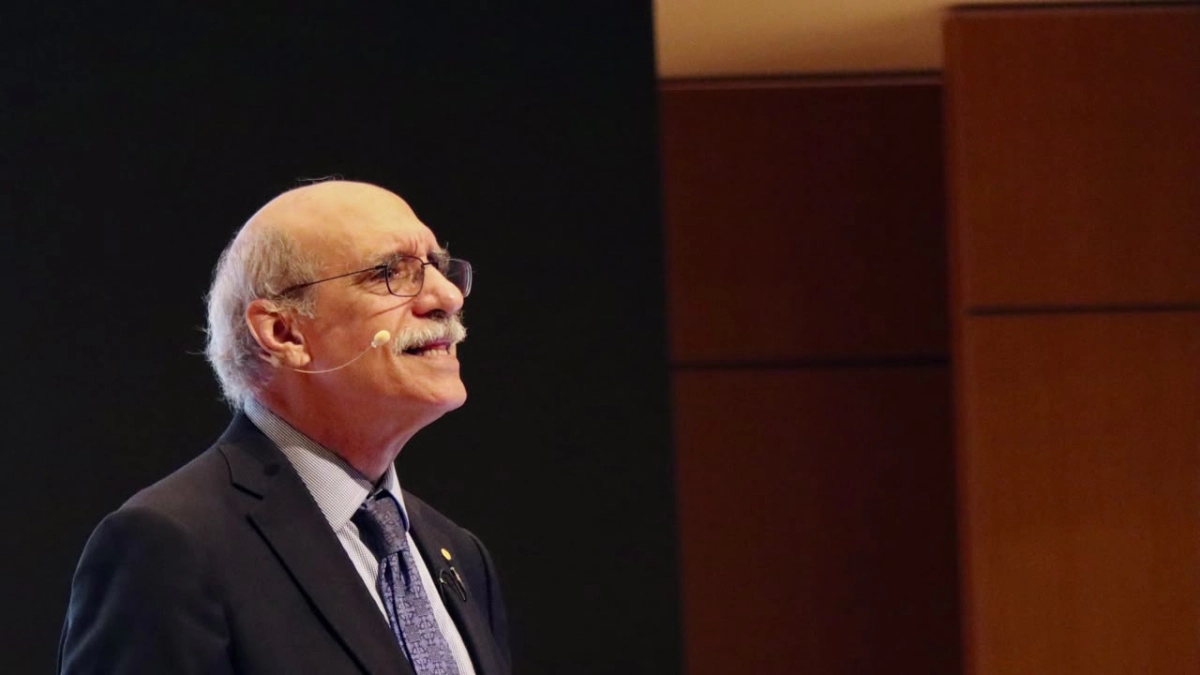
Recently, Dr. Martin Chalfie—now a professor of biological sciences at Columbia University—visited Bogotá and Medellín, Colombia, as part of the Nobel Prize Inspiration Initiative. During his tour, which engaged students, educators, and researchers, Chalfie emphasized a core philosophy: science does not merely rely on cold data or rigid frameworks; it thrives on relentless curiosity, the courage to question the obvious, and the patience to endure failure.

Chronology of a Discovery
The journey from marine biology observation to a cornerstone of modern biochemistry did not happen overnight. It is a testament to how fundamental research, driven purely by curiosity, can yield world-altering technologies decades later.
- The 1960s–1970s (The Marine Discovery): Osamu Shimomura and colleagues began studying the bioluminescent jellyfish Aequorea victoria, isolating the proteins responsible for the green glow in marine environments. At the time, the utility of this discovery was entirely theoretical.
- The 1990s (The Breakthrough): Martin Chalfie recognized the potential of using GFP as a biological marker. His team demonstrated that GFP could be expressed in other organisms—such as the roundworm Caenorhabditis elegans—to illuminate specific cells and proteins without harming the host organism.
- 2008 (The Nobel Recognition): Shimomura, Chalfie, and Tsien were awarded the Nobel Prize in Chemistry. Tsien later expanded the color palette of fluorescent proteins, allowing researchers to track multiple biological processes simultaneously.
- 2014 (The Nanoscopy Evolution): The foundation laid by GFP directly contributed to the development of super-resolution fluorescence microscopy (nanoscopy), earning another Nobel Prize in Chemistry and pushing optical limits to observe molecules at the nanometer scale.
- Present Day (Global Outreach and Education): Chalfie travels globally, advocating for foundational science education, discussing the integration of artificial intelligence in academia, and warning against the dangers of scientific censorship and funding cuts.
Supporting Data and Insights
During his conversations with students and academics in Colombia, Chalfie addressed several critical themes shaping contemporary science, education, and research infrastructure.

1. The Value of Asking "Obvious" Questions
Chalfie argues that breakthroughs often emerge when researchers dare to ask simple, overlooked questions. He frequently uses everyday phenomena to illustrate this concept:
- The Chicken vs. Beef Paradox: Why is poultry meat light and beef dark? The answer lies in muscle fiber types. Fast-twitch muscles do not require a constant oxygen supply, whereas slow-twitch posture muscles rely heavily on oxygen-carrying myoglobin (which is red, hence the color of beef).
- Practical Innovation: In a school science fair, Chalfie encountered a ballet dancer who sought to extend the lifespan of her rapidly degrading pointe shoes. By identifying an everyday problem and applying analytical thinking, she engineered a practical solution.
2. Artificial Intelligence in Academia
Addressing the anxieties surrounding generative AI and cheating in classrooms, Chalfie offers a pragmatic perspective: students often turn to AI shortcuts because they are motivated primarily by grades rather than understanding.
At Columbia University, Chalfie adapts his curriculum to incorporate AI constructively. Instead of assigning traditional essays, he tasks graduate students with evaluating scientific summaries generated by AI against original research papers. By forcing students to hunt for AI-induced errors in the text, they read the primary literature with heightened critical scrutiny.
3. The Three Tiers of Scientific Development
When asked how developing nations like Colombia can strengthen their research ecosystems, Chalfie outlined a three-step framework:

- Education: Providing a strong foundational schooling system.
- Scientific Training: Hands-on laboratory experience, moving beyond theoretical textbook knowledge to experiment design and execution.
- Infrastructure and Opportunity: Providing the institutional funding, facilities, and environments necessary to retain top-tier talent.
Official Responses and Perspectives
On Failure and Resilience
"Students starting a scientific career begin very motivated, but also anxious because they want instant success. However, not all our ideas are good, and that is why we must learn to cope with frustration. The joy of doing science is answering a question… What must guide us is the search to expand the limits of what we know. The danger, in my view, is becoming discouraged and not continuing to try."
— Martin Chalfie, Nobel Laureate in Chemistry
On Research Funding and Political Interference
Chalfie expressed deep concern regarding the current political and financial climate for science in the United States, citing budget cuts and ideological interference:
"In the U.S., we are going through a turbulent situation regarding funding for science. Beyond the cuts, I am troubled by issues such as grants to the National Institutes of Health being approved by people outside of science. This is harmful and unnecessary… The problem with science does not lie in what is discovered, but in how it is used. There is fear of knowing reality, and any manifestation of fear is damaging to science."
On Scientific Denialism and Misinformation
Reflecting on lessons from the COVID-19 pandemic, the tobacco industry controversies, and climate change denial, Chalfie analyzed the mechanics of public skepticism:

"The logic seems to be: ‘If you don’t like what you hear, cast doubt on those who warn of the problems.’ Misinformation and denialism have led scientists and researchers to understand the importance of raising their voices. The more opportunities we have to bring science closer to society, the better."
Implications
The legacy of Martin Chalfie’s work with the Green Fluorescent Protein extends far beyond a glowing molecule; it serves as a masterclass in the unpredictability and necessity of basic research.

- The Peril of Short-Term Thinking: Governments and funding bodies globally face mounting pressure to allocate resources exclusively toward immediate societal crises—such as poverty or short-term economic gains. Chalfie warns that if nations neglect fundamental, curiosity-driven science, long-term innovation stalls, leaving societies ill-equipped for future challenges.
- Combating "Brain Drain": For developing nations, retaining brilliant minds requires more than patriotic appeals; it demands robust laboratory infrastructure and competitive funding opportunities. Without these, nations will continue to lose their brightest innovators to foreign institutions.
- Redefining Education in the Age of Automation: As artificial intelligence reshapes academic assignments, educational models must pivot away from rote memorization and standardized testing toward critical analysis, experimentation, and problem-solving.
Ultimately, Chalfie’s message is an optimistic validation of human curiosity: by teaching students not to fear failure, by encouraging them to question the world around them, and by defending the integrity of empirical inquiry, science can continue to illuminate the darkest corners of the unknown.