By Mateo Chacón Orduz Subeditor of Vida de Hoy / Special to Global Education Review
Main Facts
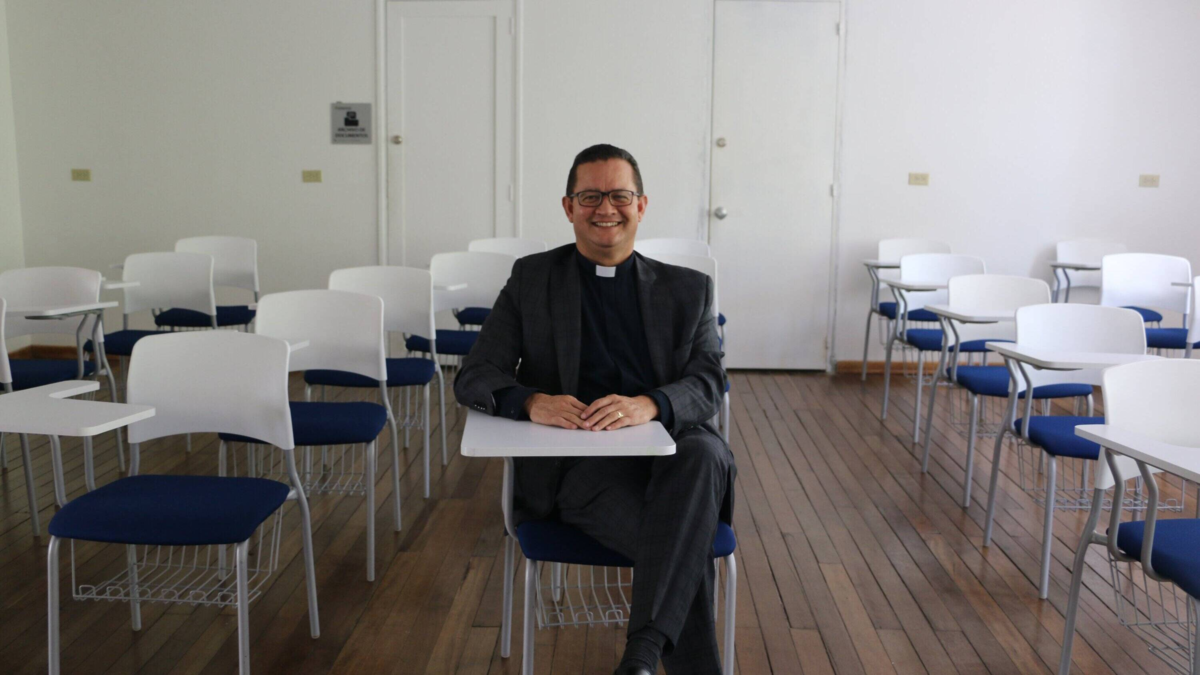
The landscape of Colombian higher education is undergoing a pivotal transition. Father Harold Castilla, the rector of the Min minuto de Dios University Corporation (Uniminuto) and a prominent figure in the nation’s academic sphere, has officially assumed the presidency of the Colombian Association of Universities (Ascun). Taking the helm of the country’s most influential higher education guild for a two-year term, Castilla steps into the role at a critical crossroads defined by rapid technological disruption, fiscal challenges, and shifting demographics.
In an extensive and revealing interview, Castilla outlined his core vision for the sector: transitioning away from rigid, linear educational models toward a flexible, lifelong learning ecosystem. He emphasized that modern universities must confront sweeping contemporary transformations—namely artificial intelligence, climate change, and demographic shifts—while addressing fundamental structural issues. Among these are persistent equity gaps in access, high dropout rates, the fragility of student financing mechanisms such as the ICETEX (Instituto Colombiano de Crédito Educativo y Estudios Técnicos en el Exterior), and the necessity of bolstering a resilient mixed-education model that supports both public and private institutions.
Chronology and Background: The Ascent of Father Harold Castilla
To understand the weight of Father Castilla’s new mandate at Ascun, it is necessary to examine the timeline of institutional developments leading up to his appointment:
Pre-2024 (Foundational Leadership): Father Castilla established himself as a forward-thinking administrator through his tenure as rector of Uniminuto, spearheading inclusion models aimed at bringing higher education to vulnerable and regional populations across Colombia. His philosophy has consistently centered on the idea that "it is important for individuals not to have to migrate to study," advocating for localized, accessible campuses.
Two Years Prior to Presidency: Castilla served actively as the vice president of Ascun. In this role, he helped shape national policy discussions, gaining deep familiarity with the regulatory, financial, and pedagogical hurdles facing Colombian universities.
Late October 2026: Castilla officially assumes the presidency of Ascun for a two-term mandate, succeeding previous leadership at a time when the gross enrollment rate in higher education hovers stubbornly around the 50 percent mark.
Current Mandate (2026–2028): Castilla steps into office alongside ongoing national debates regarding structural education reforms, the financing of public universities beyond mere tuition coverage, and the unlocking of stagnant science, technology, and innovation royalty funds.
Supporting Data and Sector Landscape
The structural challenges highlighted by Castilla are grounded in hard statistical realities characterizing Colombia’s educational ecosystem:
The 50 Percent Coverage Ceiling: Despite incremental gains over the past decade, national gross enrollment in higher education remains stagnant at approximately 50 percent. This leaves a massive cohort of young people—frequently categorized as "Ninis" (youth who neither study nor work)—outside the academic pipeline.
High Dropout Rates: Institutional attrition remains one of the most pressing leaks in the academic pipeline. Even among students who successfully secure admission, economic pressures, lack of vocational alignment, and social vulnerabilities trigger high drop-out rates during early semesters.
Broken Educational Pathways: The educational continuum in Colombia suffers from structural fractures. Disconnections between early childhood education, basic secondary schooling, and post-secondary opportunities create bottlenecks that prevent seamless student transitions.
Financial Pressures on the Mixed System: Colombia operates on a mixed model featuring both public institutions (increasingly reliant on state subsidies and free-tuition policies) and private institutions (reliant on student tuition and demand-side financing). Contractions in national fiscal budgets have strained public funding while reducing the purchasing power of families depending on credit mechanisms like ICETEX.
Stagnant Innovation Resources: Millions of pesos originating from national royalties designated for science, technology, and innovation have faced administrative blockages, stalling research projects that could otherwise modernize academic infrastructure.
Official Responses and Perspectives: A Dialogue on Reform
During his conversation with the press, Father Castilla detailed the collaborative approaches required from various stakeholders to steer the educational ship safely through turbulent waters.
On the Role of Ascun and the National Government
Castilla expressed cautious optimism regarding the current administration’s willingness to engage constructively with academic leadership. Recent dialogues involving the Ministry of Science and Technology, representatives from regional administrative planning bodies (OCAD), and ICETEX governing boards indicate a shared sense of urgency.
"Personally, I feel that there is good attention to the problems: they are listening and they have every desire to find a way out," Castilla noted, pointing specifically to joint efforts to unblock delayed royalty funds and revitalize student credit portfolios.
On the Dual Support for Public and Private Institutions
Addressing the polarization sometimes found in education funding debates, Castilla championed the preservation of Colombia’s mixed-education system. While acknowledging the imperative to strengthen public universities beyond basic tuition payments—especially in an era of fiscal contraction—he insisted that private institutions must not be neglected. The freedom of choice for families to enroll in private establishments is vital for maintaining overall enrollment capacity and systemic diversity.
On the Integration of Artificial Intelligence and Faculty Preparedness
Castilla was unequivocal regarding the inevitability of artificial intelligence: “There is no turning back: that is the world of today.” Rather than resisting technological disruption, universities must embed AI within an ethical framework, providing human oversight and clear educational purposes.
Crucially, Castilla underscored that faculty members are the linchpin of this transformation. Valuing, training, and supporting teachers is non-negotiable. Educators must be the primary agents of change, ensuring they do not teach for a static past, but rather equip students for an agile, digitally augmented future.
Implications: Building a Holistic Educational Future
The presidency of Father Harold Castilla at Ascun arrives at a historical juncture where traditional pedagogical paradigms are collapsing. The implications of his strategic vision extend across several key dimensions of Colombian society:
1. Moving Beyond the Linear Model of Life
The traditional life trajectory—born, study, work, retire—has been dismantled by technological acceleration and economic shifts. Castilla argues that the modern university must cater to "lifelong learning." Students will increasingly cycle in and out of higher education throughout their lives, requiring modular, flexible certification programs that respond immediately to labor market demands rather than rigid, multi-year degree silos.
2. Economic and Regional Decentralization
By reinforcing his foundational belief that students should not be forced to migrate to major urban centers to access quality education, Castilla places regional equity at the core of his agenda. Expanding digital infrastructure, strengthening regional university nodes, and aligning curricula with local productive economies are vital steps toward reducing regional inequality.
3. A Holistic, Post-Media Ecosystem
Solving the higher education crisis cannot be done in isolation. Castilla advocates for an integrated, holistic approach that bridges the gaps starting from early childhood education and basic secondary schooling. By treating education as a continuous post-media ecosystem rather than fragmented silos, the state, the private sector, and academic institutions can work in unison to eliminate the structural fractures that currently marginalize millions of young Colombians.
Ultimately, under Father Castilla’s leadership, Ascun aims to forge a collaborative social pact. By uniting government policy, corporate enterprise, and institutional academic rigor, Colombia’s higher education sector hopes to transform current vulnerabilities into catalysts for a more inclusive, technologically literate, and resilient society.
EST. READING TIME: 6-8 MINUTES Published in Lifestyle & Parenting News Main Facts The traditional bath time for infants and children in Colombian households has transcended its original, purely functional purpose of physical cleanliness. What…
As the international community navigates a complex matrix of geopolitical friction, extreme weather events, and transnational security threats, a series of critical developments across continents has underscored the fragility of global stability. From escalating conflicts…
By Edwin Caicedo | Environmental and Health Journalism Updated and Expanded Report Main Facts: A Historic Milestone for Urban Mobility in South America Medellín, the vibrant capital of Colombia’s Antioquia department, has achieved a historic…