Main Facts: The Colossus of the East and Its Vital Basin
Originating in the high-altitude tranquility of the Tibetan Plateau within China’s Qinghai province, the Mekong River flows as a true geographical colossus. Over a winding course of nearly 5,000 kilometers, it cuts through Myanmar, Laos, Thailand, and Cambodia before dramatically fragmenting in Vietnam. Here, it splits into nine major branches—often referred to locally as the "Nine Dragons"—which further disperse into an intricate web of secondary streams, canals, and fertile islands. Together, they irrigate a massive delta covering 40,000 square kilometers.
While the Amazon reigns supreme in sheer volume, the Mekong basin stands out as one of the most biodiverse regions on Earth. It supports over 1,000 distinct species of animals and plants, including rare megafauna such as the critically endangered Mekong giant catfish and the freshwater stingray.
Economically and socially, the river is an irreplaceable lifeline. In Vietnam alone, the delta encompasses roughly 12 percent of the nation’s total land area yet generates a staggering 20 percent of its food supply, earning the country its reputation as Southeast Asia’s "rice bowl." For Cambodia, the river acts as a literal and figurative spine, slicing the nation cleanly from north to south and dictating the rhythms of daily life, transportation, and agriculture.
Chronology of an Expedition: From the Temples of Angkor to the Chaos of Saigon
Phase 1: The Luminous Waters of Tonlé Sap and Siem Reap
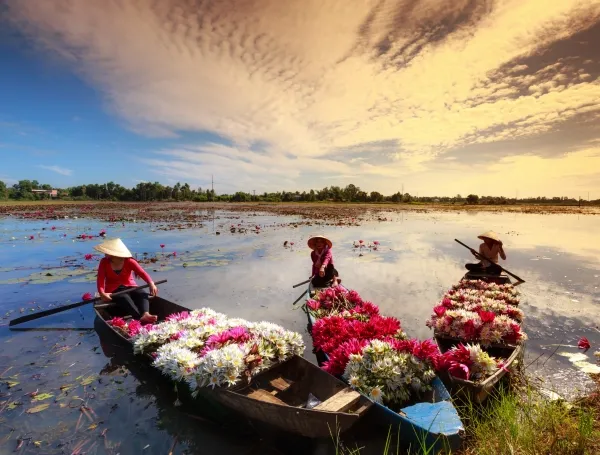
The journey through the Mekong’s ecosystem often begins far from the main channel, starting in Siem Reap, the gateway to the magnificent temples of Angkor Wat. Nearby, the expansive Tonlé Sap lagoon feeds sprawling fields of pink lotus flowers that stretch to the horizon. Beyond their striking aesthetic value, these blossoms hold deep spiritual significance in Buddhism, symbolizing the purity of body and soul rising from murky mud into ultimate enlightenment.
Tonlé Sap ultimately drains into a river of the same name, flowing southward to merge directly with the Mekong at Cambodia’s vibrant capital, Phnom Penh. From the bustling riverfront promenade known as Sisowath Quay, travelers can board modern cruise liners bound for Ho Chi Minh City or opt for more rustic vessels that navigate the waterways toward the Vietnamese border.
Phase 2: Chau Doc and the Flooded Forests
Four hours downriver from the capital lies Chau Doc, the first major Vietnamese settlement encountered by water. Approaching the town requires threading a path through dense carpets of aquatic vegetation before docking near the settlement’s few upscale accommodations.

Chau Doc’s architectural character is defined by narrow homes with wide-open street fronts acting as informal storefronts. As evening falls, bringing a brief respite from the oppressive tropical humidity, families gather on the floor around low dining tables, sharing meals adjacent to small home shrines dedicated to Buddha, softly illuminated by neon lights.
A mandatory excursion from Chau Doc is the Cajuput Tra forest. During the peak flood season between September and November, the water transforms into a brilliant green highway blanketed in duckweed. Traditional wooden boats, known as sampans, glide silently through this botanical tunnel, their prows cutting effortlessly through the luminous green carpet.

Nearby lie the Tram Chim National Park and the Tra Su cajeput forest, celebrated havens for ornithology enthusiasts. Tram Chim, a protected 7,000-hectare wetland designated as a Ramsar site of international importance, serves as the fragile home for the eastern sarus crane—a majestic bird currently facing the grim reality of critical endangerment.
Phase 3: Can Tho and the Floating Markets
Continuing 120 kilometers south, the expedition reaches Can Tho, a city characterized by its liberal use of vibrant neon lights illuminating everything from household shrines to bridges and riverboats. Can Tho serves as the primary jumping-off point for exploring the iconic Cai Rang floating market.

Departing before dawn on traditional river craft, visitors are guided by women impeccably dressed in áo dài—traditional, form-fitting silk tunics split at the waist and worn over trousers. En route to the market, tours frequently stop at local cottage industries specializing in rice noodles. Here, vast sheets of rice paste dry on woven palm-frond mats under the intense tropical sun before being mechanically sliced into noodles.
Arriving at Cai Rang reveals a chaotic yet orderly maritime bazaar. Vendors market fruits, vegetables, and provisions directly from their boats. To advertise their stock, each merchant hoists a sample of their goods high atop a bamboo pole, allowing potential buyers to spot what they need from afar amidst the hum of boat engines.

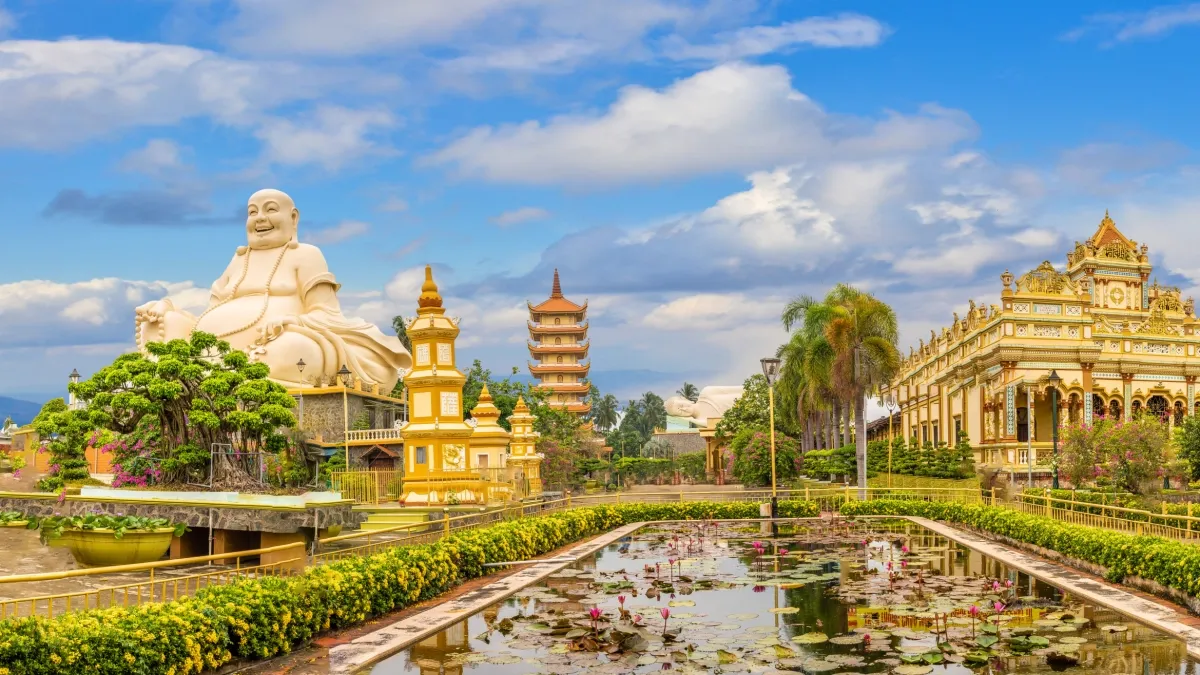
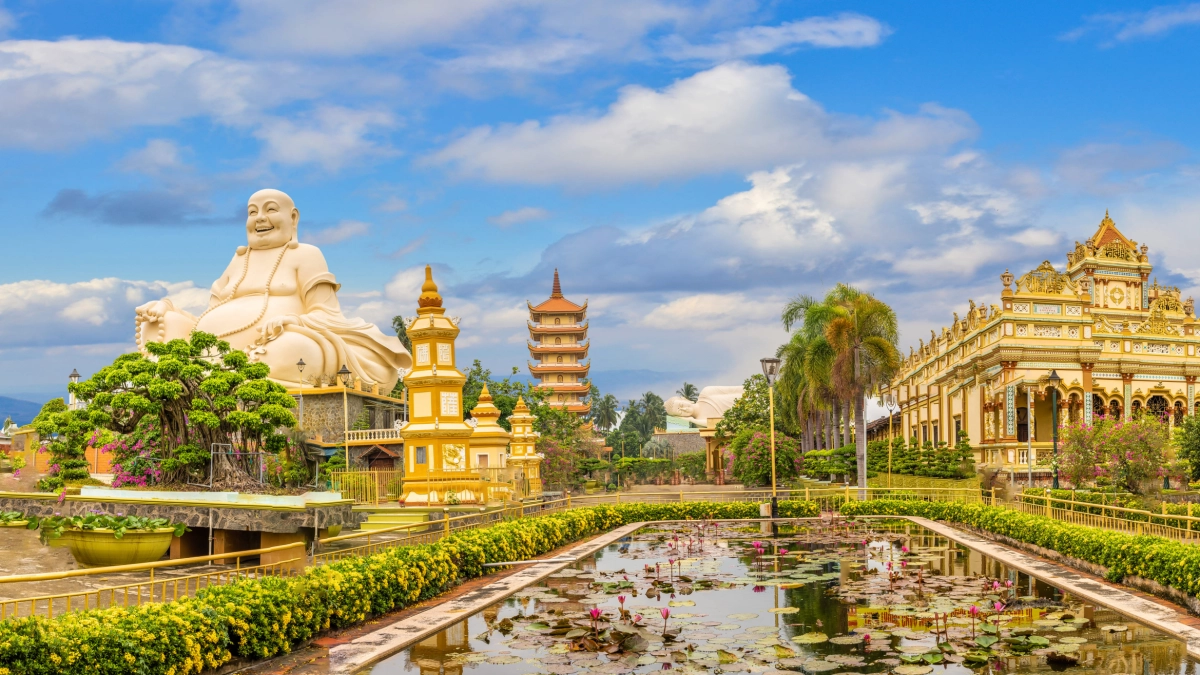
Further along, the river branches into the Ben Tre and My Tho distributaries, where dense clusters of coconut palms offer rare, cooling shade. These shaded banks host traditional cottage factories producing coconut candy, a beloved regional delicacy. Along the shores of the Bao Dinh canal stands the Vinh Tràng Pagoda, a renowned Buddhist temple framed by two hectares of fruit orchards. The temple’s striking architecture reflects an eclectic fusion of Asian and European design elements, housing three towering, larger-than-life Buddha statues.
Phase 4: The Final Stretch in Ho Chi Minh City
The geographical journey concludes in Ho Chi Minh City, historically and still widely known as Saigon. Though situated on the banks of the narrower Saigon River rather than the Mekong proper, the city functions as the ultimate commercial and logistical terminal for the entire delta. It serves as the primary port where the region’s vast harvests of rice, tropical fruit, and fish are processed and exported.
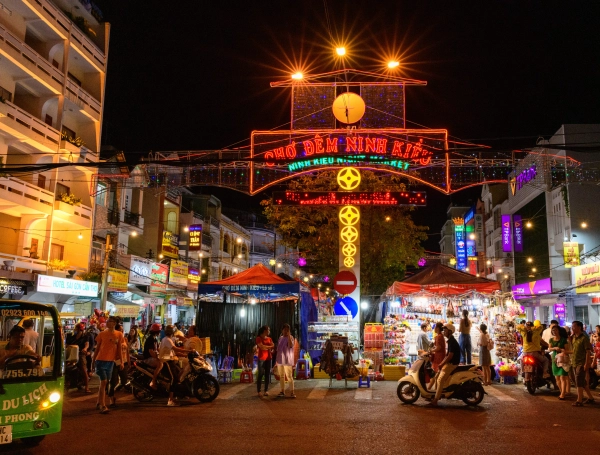
The urban landscape presents a fascinating study in contrasts. A statue of revolutionary leader Ho Chi Minh stands prominently in Vien Van Hoa park outside the Reunification Palace. Just steps away, modern globalization asserts itself through international fast-food chains bearing the same red and yellow palette, alongside newly established luxury hotels.
However, traditional commerce thrives side-by-side with modernity. Tailors and cobblers remain deeply woven into the local fabric. Inside the sprawling Ben Thanh market, skilled artisans can custom-tailor a complete suit or dress within a matter of hours.
Supporting Data: Statistics of the Basin
- Length of the River: Approximately 5,000 kilometers, making it one of the longest rivers in Asia.
- Delta Area: Spans 40,000 square kilometers, heavily shaping Vietnam’s agricultural output.
- National Contribution: The Mekong Delta accounts for roughly 12 percent of Vietnam’s total land mass and provides 20 percent of the nation’s food supply.
- Biodiversity: Home to over 1,000 recorded animal and plant species, boasting some of the highest freshwater biodiversity levels on the planet.
- Urban Traffic Metrics: Ho Chi Minh City holds staggering urban transit figures, with roughly 7 million motorbikes navigating the streets for a population of 9 million residents, establishing a high density of two-wheeled transport per capita.
Official Responses and Conservation Efforts
Governments, environmental organizations, and local communities across the Mekong basin face mounting challenges regarding the river’s ecological health. With rapid industrialization, upstream dam construction in China and Laos, and the looming threats of climate change, the volume, sediment flow, and fish migrations of the Mekong have experienced measurable disruptions.
- Ramsar Convention Initiatives: Wetlands such as Tram Chim have been officially designated under international conservation frameworks to protect endangered species, particularly the red-crowned crane. Local authorities work closely with international conservation groups to regulate water levels and preserve natural feeding grounds.
- Sustainable Tourism Policies: Municipalities in Vietnam and Cambodia are increasingly promoting eco-tourism initiatives aimed at preserving traditional ways of life—such as floating markets and artisanal production—while mitigating the environmental footprint of rising international visitor numbers.
- Fisheries Management: Regional bodies continue to push for cross-border cooperation to address overfishing and the blocking of migratory routes caused by large-scale hydroelectric projects, emphasizing the socio-economic disaster that would follow the collapse of the basin’s fisheries.
Implications: Cultural Resilience and Environmental Vulnerability
The enduring allure of the Mekong lies not merely in its impressive geography, but in the profound symbiosis between the river and its people. As French author Marguerite Duras famously observed in The Lover, the river represents a wild, untamed conduit where vast expanses of water rush inexorably toward the ocean, carrying the stories, labor, and heritage of millions.

Yet, this timeless landscape stands at a critical crossroads. The cultural practices documented along its banks—from the rhythmic tending of lotus fields and floating commerce to the quiet evening prayers before neon-lit shrines—rely entirely on the ecological integrity of the watershed.
As urbanization accelerates—evidenced by the roaring oceans of motorbikes in Saigon and changing agricultural demands—the challenge for the nations sharing the Mekong basin will be balancing economic modernization with environmental preservation. Failure to protect this great Asian artery threatens not only a biodiversity hotspot of global significance, but the foundational food security and cultural identity of millions who call its shores home.