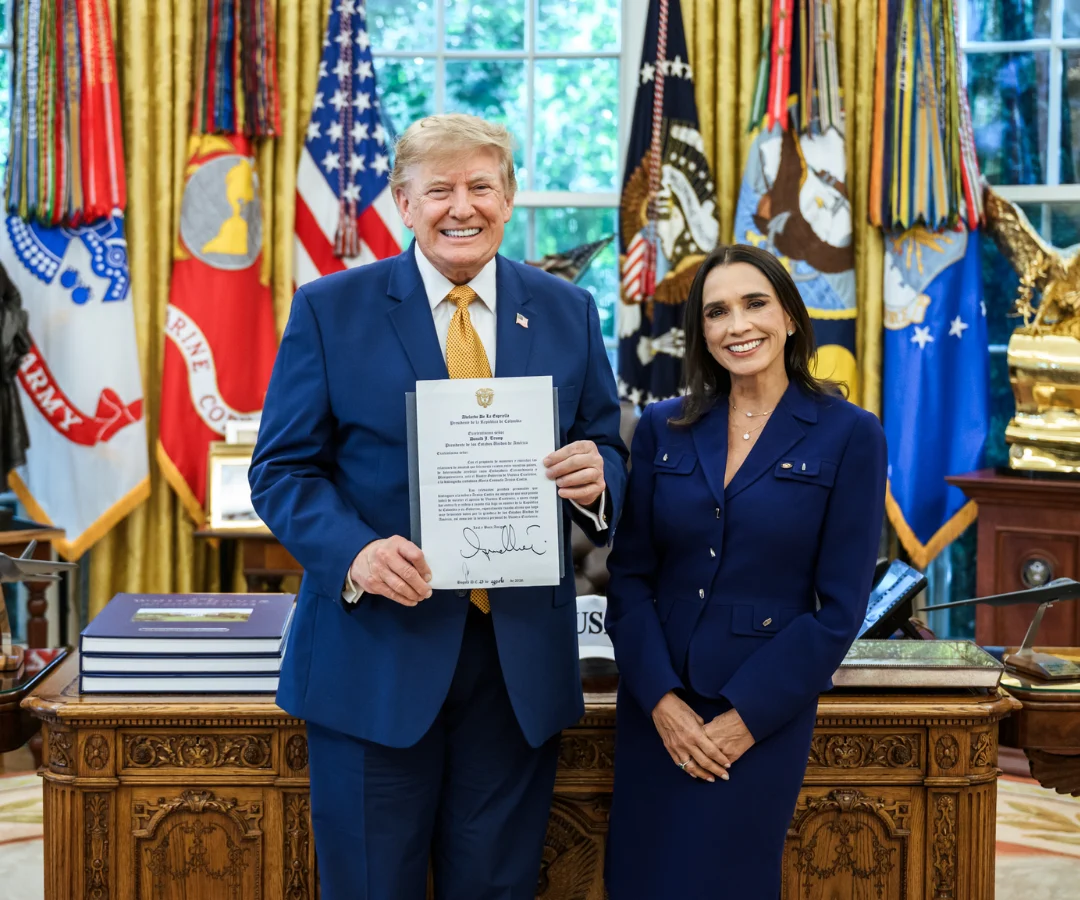
WASHINGTON, D.C. — In a diplomatic ceremony at the White House that marks a pivotal juncture for Andean-American geopolitics, Colombia’s newly appointed Ambassador to the United States, María Consuelo Araújo, officially assumed her post. The diplomat formally presented her credentials to United States President Donald Trump, initiating a heavily anticipated chapter in bilateral cooperation.
The meeting, conducted in the historic Oval Office, went beyond traditional diplomatic protocol. According to readouts provided by the Colombian delegation, the conversation centered on forging a modernized, pragmatic, and robust partnership. Central to the dialogue were mutual commitments to regional security, economic prosperity, and strict adherence to measurable, results-driven governance.
For Bogotá, the transition represents a deliberate recalibration of its foreign policy under the administration of President Abelardo de la Espriella. As hemispheric challenges multiply—ranging from transnational organized crime and shifting economic landscapes to migration and energy security—the newly minted diplomatic roadmap seeks to align Colombian domestic stability more closely with Washington’s strategic priorities in the Western Hemisphere.
Main Facts
The formal accreditation of Ambassador María Consuelo Araújo solidifies the diplomatic apparatus designed by the administration of President Abelardo de la Espriella to navigate Washington’s corridors of power. The core elements defining this new phase of bilateral relations include:
- The Diplomatic Mission: María Consuelo Araújo, a seasoned Colombian stateswoman and diplomat with extensive experience in public administration and international relations, has formally taken the helm at the Embassy of Colombia in Washington, D.C.
- The Presidential Meeting: The presentation of credentials took place directly with U.S. President Donald Trump, underscoring the political weight Washington assigns to its relationship with Bogotá, historically considered its most steadfast strategic ally in South America.
- Core Agenda Pillars: The renewed bilateral framework is anchored by three primary pillars: uncompromising regional security cooperation, shared economic prosperity and trade expansion, and goal-oriented execution of strategic objectives.
- A Shift in Foreign Policy Lineaments: The encounter served as the launching pad for the overarching diplomatic strategy devised by President Abelardo de la Espriella’s administration, which seeks to modernize diplomatic engagement and emphasize transactional, high-yield cooperation between the two nations.
Chronology of Events: The Path to the Oval Office
The road leading to María Consuelo Araújo’s formal presentation of credentials to President Donald Trump is the culmination of a carefully orchestrated diplomatic transition and a broader political shift within Colombia.
Phase One: The Political Transition in Bogotá
The narrative of this renewed diplomatic push began with the ascendancy of President Abelardo de la Espriella to the Casa de Nariño. De la Espriella campaigned on a platform of stringent security, economic revitalization, and a recalibration of international alliances to favor pragmatic partnerships that yield immediate, tangible benefits for Colombian citizens. Recognizing the indispensable nature of the Washington-Bogotá axis, the new administration immediately prioritized the selection of a high-caliber diplomat capable of navigating the complex political terrain of the United States capital.
Phase Two: Appointment and Senate Confirmation
María Consuelo Araújo was tapped for the Washington ambassadorial post due to her extensive executive background and proven capability in managing complex institutional portfolios. Following her formal nomination by President de la Espriella, Araújo underwent the rigorous legislative review process in Bogotá, securing overwhelming support from congressional committees that recognized the urgent need for experienced leadership abroad. Her appointment was widely interpreted by foreign policy analysts as a signal that the new Colombian government intended to send its heavyweights to Washington.
Phase Three: Arrival in Washington and Preliminary Briefings
Upon landing in the United States capital, Araújo did not waste time. Before her formal audience at the White House, she engaged in a series of intensive briefings with senior U.S. State Department officials, members of Congress from both sides of the aisle, and key stakeholders within the Washington think-tank community. These preliminary meetings were designed to take the temperature of the U.S. political establishment and fine-tune the strategic talking points that would eventually be laid before President Trump.
Phase Four: The White House Ceremony
The culmination of this preliminary phase occurred inside the White House, where Araújo formally handed over her credentials. The symbolic act legally and diplomatically instated her as Ambassador Extraordinary and Plenipotentiary of the Republic of Colombia to the United States. The closed-door discussion that followed allowed Araújo to personally deliver President de la Espriella’s message of renewed partnership, setting the tone for the executive-level interactions that will define the upcoming years.
Supporting Data: The Anatomy of U.S.-Colombian Interdependence
To fully understand the gravity of Ambassador Araújo’s mission, one must examine the vast structural ties that bind the United States and Colombia. For decades, this relationship has operated as a cornerstone of U.S. foreign policy in Latin America.
Trade and Economic Indicators
The United States remains Colombia’s primary trading partner. The U.S.-Colombia Trade Promotion Agreement (CTPA), which entered into force over a decade ago, has facilitated billions of dollars in bilateral commerce.
- Export Markets: Key Colombian exports to the U.S. include crude oil, coffee, cut flowers, gold, and manufactured goods. Conversely, the U.S. exports vital machinery, agricultural products (such as corn and wheat), and technological inputs to Colombia.
- Foreign Direct Investment (FDI): U.S. corporations represent the largest source of foreign direct investment in Colombia, concentrating heavily on energy, infrastructure, telecommunications, and financial services.
Security and Counter-Narcotics Cooperation
Security has historically served as the bedrock of the alliance. Through historic bipartisan initiatives like Plan Colombia and its successor frameworks, the U.S. and Colombia have coordinated extensively to dismantle drug-trafficking cartels, combat illegal armed groups, and strengthen the institutional capacity of the Colombian Armed Forces and National Police.
- Intelligence Sharing: Joint intelligence operations continue to play a critical role in neutralizing high-value targets within transnational criminal networks.
- Regional Stability: Colombia has frequently acted as a net exporter of security in the region, partnering with U.S. Southern Command (SOUTHCOM) to train law enforcement and military personnel across Central and South America.
Official Responses and Diplomatic Statements
The formalization of Araújo’s ambassadorship elicited immediate reactions from both governments, highlighting an alignment of vision between President Donald Trump and President Abelardo de la Espriella.
The Colombian Executive Perspective
Speaking from Bogotá following the White House meeting, administration spokespersons for President Abelardo de la Espriella emphasized that the new diplomatic approach discards ideological platitudes in favor of results-based realism.
"Our relationship with the United States cannot be taken for granted; it must be continuously nurtured through mutual respect, shared security burdens, and aggressive economic cooperation," noted a high-ranking official close to the Colombian presidency. "Ambassador Araújo carries the absolute mandate of President de la Espriella to ensure that every agreement reached translates into enhanced security and prosperity for the Colombian people."
Ambassador Araújo’s Vision
In statements released following her meeting with President Trump, Ambassador Araújo reiterated her commitment to elevating the bilateral dialogue.
"It is an immense honor to represent Colombia before the United States at this critical juncture," Araújo stated. "Our mandate is clear: we are here to build a modernized, resilient relationship. By focusing intensely on security, economic dynamism, and concrete execution, we will ensure that the historic friendship between our two nations yields unprecedented dividends for our citizens."
Washington’s Reception
While the White House maintained standard protocol regarding the closed-door nature of the credential presentation, diplomatic observers in Washington noted a warm reception. The Trump administration has consistently favored bilateral frameworks that demand accountability, clear metrics, and reciprocal commitments from its international partners. Colombia’s pivot toward a stern, security-focused, and market-driven posture under de la Espriella resonates strongly with Washington’s current foreign policy priorities in the hemisphere.
Strategic Implications: What the Future Holds
Ambassador María Consuelo Araújo’s tenure in Washington begins at a time of profound geopolitical transformation. The success of her mission will have sweeping implications for both nations across several critical domains.
1. Redefining Counter-Narcotics and Regional Security
With transnational criminal organizations evolving and diversifying their illicit revenue streams, the traditional metrics of counter-narcotics are undergoing a radical overhaul. Under the De la Espriella administration, Colombia is expected to push for tougher, more aggressive interdiction strategies, coupled with enhanced technological and intelligence support from the United States. Araújo will be tasked with securing advanced military assets, cybersecurity assistance, and specialized training programs to keep Colombian forces ahead of evolving criminal threats.
2. Economic Pragmatism and Supply Chain Reshoring
As global supply chains experience structural reorganization, the concept of "nearshoring" has gained immense traction in Washington. Colombia is uniquely positioned to capture manufacturing and technological investments that are currently leaving volatile regions or distant markets. Ambassador Araújo’s economic diplomacy will focus heavily on convincing U.S. corporations to relocate industrial capacity to Colombia, leveraging the country’s strategic geographic location, skilled labor force, and stable legal framework under the new administration.
3. Managing Regional Geopolitics and Migration
Beyond bilateral trade and security, Colombia remains a frontline state regarding broader hemispheric crises, particularly mass migration flows and the ongoing political instability in neighboring Venezuela. President Trump’s administration closely monitors stability along the Andean corridor. Araújo’s ability to coordinate closely with U.S. agencies on regional containment strategies, border management, and democratic restoration efforts will be a litmus test for the effectiveness of the renewed bilateral partnership.
Conclusion
The presentation of credentials by Ambassador María Consuelo Araújo to President Donald Trump is far more than a routine diplomatic formality; it is the official kickoff of a recalibrated strategic alliance. Backed by the resolute political will of President Abelardo de la Espriella in Bogotá and met with a results-oriented receptivity in Washington, the U.S.-Colombian partnership is poised to enter a dynamic era. As Araújo steps into her role at the embassy on S Street, the framework she builds today will dictate the trajectory of hemispheric security, economic collaboration, and democratic stability for years to come.