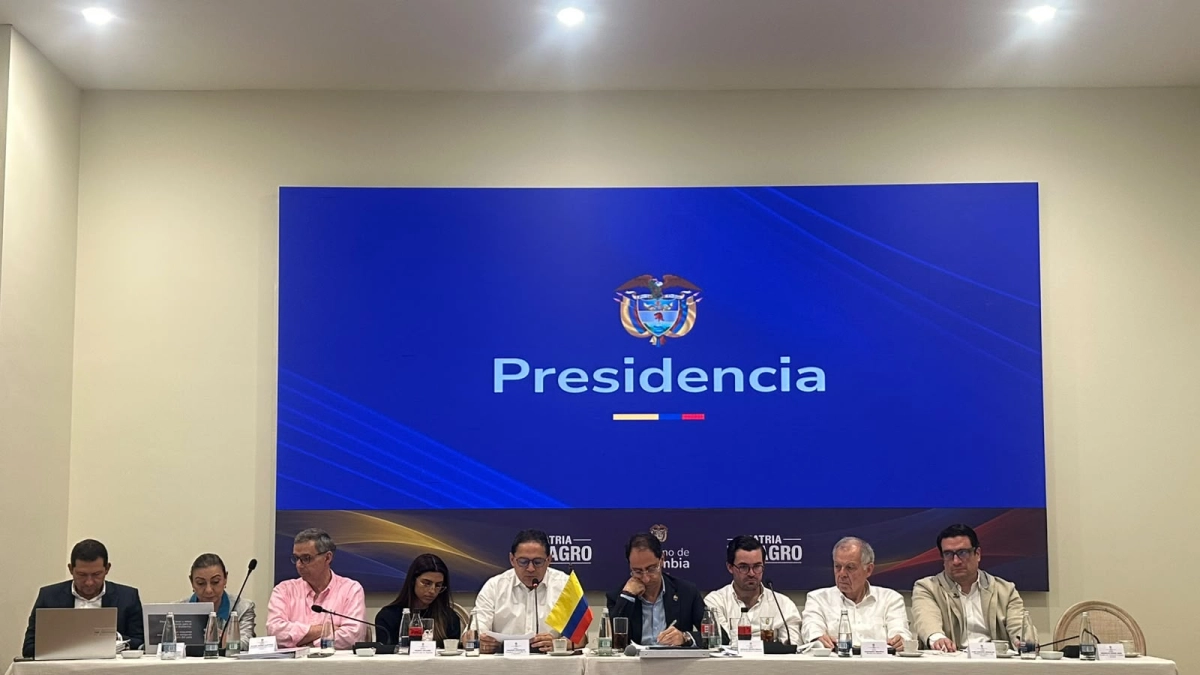
BARRANQUILLA — In an unprecedented political move that marks a significant departure from traditional legislative mechanics in the capital city of Bogotá, the Economic Committees of the Senate and the Chamber of Representatives convened in Barranquilla on Saturday. Meeting at the Casa Libertad y Orden—the official alternate headquarters of the national executive branch—lawmakers gathered for a high-stakes negotiation summit with high-ranking officials of the administration of President Abelardo De La Espriella.
The primary objective of the summit was to evaluate, negotiate, and ultimately reshape the controversial economic rescue bill and tax reform package currently winding its way through Congress. While President De La Espriella was notably absent from the proceedings, the administration maintained a formidable presence, deploying a high-level ministerial delegation led by Vice President José Manuel Restrepo, along with Minister of Finance Miguel Gómez, Minister of Interior Alejandro Ordóñez, and Minister of Justice Iván Cancino.
The meeting underscores the intense political friction surrounding fiscal policy in Colombia. As the government attempts to stabilize public finances, lawmakers face mounting pressure from constituents, business sectors, and political parties to avert measures that could further squeeze the purchasing power of ordinary citizens.
Main Facts
The landmark summit in Barranquilla represents a critical turning point in the legislative debate surrounding President De La Espriella’s economic agenda. The core facts of the unfolding situation include:
An Unprecedented Venue: For the first time in recent history, the joint Economic Committees of both legislative houses traveled outside Bogotá to hold formal, high-level sessions at the Casa Libertad y Orden, the executive branch’s alternate seat in Barranquilla.
Government Representation: Although President Abelardo De La Espriella did not attend the Saturday sessions, he ensured robust representation by sending a delegation composed of Vice President José Manuel Restrepo, Finance Minister Miguel Gómez, Interior Minister Alejandro Ordóñez, and Justice Minister Iván Cancino.
The Legislative Sticking Point: The central subject of the negotiations is the government’s proposed tax reform and economic rescue package, which aims to address deep structural deficits in public finances.
The Opposition’s Red Lines: The Centro Democrático party, acting through its leadership and the President of the Senate, Honorio Henríquez, has firmly drawn the line against proposed increases to the Value-Added Tax (IVA). Specifically, the party rejects hikes targeting the family basket (canasta familiar), internet services, health insurance policies, and essential items sold in neighborhood mom-and-pop shops.
Alternative Proposals: To bypass the need for regressive tax hikes, the opposition has introduced a sweeping counter-proposal centered on radically shrinking the state apparatus—including the merger of more than 200 public entities—alongside boosting private investment incentives and selling an additional state stake in Ecopetrol to the solidarity sector.
Chronology of Events
The road to the Barranquilla summit has been marked by escalating public debates, fiscal diagnoses, and strategic political alignments over the past several weeks.
Early November 2026: The Fiscal Reality Sets In
As the administration of President Abelardo De La Espriella prepared its fiscal roadmap, independent economic analysts and government officials alike acknowledged the severity of Colombia’s macroeconomic imbalances. The administration released early drafts of a tax reform and economic rescue bill designed to generate immediate revenue. However, the initial text immediately sparked a wave of anxiety among consumers and business owners due to projected increases in consumer goods and digital services.
November 6, 2026: Calls for Disruptive Reform
Political actors wasted no time staking out positions. Former President Álvaro Uribe publicly called on the De La Espriella administration to pursue a "disruptive" tax reform. Uribe advocated for a substantially smaller, corruption-free state as a more sustainable solution to fiscal deficits than increasing the tax burden on citizens. Simultaneously, the administration grappled with broader security and governance challenges, including a major terrorist attack in Santa Rosa, southern Bolívar, which prompted strong counter-terrorism vows from the President.
November 7, 2026: Release of Alternative White Papers
As tensions mounted ahead of the weekend, the Centro Democrático released a formal policy report on Friday, November 7. While the party conceded that the administration’s diagnosis of the national deficit was accurate, it formally rejected the proposed tax increases on the middle and working classes. Plans for the unprecedented weekend summit in Barranquilla were finalized to prevent a legislative deadlock.
November 8, 2026: The Barranquilla Summit
On Saturday, November 8, members of the Senate and Chamber Economic Committees arrived at the Casa Libertad y Orden in Barranquilla. Meeting behind closed doors and subsequently establishing ongoing technical sub-committees, lawmakers and executive ministers engaged in hours of intense dialogue. Following the sessions, legislators expressed cautious optimism, highlighting an atmosphere of conciliation while vowing to fiercely protect household economies.
Supporting Data and Economic Context
The urgency driving the Barranquilla summit is rooted in hard economic realities. Colombia’s public finances have faced successive shocks, compounded by high debt-servicing costs, sluggish global growth, and structural spending pressures.
According to government figures presented to the economic committees:
The Deficit Challenge: The fiscal deficit requires immediate structural correction to maintain sovereign credit ratings and ensure macroeconomic stability. Without intervention, borrowing costs for both the public and private sectors could spiral.
The Tax Burden Debate: The administration’s draft bill initially sought to broaden the IVA base to capture more revenue from consumption. Economists note that while broadening the base increases collection efficiency, it disproportionately affects low- and middle-income households unless paired with targeted compensations.
State Bloat Metrics: The Centro Democrático’s alternative proposal highlights that over 200 public entities, agencies, and decentralized offices currently drain national coffers. Consolidating these bodies could theoretically yield billions of pesos in annual operational savings, shifting the burden of fiscal adjustment away from taxpayers and onto the bureaucracy.
Ecopetrol Stake Valuation: The proposal to divest an additional portion of state-owned oil giant Ecopetrol specifically to the solidarity sector (pension funds, cooperatives, and employee funds) aims to democratize capital while injecting non-tax liquidity directly into the national treasury.
Official Responses and Political Reactions
Reactions from key political figures following the Barranquilla meetings reveal a delicate balancing act between executive ambition and legislative pragmatism.
Yamit Noé Hurtado (Alianza Verde)
Representative Yamit Noé Hurtado struck an optimistic yet resolute tone following the conclusion of the joint committee meetings. Speaking from the Casa Libertad y Orden, Hurtado emphasized that the legislative branch intends to act as a crucial shield for citizens’ finances.
"We just emerged from these joint economic committee sessions of the Chamber and Senate here at the Casa Libertad y Orden in Barranquilla. We see an atmosphere of conciliation, of contexts for agreement," Hurtado stated in a video broadcast across digital platforms.
He added: "With the launch of the technical desks, we are going to keep fighting for the benefit and the pockets of Colombians. We do not want them to increase costs for the average citizen, ensuring they can maintain adequate lines for their personal and family economies."
Honorio Henríquez (Centro Democrático)
Senate President Honorio Henríquez assumed the formal role of chief spokesperson for the Centro Democrático, presenting the party’s comprehensive alternative to the executive’s tax proposals. Henríquez clarified that while his party stands shoulder-to-shoulder with the executive branch in recognizing the gravity of the fiscal crisis, they refuse to endorse measures that penalize consumer spending.
The opposition’s stance focuses squarely on protecting the foundational pillars of household survival:
No IVA on the Family Basket: Protecting basic food items from additional taxation.
Preserving Digital Inclusion: Opposing new taxes on internet services, which are viewed as vital tools for education and economic mobility.
Safeguarding Wellness: Rejecting levies on health insurance policies (pólizas de salud).
Protecting Local Commerce: Defending neighborhood mom-and-pop shops (tiendas de barrio) from measures that would price their high-rotation goods out of reach for working-class families.
The Executive Delegation
While President De La Espriella remained in the capital attending to other national priorities, Vice President José Manuel Restrepo and Finance Minister Miguel Gómez defended the necessity of fiscal reform while signaling a willingness to compromise during the technical table negotiations. Administration officials stressed that all proposals—including structural state downsizing and spending rationalization—would be thoroughly vetted by technical experts over the coming days to ensure that deficit-reduction targets are successfully met without triggering a recession.
Implications for the Future of Colombia’s Economy
The summit in Barranquilla has set a new precedent for executive-legislative relations in Colombia. By taking the debate out of Bogotá and into the Caribbean coast, the political actors involved have decentralized the legislative process, bringing high-level statecraft directly to the regions.
The implications of this ongoing negotiation are profound:
The Fate of the Tax Reform: The willingness of the executive branch to engage with the Centro Democrático’s alternative proposals signals that the final tax reform bill is likely to look significantly different from the original draft. Regressive consumption taxes face an uphill battle in Congress.
A Test of Executive-Legislative Cohesion: Although President De La Espriella’s coalition enjoys broad ideological alignments with parties like the Centro Democrático, fiscal policy remains a friction point. The success of the technical desks will determine whether the administration can maintain a unified front through the remainder of its legislative agenda.
Long-Term Structural Reform: If the administration embraces elements of the opposition’s plan—such as the massive consolidation of public agencies—it could pave the way for the most ambitious state-modernization project in recent Colombian history, fundamentally redefining the size and scope of government intervention in the economy.
As technical teams dig into the spreadsheets and legal frameworks in Barranquilla, millions of Colombians await the outcome of negotiations that will directly dictate the cost of living, the health of the national treasury, and the trajectory of the nation’s economic recovery.
Bogotá, Colombia – July 17, 2026 – In a move that has sent ripples of surprise and speculation across Colombia’s political and cultural landscapes, President-elect Abelardo de la Espriella has announced the designation of former…
Eyes on the Prize: Senate Presidency Battle Heats Up as Alfredo Deluque Emerges as Frontrunner BOGOTÁ, Colombia – July 20, 2026 – The eyes of the nation are fixed on Colombia’s capital this Monday, July…
Main Facts In a gesture that blends symbolic weight with immediate philanthropic impact, Colombian President Abelardo De La Espriella has officially fulfilled a central promise from his electoral campaign. During a high-profile working visit to…